
Exploring the Meaning of Kakopatheo in Greek
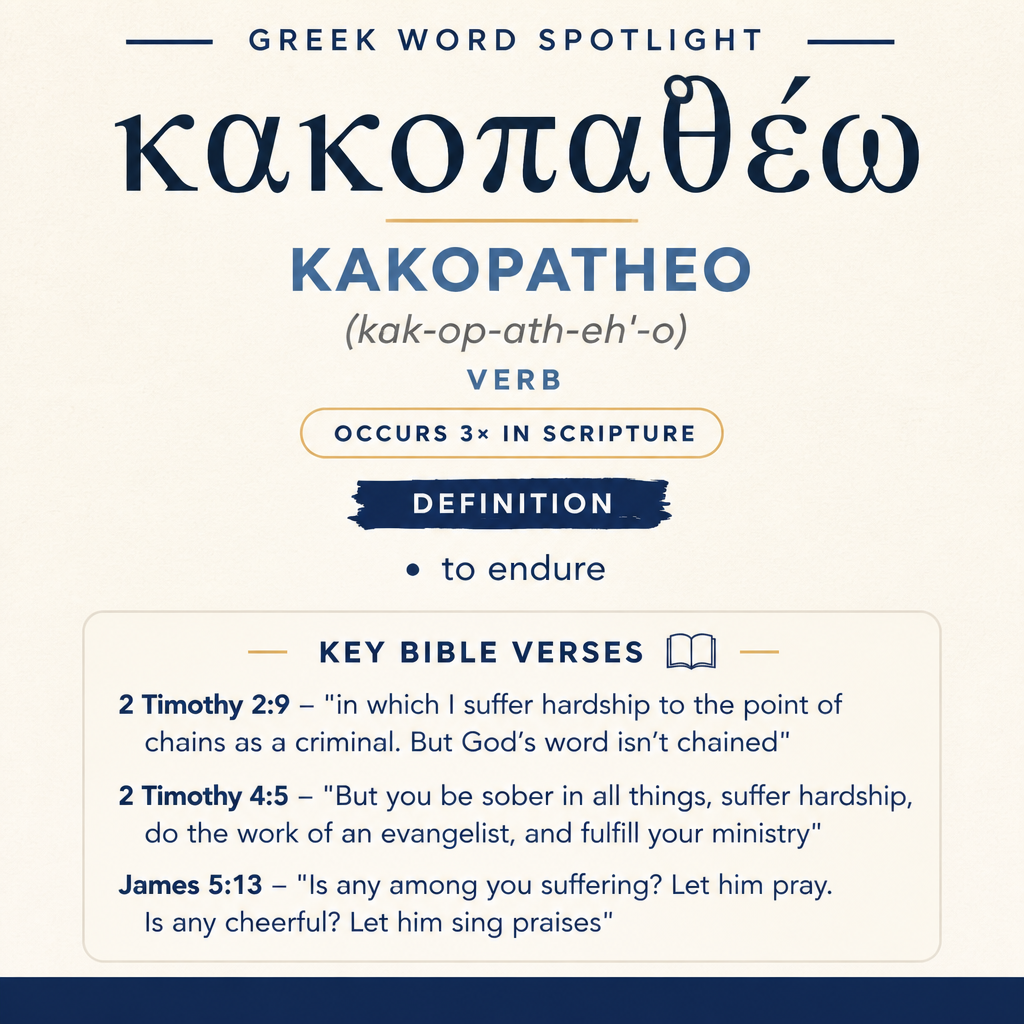
κακοπαθέω means “to endure” and appears three times in Scripture: 2 Timothy 2:9; 2 Timothy 4:5; James 5:13.
Core Meaning
κακοπαθέω is defined as “to endure.” In its contexts, it describes experiencing hardship or suffering.
Learn More →Pauline Usage
In 2 Timothy 2:9, it is used of suffering hardship even to the point of chains. In 2 Timothy 4:5, it is a command to suffer hardship while fulfilling ministry.
Learn More →James’s Exhortation
In James 5:13, it describes a person who is suffering. The response given is prayer.
Learn More →κακοπαθέω means “to endure” and appears in three New Testament settings: Paul’s imprisonment, Paul’s charge to Timothy for ministry, and James’s counsel to sufferers in the congregation. In each, the verb frames hardship as something borne rather than merely observed.
Root and Related Words
κακοπαθέω is related to kakopatheia (κακοπάθεια), “suffering” (Strong’s G2552).

Occurrences
“in which I suffer hardship to the point of chains as a criminal. But God’s word isn’t chained.” (2 Timothy 2:9)
Here κακοπαθέω stands inside a first-person report: Paul speaks of what he endures “to the point of chains.” The verb gathers up the whole experience of hardship into a single action of bearing it, then anchors that endurance in a vivid limit-case—public restraint and shame “as a criminal.” The contrast that follows (“But God’s word isn’t chained.”) sharpens the force of the verb: Paul’s enduring is real, physical, and socially degrading, yet it does not succeed in restraining what he serves. In this scene, enduring is not abstract resilience; it is pressure that reaches “chains,” endured alongside an unbound message.

“But you be sober in all things, suffer hardship, do the work of an evangelist, and fulfill your ministry.” (2 Timothy 4:5)
In this command sequence, κακοπαθέω is placed among imperatives that define a pattern of ministerial steadiness: “be sober,” “suffer hardship,” “do the work,” “fulfill.” Endurance is presented as one component of faithful completion rather than an interruption of it. The verb’s placement makes hardship neither a surprise nor a disqualifier; it is treated as an expected burden to be borne while continuing the task. The surrounding verbs also keep the focus on sustained conduct—sobriety “in all things,” ongoing work, and finishing a charge—so that enduring is pictured as continuing under strain, not pausing until strain passes.
“Is any among you suffering? Let him pray. Is any cheerful? Let him sing praises.” (James 5:13)
James uses κακοπαθέω in a congregational diagnostic: “Is any among you suffering?” The verb names a condition that may be present in the community at any given moment and invites an immediate, fitting response: “Let him pray.” Endurance here is personal and situational—someone is in the midst of hardship—and the instruction assumes that such endurance can be actively carried out in dependence, expressed through prayer. By pairing the sufferer with “any cheerful” and directing each to a corresponding practice (prayer or praise), the verse places endurance within ordinary rhythms of communal life: some endure suffering, others experience cheer, and both states are addressed without embarrassment or delay.
Sense and Usage
Across these three uses, “to endure” is consistently linked to hardship that presses on a person and must be borne. In 2 Timothy 2:9, endurance is portrayed at its harshest edge—enduring “to the point of chains”—and the sentence structure makes the endurance a lived reality set against the unstoppable character of God’s word. In 2 Timothy 4:5, endurance is treated as a steady discipline required for ministry: it belongs alongside clear-mindedness and the completion of assigned work. In James 5:13, endurance is named in pastoral, practical terms and paired with an action that fits the moment, so that the one enduring is not left merely to grit teeth but is directed to prayer as the appropriate response while suffering continues.
The scenes also show how κακοπαθέω can function both descriptively and prescriptively. Paul describes his own endurance (“I suffer hardship”) to illustrate what faithful service may involve under hostile conditions; he also receives endurance as part of his apostolic experience even when it carries social stigma (“as a criminal”). In the charge to Timothy, the same verb becomes an explicit expectation: endurance is commanded as part of the minister’s vocation. James then uses it in a question that searches for the reality of hardship within the gathered believers, implying that endurance is not limited to leaders or apostles but can characterize “any among you.” The verb thus bridges personal testimony, vocational instruction, and congregational care, all while keeping the focus on bearing hardship through it rather than merely acknowledging it.
Within these passages, endurance is not portrayed as an end in itself but as something that occurs within a larger framework of faithfulness. Paul’s chains highlight limitation, yet the message remains unbound; endurance is experienced under constraint without the mission being nullified. Timothy’s endurance is integrated with purposeful action—evangelistic work and fulfilling ministry—so that hardship does not cancel responsibility. In James, endurance is integrated with worshipful dependence: prayer for the sufferer and praise for the cheerful. In each case, the verb’s contribution is to name hardship as something that can be borne in a manner that remains oriented toward God and toward one’s calling.
Imagery
The most concrete image attached to κακοπαθέω in these texts is the bodily constraint of “chains” (2 Timothy 2:9). That image supplies a lens for the other uses: endurance can look like continuing a ministry charge under pressure (2 Timothy 4:5) and like turning suffering into prayer rather than isolation (James 5:13). Together they present enduring as the lived experience of hardship that can coexist with ongoing service and ongoing communion with God.
Sources: Lexical data from Strong’s Exhaustive Concordance and the Translators Brief Lexicon of Extended Strongs for Greek (STEPBible, CC BY). Occurrence data from the Translators Amalgamated Greek New Testament (STEPBible, CC BY). Scripture quotations from the World English Bible (public domain).





