
Exploring the Meaning of Kaio in Greek
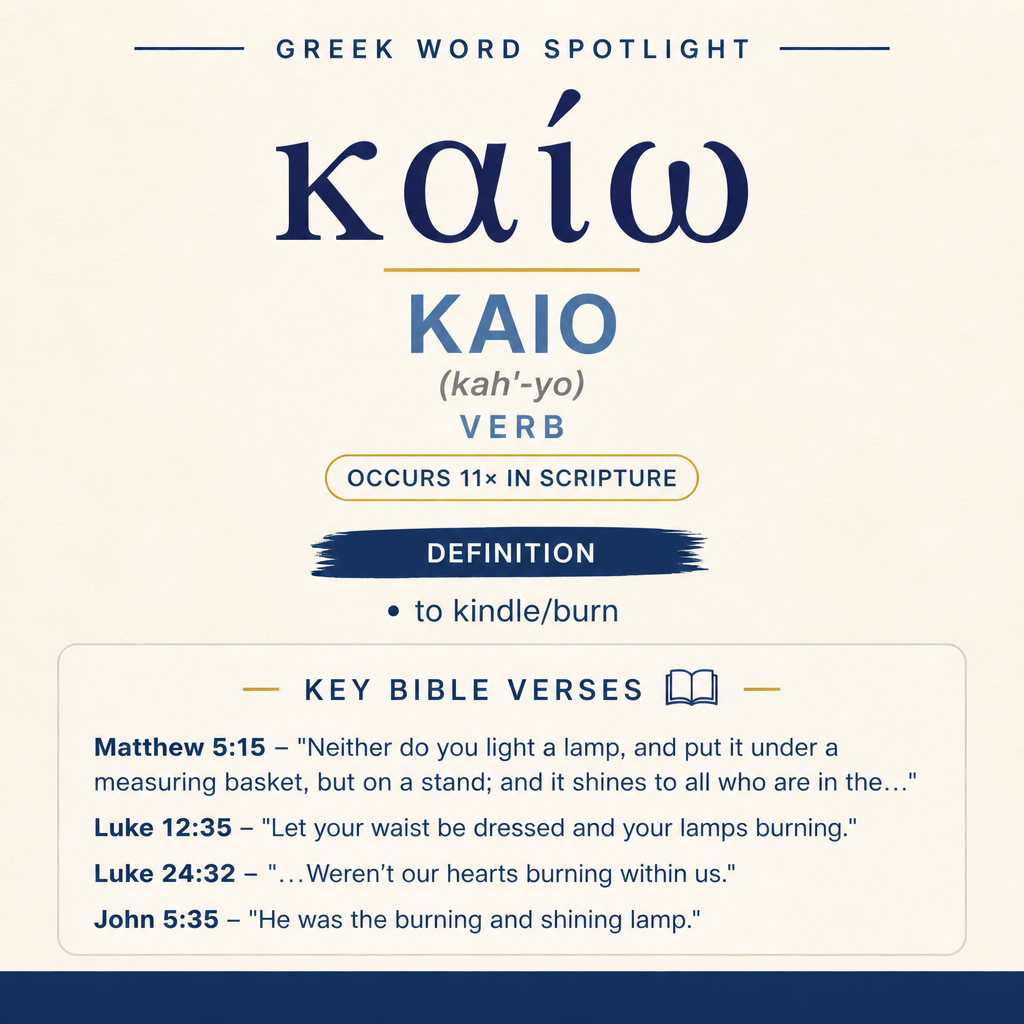
καίω means “to kindle/burn” and occurs 11 times in Scripture, including Matthew 5:15, Luke 24:32, John 5:35, Hebrews 12:18, and Revelation 4:5.
Core Meaning
καίω means “to kindle/burn.” It describes lamps burning and fire burning.
Learn More →Gospel Examples
It appears in Matthew 5:15 and Luke 12:35 for lamps being lit or kept burning. In Luke 24:32, it describes hearts burning within them.
Learn More →Other Contexts
In John 15:6 it is used of branches gathered and thrown into the fire. In Revelation 4:5 it describes seven lamps of fire burning before the throne.
Learn More →καίω speaks of kindling and burning, and it appears in scenes ranging from everyday lamplight to consuming fire and blazing heavenly portents. In these passages it can describe a controlled flame that gives light, an inward burning response, or the destructive burning of judgment imagery.
Occurrences
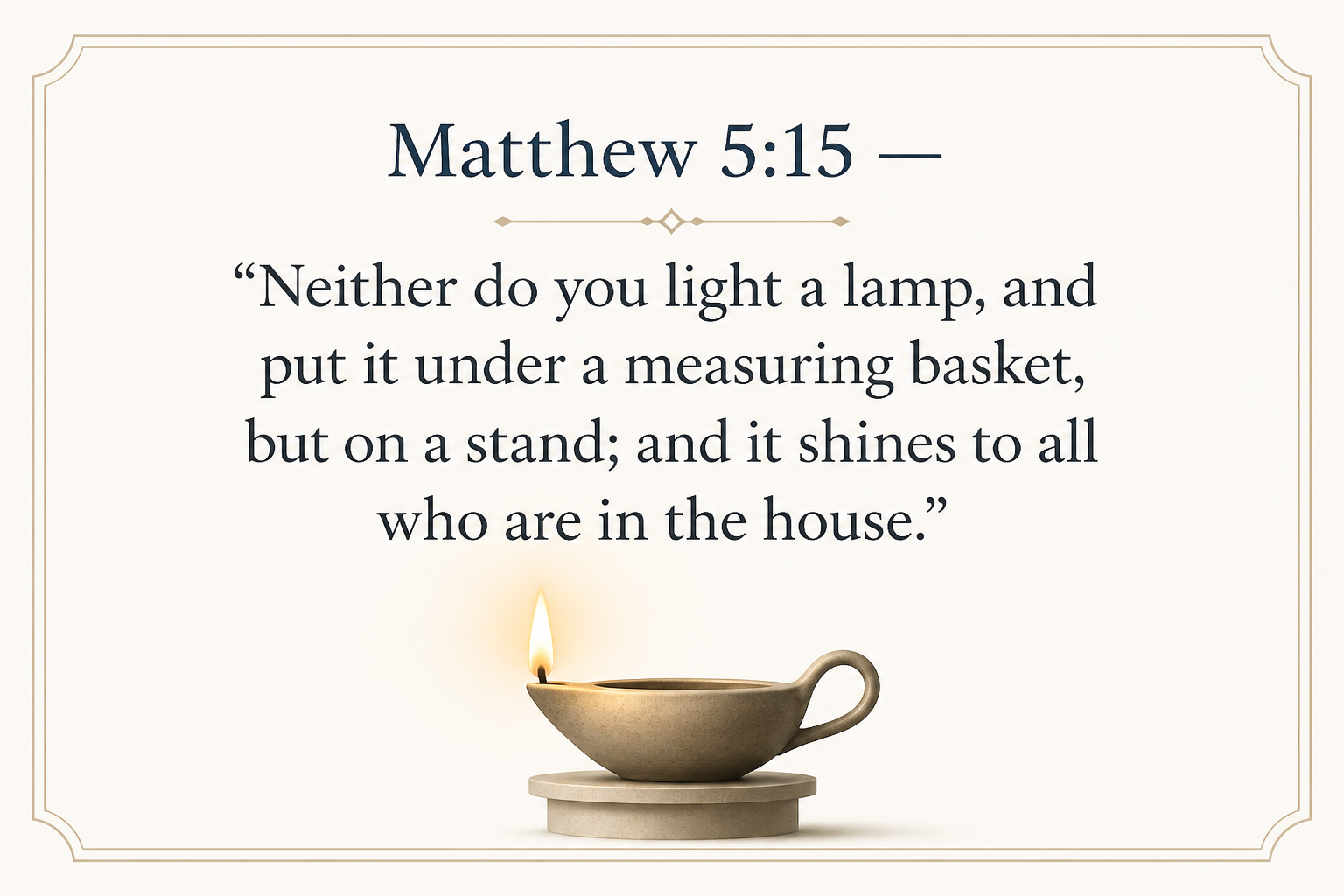
Matthew 5:15 — “Neither do you light a lamp, and put it under a measuring basket, but on a stand; and it shines to all who are in the house.”
Here καίω names the act that begins the lamp’s usefulness: the lamp is lit, then placed so that its light reaches “all who are in the house.” The burning is implied as sustained enough to “shine,” and the saying contrasts concealment (“under a measuring basket”) with proper placement (“on a stand”). καίω thus contributes the concrete starting point of illumination in a domestic setting.
Luke 12:35 — ““Let your waist be dressed and your lamps burning.”
In this short imperative, καίω is tied to readiness: lamps are to be actively burning, not merely present. The imagery assumes an ongoing flame, maintained as part of being prepared. The pairing with “waist be dressed” frames burning lamps as a visible sign of alertness and preparedness.
Luke 24:32 — “They said to one another, “Weren’t our hearts burning within us, while he spoke to us along the way, and while he opened the Scriptures to us?””
καίω is applied metaphorically to “our hearts,” describing an inner burning that accompanies speech “along the way” and the opening of “the Scriptures.” The verb conveys intensity and warmth of inner response rather than literal fire. The burning is located “within us,” presenting an inward effect corresponding to understanding and disclosure in conversation.
John 5:35 — “He was the burning and shining lamp, and you were willing to rejoice for a while in his light.”
In this description, καίω characterizes a person as “the burning and shining lamp.” Burning and shining are coupled, so the burning is the energizing condition that produces visible “light,” and others “rejoice” in it temporarily (“for a while”). The verb supports the image of a lamp whose flame is active and whose light has public effect.
John 15:6 — “If a man doesn’t remain in me, he is thrown out as a branch and is withered; and they gather them, throw them into the fire, and they are burned.”
Here καίω describes the burning of branches after they are “withered,” “gather[ed],” and “throw[n] into the fire.” The sequence emphasizes disposal and destruction: the branches do not merely touch fire; they undergo burning as the final outcome. The verb’s contribution is the decisive, consuming action at the end of the process.
Hebrews 12:18 — “For you have not come to a mountain that might be touched, and that burned with fire, and to blackness, darkness, storm,”
καίω depicts a mountain “that burned with fire,” set amid “blackness, darkness, storm.” Burning here is part of an overwhelming sensory scene: a tangible place (“might be touched”) marked by fire and accompanied by threatening atmospheric phenomena. The verb helps paint the mountain as enveloped in a dangerous, awe-inspiring blaze.
Revelation 4:5 — “Out of the throne proceed lightnings, sounds, and thunders. There were seven lamps of fire burning before his throne, which are the seven Spirits of God.”
In this throne-room vision, καίω describes “seven lamps of fire burning before his throne.” The burning is continuous and positioned “before his throne,” part of a setting filled with “lightnings, sounds, and thunders.” The verb supports the visual of steady flames in a solemn, charged environment, contributing to the scene’s brightness and intensity.
Revelation 8:8 — “The second angel sounded, and something like a great burning mountain was thrown into the sea. One third of the sea became blood,”
καίω qualifies the object’s appearance: “something like a great burning mountain.” The burning is not a minor detail but central to how the thrown object is perceived—massive and aflame as it enters the sea. The verb adds the element of active combustion to an image that leads into catastrophic change (“One third of the sea became blood”).
Revelation 8:10 — “The third angel sounded, and a great star fell from the sky, burning like a torch, and it fell on one third of the rivers, and on the springs of the waters.”
Here καίω depicts a “great star” as it falls, “burning like a torch.” The comparison to a torch conveys a bright, fiery descent rather than a silent or dark fall. The burning accompanies impact on “one third of the rivers” and “the springs of the waters,” making the star’s flaming character integral to the terror and visibility of the event.
Revelation 19:20 — “The beast was taken, and with him the false prophet who worked the signs in his sight, with which he deceived those who had received the mark of the beast and those who worshiped his image. These two were thrown alive into the lake of fire that burns with sulfur.”
καίω defines the “lake of fire” as one “that burns with sulfur.” The burning is ongoing (“burns”) and is linked with sulfur, intensifying the portrayal of the lake as a perpetually burning place of punishment. The verb underlines the active, continuing nature of the fire into which “These two were thrown alive.”
Revelation 21:8 — “But for the cowardly, unbelieving, sinners, abominable, murderers, sexually immoral, sorcerers, idolaters, and all liars, their part is in the lake that burns with fire and sulfur, which is the second death.”
Again καίω portrays the “lake” by its continuing action: it “burns with fire and sulfur.” The burning here is central to the fate described (“their part is in the lake”), and it is closely tied to the climactic description “which is the second death.” The verb contributes the sense of an enduring, active burning that defines the lake itself.

Sense and Usage
Across these contexts, καίω consistently marks the reality of fire as an active process—whether initiated, maintained, or experienced in its effects. In several passages the burning is purposeful and controlled, as with lighting a lamp and keeping lamps burning (Matthew 5:15; Luke 12:35). In those scenes, burning serves illumination: the flame is valuable because it produces light for others, either to “all who are in the house” or as “light” in which people “rejoice for a while.” The verb naturally fits situations where fire is not merely present but actively doing what fire does.
καίω can also be extended from literal flame to describe an inward experience. Luke 24:32 speaks of “our hearts burning within us” as words are spoken and Scriptures opened. The image draws on the felt intensity of burning to express a strong internal response, yet the focus remains on burning as a vivid, energetic phenomenon applied to the inner person. This usage aligns with the verb’s core idea by transferring the sensation and force of fire to a personal, internal domain without changing the basic picture: something within is kindled and active.
Other occurrences emphasize burning as destructive and fearsome. John 15:6 describes branches that end up in fire and “are burned,” where burning is the decisive conclusion of a sequence of rejection, withering, gathering, and disposal. Hebrews 12:18 places burning on a mountain amid darkness and storm, using fire to heighten the scene’s dread and unapproachability. Revelation intensifies this further: burning defines objects in catastrophic motion (“a great burning mountain,” “a great star… burning like a torch”) and describes the lake that “burns with sulfur” or “burns with fire and sulfur.” In these passages, burning functions not as guidance but as threat, judgment, and overwhelming power—fire as something to be endured, suffered, or feared, not managed.
The distribution of contexts shows how flexible the verb is while staying tethered to its concrete image. Whether a small lamp in a house, a metaphor for inner response, or a cosmic and eschatological fire, καίω supplies the active, vivid quality of burning: a force that gives light, signals readiness, stirs the inner life, or consumes and punishes.
Imagery
Taken together, these passages set burning in stark contrasts. A lamp is lit and placed where it can shine, and lamps are kept burning as part of watchful readiness (Matthew 5:15; Luke 12:35). That same burning imagery can name an inner stirring that accompanies opened Scripture (Luke 24:32). Yet the verb also frames fire as a destructive endpoint for withered branches and as an enveloping terror around a burning mountain (John 15:6; Hebrews 12:18). In Revelation, burning becomes a defining feature of both heavenly scene (“seven lamps of fire burning before his throne”) and cataclysmic judgment (“the lake of fire that burns with sulfur”; Revelation 4:5; 19:20; 21:8), so that καίω carries a range of intensity from steady light to consuming, enduring blaze.
Sources: Lexical data from Strong’s Exhaustive Concordance and the Translators Brief Lexicon of Extended Strongs for Greek (STEPBible, CC BY). Occurrence data from the Translators Amalgamated Greek New Testament (STEPBible, CC BY). Scripture quotations from the World English Bible (public domain).




