Exploring the Meaning of Isopsuchos in Greek
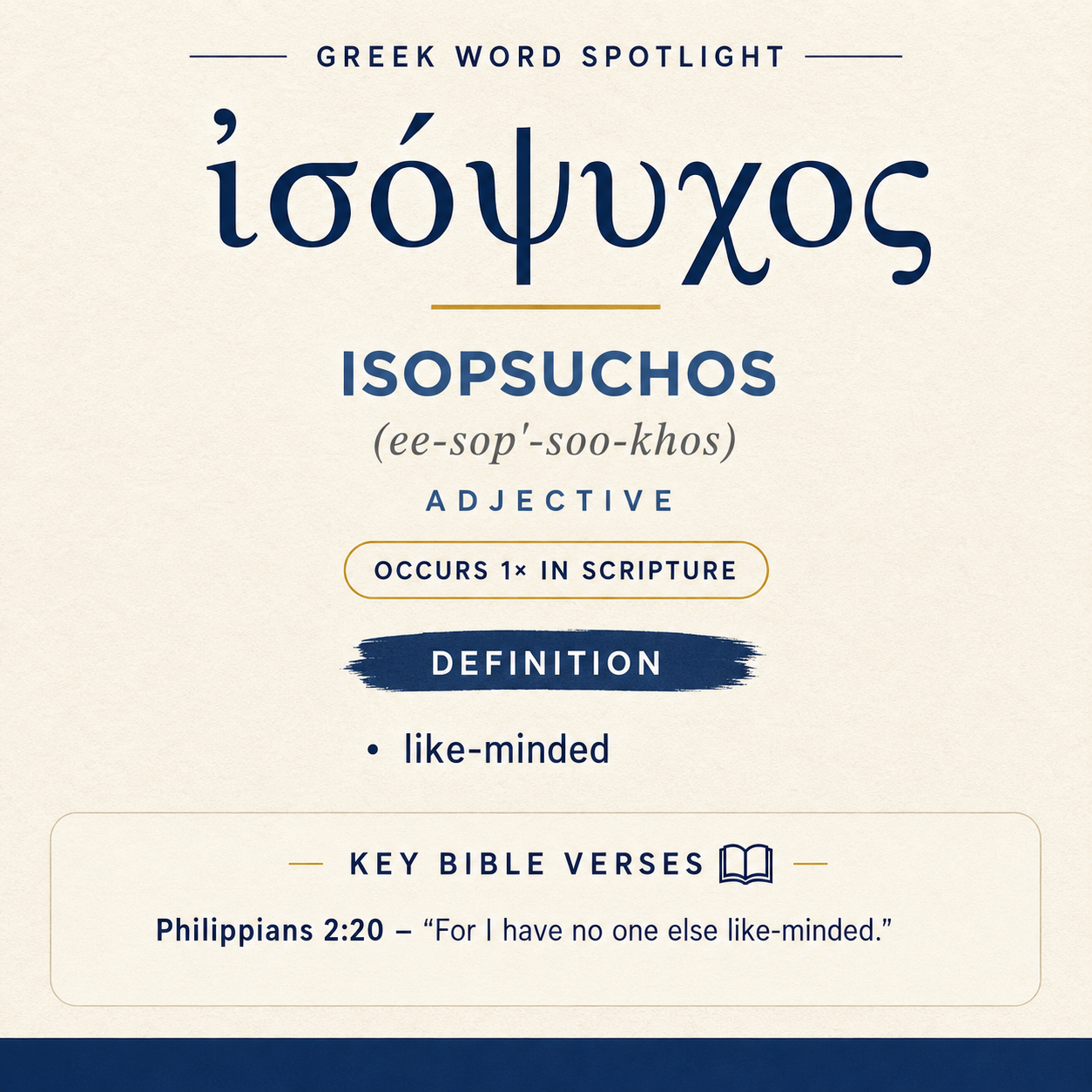
ἰσόψυχος means “like-minded” and appears once in Scripture in Philippians 2:20.
Verse Context
In Philippians 2:20, Paul says he has no one else “like-minded,” who will truly care about them.
Learn More →ἰσόψυχος expresses the idea of being “like-minded,” and it appears in the New Testament only in Paul’s statement about his co-worker’s concern for the Philippian believers. In its single context, it marks a rare kind of shared outlook that shows itself in genuine care.
Root and Related Words
ἰσόψυχος (Isopsuchos) is connected with ἴσος (isos), “equal” (Strong’s G2470), and ψυχή (psyche), “soul” (Strong’s G5590). The compound form brings these ideas together to describe a likeness at the level of the inner life.

Occurrences
“For I have no one else like-minded, who will truly care about you.” (Philippians 2:20)
Here ἰσόψυχος stands inside a personal evaluation: “I have no one else like-minded.” The adjective does not function as a general compliment but as a comparative claim—Paul sets this person apart from others who might otherwise be available. The line immediately defines what this like-mindedness looks like in practice: “who will truly care about you.” In this sentence, like-mindedness is not left as an internal, private similarity; it is tied to a reliable pattern of concern directed toward “you,” the church being addressed.

The word also shapes how the reader understands Paul’s relationships and priorities in the verse. The emphasis falls on the difficulty of finding someone whose mind and intent are aligned closely enough with Paul’s own aims that the person can be trusted to “truly care” for the community. The adjective therefore carries a relational weight: it signals a harmony of outlook that makes sincere pastoral concern predictable rather than accidental.
Sense and Usage
In this attested use, “like-minded” is a description of shared inner orientation that results in congruent action. It is not presented as mere agreement on a point, nor as a surface-level sameness of style, but as a likeness that can be observed through what someone “will” do—namely, care in a way that is “true.” The future-oriented verb phrase (“will truly care”) turns the adjective into a kind of moral and practical credential: the person called ἰσόψυχος can be counted on to act in accordance with that shared mindset when faced with real needs.
The construction “no one else like-minded” also shows that ἰσόψυχος is being used with a high bar. Paul uses it to distinguish one person among potential helpers, implying that many may participate in ministry tasks, but far fewer share the inward alignment that produces unfeigned concern. Within the verse’s logic, like-mindedness is validated by the quality of the care it yields. The adverb “truly” strengthens this connection by pressing beyond formal attention or dutiful service to something more genuine and heartfelt.
Because ἰσόψυχος is built from terms associated with “equal” and “soul,” its conceptual force naturally leans toward likeness at the deepest level of personal intention. In Philippians 2:20 that depth is expressed, not by introspective description, but by the reliability of care: like-mindedness shows itself in how someone regards and tends to others. The word thus functions as a bridge between interior disposition and outward pastoral responsibility, presenting shared mindedness as the soil in which trustworthy concern grows.
Imagery
Philippians 2:20 pictures like-mindedness through the concrete image of one person looking after another’s welfare. The verse’s language evokes a scene of attentive guardianship—care that is not performative, but “true,” and therefore dependable when the community is vulnerable.
Sources: Lexical data from Strong’s Exhaustive Concordance and the Translators Brief Lexicon of Extended Strongs for Greek (STEPBible, CC BY). Occurrence data from the Translators Amalgamated Greek New Testament (STEPBible, CC BY). Scripture quotations from the World English Bible (public domain).