
Exploring the Meaning of Isemi in Greek
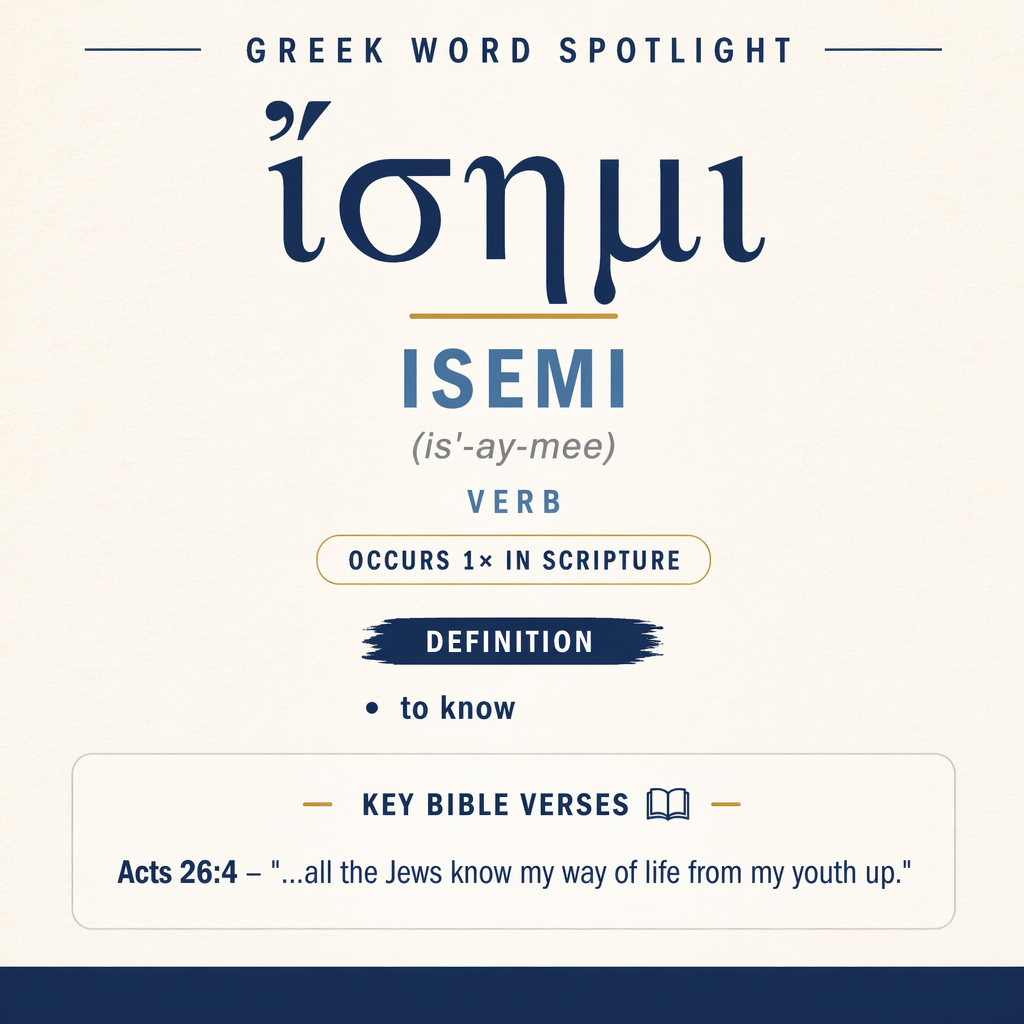
ἴσημι (Isemi) means “to know” and occurs once in Scripture, in Acts 26:4.
Scripture Occurrence
This verb occurs 1 time in Scripture. Its single occurrence is in Acts 26:4.
Learn More →Verse Context
In Acts 26:4, it appears in the statement: “all the Jews know my way of life from my youth up.”
Learn More →ἴσημι expresses the act of knowing, and it is attested in the New Testament in Paul’s defense speech before Jewish and Roman authorities. In its lone occurrence, it marks knowledge held by “all the Jews” about Paul’s long-established manner of life.
Root and Related Words
ἴσημι is connected with eido (εἴδω), “to perceive: understand” (Strong’s G1492), which frames knowing as something tied to perception and understanding.

Occurrences
“Indeed, all the Jews know my way of life from my youth up, which was from the beginning among my own nation and at Jerusalem;” (Acts 26:4)
In Acts 26:4, the verb places “knowing” in the mouth of the speaker as an appeal to public awareness: “all the Jews know my way of life.” The knowledge in view is not a private insight but a matter Paul presents as widely held and widely confirmable. He anchors this knowledge in time—“from my youth up”—and also in continuity—“from the beginning.” By specifying that this way of life was lived “among my own nation and at Jerusalem,” the statement narrows the sphere where such knowing has been formed: it comes from prolonged visibility within the very community that is now evaluating him.
The content of what is known is “my way of life.” In this setting, ἴσημι functions as the hinge between the observers (“all the Jews”) and the object of their knowledge (Paul’s patterned conduct). The verb therefore supports an argument built on reputation and long-term observation: if the audience shares a common memory of his earlier life, then his present claims and the accusations against him should be weighed in light of that remembered history.
The wording also implies that this knowing is not momentary but cumulative. Paul links the knowledge of his “way of life” to stages (“from my youth up”) and locations (“among my own nation and at Jerusalem”), describing a life lived in public view across formative years in recognizable places. Within this defense context, ἴσημι serves to establish common ground: he calls the hearers to acknowledge a body of knowledge they already possess and that could, in principle, be checked by others who shared those settings.
Sense and Usage
With the straightforward sense “to know,” ἴσημι in this passage portrays knowing as settled recognition of a person’s life-pattern over time. The statement “all the Jews know my way of life” treats knowledge as something distributed through a community: it is held by many, not monopolized by one witness. It is also knowledge with an object that can be narrated and evaluated—“my way of life”—rather than an abstract idea detached from lived reality.
The verse places knowing alongside two stabilizing details that shape how the reader understands the force of the claim. First, the temporal markers (“from my youth up,” “from the beginning”) present knowledge as the result of long exposure rather than recent rumor. Second, the social and geographic markers (“among my own nation and at Jerusalem”) present knowledge as arising within a defined group that has proximity to the life being described. In other words, ἴσημι here supports an appeal to a shared past and a shared public record, not to hidden experiences.
This use also shows how “to know” can function rhetorically in a defense. Paul’s argument depends on the idea that the audience is not starting from zero; they already have awareness of his past conduct. The verb therefore acts as an invitation to treat prior knowledge as relevant evidence: knowing becomes a bridge from biography (“my way of life from my youth up”) to present judgment (“all the Jews know”). The effect is to portray Paul’s past as legible and open to scrutiny, suggesting that his present situation should be interpreted against that background of communal knowing.
Finally, the relation to eido (εἴδω), “to perceive: understand,” helps situate the kind of knowledge implied by the verse. The claim presumes that the community’s knowing arises through perceiving and understanding the contours of someone’s life as it unfolded in familiar settings. In Acts 26:4, to know is to recognize a life lived in plain view—knowledge formed by observation that has become an acknowledged understanding within the group.
Imagery
The verse paints the quiet imagery of a life observed across years: youth, beginnings, a nation, and Jerusalem as the setting where conduct could be seen and remembered. ἴσημι gives that memory a verbal shape, turning a shared recollection of “my way of life” into an explicit point of appeal in Paul’s speech.
Sources: Lexical data from Strong’s Exhaustive Concordance and the Translators Brief Lexicon of Extended Strongs for Greek (STEPBible, CC BY). Occurrence data from the Translators Amalgamated Greek New Testament (STEPBible, CC BY). Scripture quotations from the World English Bible (public domain).




