Exploring the Meaning of Ischuros in Greek
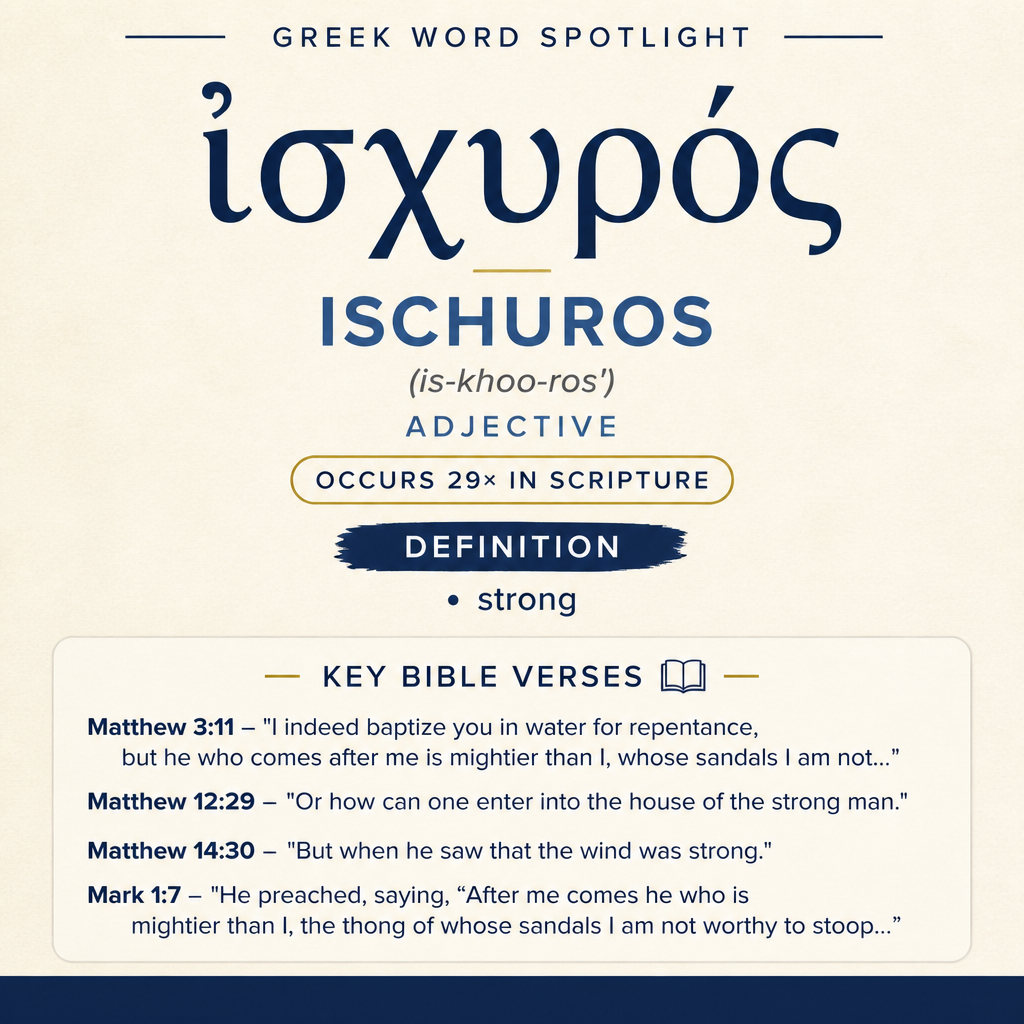
ἰσχυρός means “strong” and occurs 29 times in Scripture, including Matthew 3:11; 12:29; 14:30, Mark 1:7; 3:27, and Luke 3:16; 11:21–22.
Core Meaning
ἰσχυρός is defined as “strong.” In the listed passages it describes people and even the wind.
Learn More →Mightier Than I
In Matthew 3:11, Mark 1:7, and Luke 3:16, John says the one coming after him is “mightier than I.” The word highlights superior strength in comparison.
Learn More →Strong Man Scenes
In Matthew 12:29 and Mark 3:27, a “strong man” must be bound before his house is plundered. In Luke 11:21–22, a stronger attacker overcomes the strong man and takes his armor.
Learn More →ἰσχυρός expresses the idea of being strong, with strength variously pictured as superior status, physical force in nature, a guarded household, and comparative power in conflict. In the passages below it appears in narrative description, in metaphor, and in contrastive teaching.
Occurrences
Matthew 3:11 — “I indeed baptize you in water for repentance, but he who comes after me is mightier than I, whose sandals I am not worthy to carry. He will baptize you in the Holy Spirit.”
Here ἰσχυρός frames a comparison between John and “he who comes after me.” The word marks the coming one as stronger in the sense that John’s own role and honor are eclipsed: John is “not worthy to carry” even his sandals. The statement then ties that superiority to action—“He will baptize you in the Holy Spirit”—so strength is not merely a trait but is bound to a greater capacity to do what John cannot do with water.
Matthew 12:29 — “Or how can one enter into the house of the strong man, and plunder his goods, unless he first bind the strong man? Then he will plunder his house.”
In this saying ἰσχυρός characterizes a “strong man” whose house contains “goods” worth plundering. The adjective supplies the obstacle: a strong man does not yield his possessions without first being “bind[ed].” Strength here is practical resistance; it makes plundering impossible until the strong one is restrained. The image is domestic and concrete—house, goods, binding—so the word evokes strength that controls a space and protects property.
Matthew 14:30 — “But when he saw that the wind was strong, he was afraid, and beginning to sink, he cried out, saying, “Lord, save me!””
Applied to “the wind,” ἰσχυρός describes an overpowering natural force. The narrative shows its effect through the disciple’s reaction: seeing the wind as strong produces fear, and fear accompanies “beginning to sink.” Strength is thus portrayed as intensity that threatens stability and prompts urgent appeal—“Lord, save me!”—in the midst of danger.
Mark 1:7 — “He preached, saying, “After me comes he who is mightier than I, the thong of whose sandals I am not worthy to stoop down and loosen.”
As in Matthew 3:11, ἰσχυρός marks the superiority of the one who comes after John. Mark’s wording heightens the posture of humility: John is “not worthy to stoop down and loosen” the sandal thong. The word therefore functions socially and personally: it sets a scale of greatness and places John beneath the coming one in dignity and standing, not through abstract rank but through the concrete, lowly act he refuses as unworthy.
Mark 3:27 — “But no one can enter into the house of the strong man to plunder unless he first binds the strong man; then he will plunder his house.”
This parallels Matthew 12:29 and uses ἰσχυρός to establish why entry and plundering are impossible “unless” a first step is taken. The repeated “binds” and “strong man” keep attention on strength as control that must be neutralized. The word supplies the logic of the scenario: strength creates security; binding removes it; plunder follows.
Luke 3:16 — “John answered them all, “I indeed baptize you with water, but he comes who is mightier than I, the strap of whose sandals I am not worthy to loosen. He will baptize you in the Holy Spirit and fire,”
Again, ἰσχυρός introduces a stronger coming figure contrasted with John. Luke, like the others, expresses John’s unworthiness through a menial act—unfastening “the strap of whose sandals.” The word sets a comparative scale (“mightier than I”) and aligns that superior strength with a distinctive baptism: “in the Holy Spirit and fire.” Strength in this setting is tied to an ability to administer a baptism of a different order than water.
Luke 11:21 — “When the strong man, fully armed, guards his own dwelling, his goods are safe.”
Luke develops the strong-man image by adding the detail “fully armed.” ἰσχυρός is linked to preparedness and defense: the strong man “guards his own dwelling,” and the result is that “his goods are safe.” The word contributes the sense that security flows from strength coupled with armament and vigilance; the strong one successfully maintains control over his household and possessions.
Luke 11:22 — “But when someone stronger attacks him and overcomes him, he takes from him his whole armor in which he trusted, and divides his plunder.”
Here ἰσχυρός is comparative: “someone stronger” appears. The narrative logic moves from strength to outcome—attack, overcoming, disarmament, and redistribution. Strength is measured by victory: the stronger one “overcomes him,” removes “his whole armor in which he trusted,” and “divides his plunder.” The word thus marks not only the presence of strength but the existence of gradations of strength, where superior strength strips a lesser strong man of the very defenses that made his goods safe.
Luke 15:14 — “When he had spent all of it, there arose a severe famine in that country, and he began to be in need.”
In this line ἰσχυρός modifies “famine” as “severe.” The strength of the famine is shown by its consequences: after resources are spent, the famine’s severity presses the person into need. The word intensifies the hardship; it portrays conditions strong enough to expose and worsen vulnerability.
1 Corinthians 1:25 — “because the foolishness of God is wiser than men, and the weakness of God is stronger than men.”
Paul uses ἰσχυρός for a surprising comparison: “the weakness of God is stronger than men.” Strength is presented as surpassing human strength even when described in terms that sound like the opposite (“weakness”). The sentence sets up a reversal in which what appears weak, in relation to God, proves stronger than what is typically regarded as strong “than men.” The word functions to establish superiority across categories that do not align with ordinary expectations.
1 Corinthians 1:27 — “but God chose the foolish things of the world that he might put to shame those who are wise. God chose the weak things of the world that he might put to shame the things that are strong.”
Here ἰσχυρός stands for those “things that are strong” in the world’s eyes, set in contrast to “the weak things of the world.” The word labels the objects of shame: the strong are not simply opposed but are specifically the ones “put to shame” by God’s choice of what is weak. Strength, in this rhetorical frame, is a recognizable category of worldly advantage that does not secure honor when God’s choosing and purpose are in view.
1 Corinthians 4:10 — “We are fools for Christ’s sake, but you are wise in Christ. We are weak, but you are strong. You have honor, but we have dishonor.”
In this contrast ἰσχυρός is used directly of people: “you are strong.” Strength is paired with other social valuations—wisdom and honor—while Paul aligns himself with weakness and dishonor. The adjective therefore participates in an evaluative set: strong/weak, honored/dishonored. Within the sentence, “strong” is not isolated as physical power but appears as a marker of perceived standing in the community addressed.
Sense and Usage
Across these passages, “strong” is consistently relational: it is strength in comparison to someone else (John versus the coming one), strength that must be dealt with to accomplish an objective (binding a strong man to plunder), strength that changes what is possible in a moment (a strong wind leading to fear and sinking), and strength that produces security or loss (a fully armed guard whose goods are safe, then a stronger attacker who overcomes and strips armor).
The word also flexes across domains without changing its core sense. In the Gospels it can be attached to a person (“the strong man,” “he who is mightier than I”), to an impersonal force (“the wind was strong”), and to a condition (“a severe famine”). In each case, the surrounding verbs make strength visible. A stronger figure “will baptize you,” the strong man “guards,” the stronger one “attacks” and “overcomes,” the strong wind provokes fear and sinking, and the severe famine drives someone into need. The adjective supplies the degree; the narrative supplies the effects.
Paul’s uses in 1 Corinthians place the word into paradox and reversal. “Stronger than men” is predicated of what is called “the weakness of God,” and “the things that are strong” are precisely those that can be “put to shame” by God’s choice of what is weak. In 1 Corinthians 4:10, “strong” sits among community assessments (wise/strong/honored) that Paul contrasts with his own posture (foolish/weak/dishonored). Taken together, these statements show that ἰσχυρός can name real strength while also functioning as a category whose prestige is contested by the logic of God’s action and calling.
Imagery
The strongest visual scenes tied to ἰσχυρός in these verses are concrete: a guarded dwelling with an armed man and secure goods (Luke 11:21), a stronger attacker who strips armor and divides plunder (Luke 11:22), and a moment on the water where “the wind was strong” and fear accompanies sinking (Matthew 14:30). Alongside these, John’s repeated confession of unworthiness regarding sandals (Matthew 3:11; Mark 1:7; Luke 3:16) gives strength a relational shape: the “mightier” one is known not by abstract description but by the humility he evokes and the greater work he is said to accomplish.
Sources: Lexical data from Strong’s Exhaustive Concordance and the Translators Brief Lexicon of Extended Strongs for Greek (STEPBible, CC BY). Occurrence data from the Translators Amalgamated Greek New Testament (STEPBible, CC BY). Scripture quotations from the World English Bible (public domain).