Exploring the Meaning of Ioustos in Greek
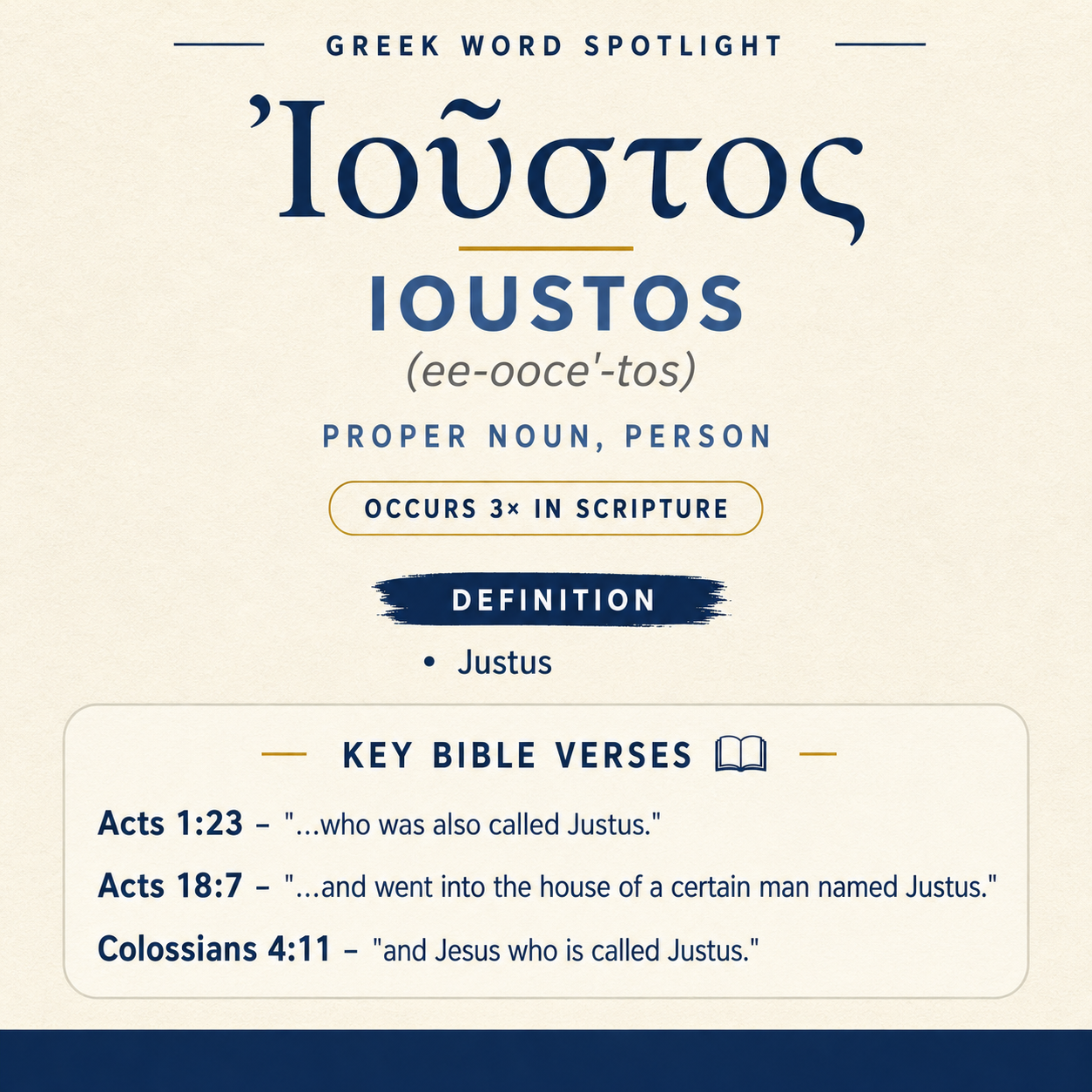
Ἰοῦστος (Ioustos) means “Justus” and appears three times in Scripture: Acts 1:23; Acts 18:7; Colossians 4:11.
Acts References
In Acts 1:23, Joseph called Barsabbas was also called Justus. In Acts 18:7, Paul went into the house of a man named Justus.
Learn More →Colossians Reference
In Colossians 4:11, “Jesus” is described as being called Justus.
Learn More →Ἰοῦστος means “Justus” and appears as a personal name in Acts 1:23, Acts 18:7, and Colossians 4:11. In each passage, it functions to distinguish a particular individual within a larger setting of believers and workers.
Occurrences
“They put forward two, Joseph called Barsabbas, who was also called Justus, and Matthias.” (Acts 1:23)
Here Ἰοῦστος identifies one of two men presented to the group: “Joseph called Barsabbas, who was also called Justus.” The wording places “Justus” as an additional name attached to Joseph Barsabbas, marking him out with a second designation in the moment when two candidates are being set side by side. In a sentence built around selection and comparison—“two… and Matthias”—the presence of the alternate name helps fix the identity of this Joseph precisely, so that the reader does not confuse him with any other Joseph. The verse also shows how naturally this second name sits within public speech: the community can refer to him by this additional name as part of the formal presentation.
“He departed there, and went into the house of a certain man named Justus, one who worshiped God, whose house was next door to the synagogue.” (Acts 18:7)
In this narrative detail, Ἰοῦστος supplies the name of the householder who becomes a key point of contact: “a certain man named Justus.” The sentence adds two identifying descriptions that shape how the name is heard: he is “one who worshiped God,” and his location is specified—his “house was next door to the synagogue.” “Justus” therefore is not merely a label but the anchor for a concrete scene: a departure (“He departed there”) followed immediately by a move into a specific household. The name lets the reader track this shift in setting with clarity: the action relocates from one place to another, and the new place is tied to a man with a known devotion (“worshiped God”) and a strategic proximity (“next door”) that frames what follows around adjacency and access. The verse’s geography is relational rather than abstract: the synagogue is the reference point, and Justus’s house is defined by its nearness to it, making the named person part of the spatial logic of the story.
“and Jesus who is called Justus. These are my only fellow workers for God’s Kingdom who are of the circumcision, men who have been a comfort to me.” (Colossians 4:11)
In this closing list of associates, Ἰοῦστος appears as a second name attached to another individual: “Jesus who is called Justus.” The naming formula “who is called” signals that “Justus” functions as an identifying designation for someone otherwise known as “Jesus.” The following lines broaden the significance of the person so identified: “These are my only fellow workers for God’s Kingdom who are of the circumcision, men who have been a comfort to me.” Within that collective description, “Justus” marks one of a small circle of “fellow workers,” and the sentence presses the interpersonal weight of that circle—“a comfort to me.” The name therefore participates in a web of relationships: it locates an individual within a defined group (“my only fellow workers… who are of the circumcision”) and within the writer’s experience of support (“have been a comfort”). The effect is not merely to record a name, but to attach that name to service and consolation in the context of ministry partnership.

Sense and Usage
As “Justus,” Ἰοῦστος operates consistently as a personal designation, and the three occurrences together show two distinct naming patterns. In Acts 1:23 it is linked to “Joseph called Barsabbas” through “who was also called,” presenting “Justus” as an additional identifier for a man already marked by another name. In Colossians 4:11 it is linked to “Jesus” through “who is called,” again presenting “Justus” as a name by which someone is known alongside another. These two passages together show that “Justus” can function in situations where more than one name is in active use for the same person; the text does not treat this as unusual but as a straightforward way to specify identity.
Acts 18:7 differs by presenting “Justus” as the sole name given for the man whose house becomes the setting: “a certain man named Justus.” Here the name stands without an explicit alternate, but it is still surrounded by clarifying descriptors (“one who worshiped God,” “whose house was next door to the synagogue”). Across all three verses, then, “Justus” serves the practical work of identification—either by supplementing another name or by anchoring a person within a network of traits and associations.
The contexts also show how a personal name can carry narrative and relational weight without requiring explanation. In Acts 1:23, the name belongs to a candidate in a moment of communal decision-making, where precision matters because two specific individuals are being “put forward.” In Acts 18:7, the name is tied to a household and its location, making the named individual part of the story’s movement through places: departure, arrival, and proximity to the synagogue. In Colossians 4:11, the name appears within a list of co-laborers and is immediately followed by language of shared work and personal encouragement. In each case, “Justus” functions as a stable reference point: it lets the reader follow who is being discussed as the scene shifts from public selection, to a particular house, to a circle of ministry colleagues.
Imagery
The passages attach “Justus” to concrete scenes rather than abstract description. Acts 18:7 places the name at the threshold of a house “next door to the synagogue,” an image of immediate adjacency—two buildings side by side, with a named home becoming a point of entry. Acts 1:23 evokes a gathering where two men are set forward by name, and Colossians 4:11 evokes companionship in labor that becomes “a comfort.” Taken together, these scenes let “Justus” be heard as the name of identifiable people at decisive moments: in a communal presentation, in a household setting defined by location, and in a working fellowship remembered for encouragement.
Sources: Lexical data from Strong’s Exhaustive Concordance and the Translators Brief Lexicon of Extended Strongs for Greek (STEPBible, CC BY). Occurrence data from the Translators Amalgamated Greek New Testament (STEPBible, CC BY). Scripture quotations from the World English Bible (public domain).