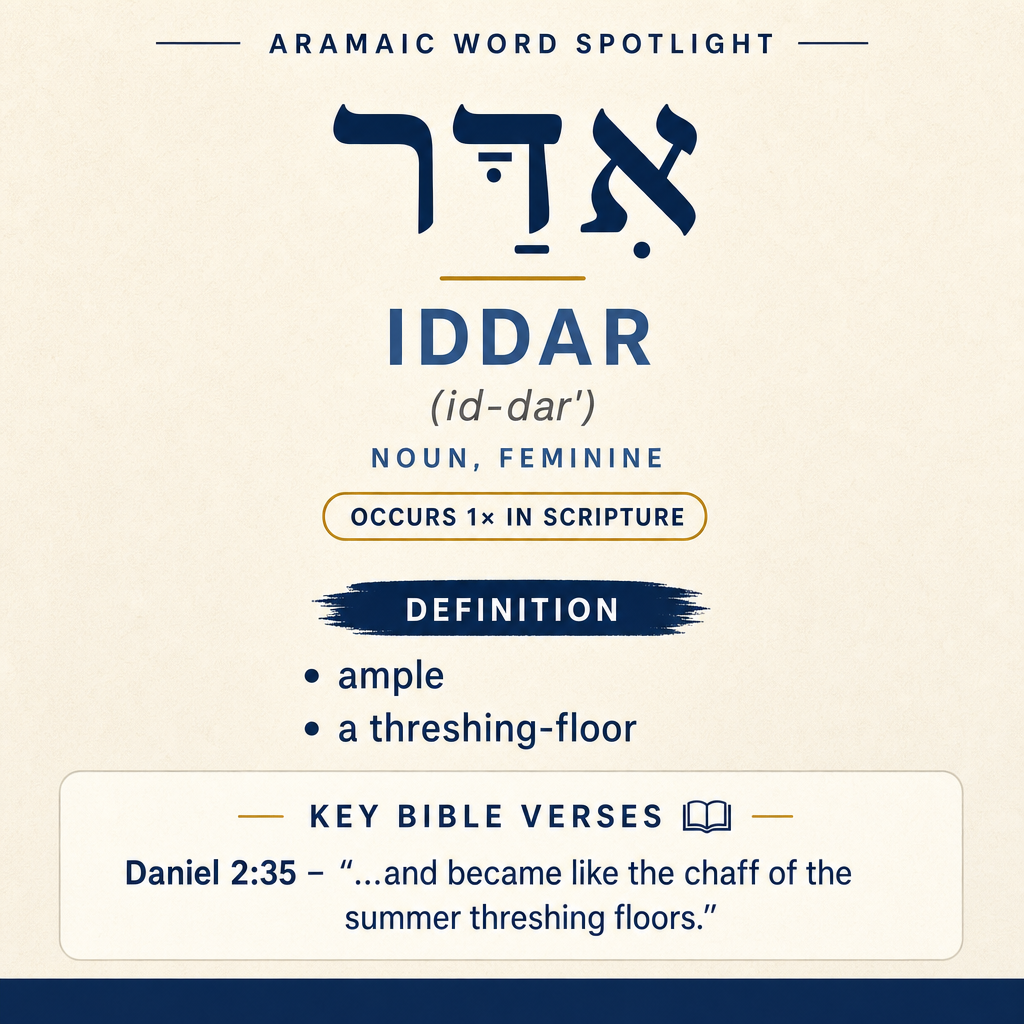
‘iddar (Aramaic)

id-dar’
Parts of Speech: Noun Feminine

‘iddar (Aramaic) Definition

NAS Word Usage – Total: 1

  1. threshing floor

Understanding the Meaning of ‘iddar in Hebrew

The word ‘iddar (אִדַּר) is an Aramaic term that translates to “to be great” or “to be exalted” in Hebrew. This term possesses rich cultural and linguistic significance, especially in the context of ancient texts and their interpretations. Understanding ‘iddar helps reveal the interconnectedness of Hebrew and Aramaic and enhances our comprehension of Biblical passages where this term appears.

Books Worth Reading:
Sponsored
Book 3154Book 3131Book 3162Book 3129Book 3161

Aramaic and Hebrew: A Brief Overview

Before diving deeper into the meaning of ‘iddar, it is essential to understand the relationship between Aramaic and Hebrew. Both languages belong to the Semitic language family, sharing similar roots, vocabulary, and grammatical structures. Aramaic was widely spoken in ancient Israel and surrounding regions, especially during the Babylonian Exile (586–539 B.C.E.), while Hebrew remained the liturgical language of the Jewish people. It’s important to note that many Hebrew texts, particularly in the Later Prophets and the Talmud, include sections in Aramaic.

The Role of ‘iddar in Biblical Contexts

In the Old Testament and in other Jewish writings, ‘iddar appears primarily in poetic and exalted language. For example, when someone speaks of God’s greatness or majesty, the term ‘iddar fits perfectly. In Nebuchadnezzar’s decree in Daniel 4:1-3, we can see a connection to this concept, where the king praises the Most High God, emphasizing His greatness and sovereignty. Here, ‘iddar captures the essence of divine majesty.

Real-World Application: Scriptural Interpretation

Consider a modern-day interpretation of a Biblical passage that uses ‘iddar. In Daniel 4, Nebuchadnezzar recounts his own experience of pride and subsequent punishment by God. When he acknowledges God’s greatness, the Aramaic word ‘iddar conveys his realization of God’s supremacy:

Books Worth Reading:
Sponsored
Book 3154Book 3131Book 3162Book 3129Book 3161

> “His dominion is an everlasting dominion, and His kingdom endures from generation to generation.”

By recognizing ‘iddar, readers grasp the transformation in Nebuchadnezzar’s perspective, which transitions from human pride to divine acknowledgment.

Hypothetical Situation: Classroom Discussion

Imagine a classroom discussing Biblical themes. A teacher poses a question: “What does it reveal about God’s relationship with mankind when we speak of God using the word ‘iddar?” Students could explore how using ‘iddar emphasizes God’s greatness compared to human limitations. They might relate this to their own lives, expressing how moments of humility before something greater than themselves can inspire growth and understanding.

Books Worth Reading:
Sponsored
Book 3154Book 3131Book 3162Book 3129Book 3161

This discussion illustrates how ‘iddar can be applied to both ancient and modern contexts to frame conversations about power, greatness, and humility.

Nuances of ‘iddar: Connotations and Implications

The term ‘iddar carries additional implications beyond just “great.” In Hebrew texts, it intertwines with themes of glory, authority, and the recognition of a higher power.

The Exaltation of Kings and Leaders

When looking at historical contexts, kings and leaders were often exalted through language that included ‘iddar. This term provided a means to express their elevated status and invoked respect. For instance, in ancient Israel, when prophets conveyed messages from God concerning a king’s reign, their use of ‘iddar emphasized that these rulers were chosen by God for a greater purpose.

Books Worth Reading:
Sponsored
Book 3154Book 3131Book 3162Book 3129Book 3161

An example from the Book of Psalms highlights the gravity of such exaltation:

> “I will sing of the mercies of the Lord forever; with my mouth will I make known Your faithfulness to all generations.” (Psalm 89:1)

The recognition of God’s promises might be tied back to the greatness embodied in ‘iddar, positioning God as the ultimate authority over temporal leaders.

Books Worth Reading:
Sponsored
Book 3154Book 3131Book 3162Book 3129Book 3161

Literary Devices and Call to Worship

In scripture, the term ‘iddar may also appear as part of a call to worship. Poetic passages often employ linguistic structures where ‘iddar amplifies a sentiment of reverence.

For instance, consider a liturgical setting where a leader introduces a prayer or hymn focusing on God’s magnificence. By stating, “Let us ‘iddar His name,” the communal act reinforces their collective acknowledgment of God’s supremacy and invites participants into a space of reverent worship.

This usage emphasizes how ‘iddar serves as both a descriptor and a summons to respond to God’s greatness.

Books Worth Reading:
Sponsored
Book 3154Book 3131Book 3162Book 3129Book 3161

‘iddar in Cultural Practices

In Jewish tradition, the recognition of greatness is not limited to theological contexts; it also appears in cultural practices and communal gatherings. The significance of acknowledging greatness extends to celebrations, commemorations, or rites where the community recognizes higher authority.

Example: Rosh Hashanah and the New Year

During Rosh Hashanah, the Jewish New Year, it is common for prayers to include themes of recognizing God’s greatness. People gather, recite prayers, and blow the shofar, the ram’s horn. The act can be viewed as an embodiment of ‘iddar, where the community collectively elevates their thoughts and intentions towards God.

The invocation of ‘iddar in this context encapsulates the spirit of renewal and recognition of God’s greatness, motivating individuals to reflect on their own lives and aspirations in the coming year.

Books Worth Reading:
Sponsored
Book 3154Book 3131Book 3162Book 3129Book 3161

Biblical Commentary and Interpretation

Various Biblical commentators have explored the term ‘iddar, providing insights into how it can shape our understanding of the scriptures. The medieval rabbi Rashi, for example, emphasized that when God declares Himself “great,” as seen in the writings of the prophets, it offers a profound statement on divine authority and power. Rashi’s insights encourage readers to appreciate the complexities of language and its implications.

Example from Midrash

In the Midrash, ‘iddar may signify the greatness that God imparts to Israel as a chosen people. Instead of portraying greatness as a singular trait assigned to God alone, Midrash often suggests a reciprocal relationship—where readers recognize that to be close to God is also to embody greatness through love, justice, and righteousness.

The interpretation of ‘iddar, then, becomes not just a description of a quality but also a guiding principle in the community’s interactions and spiritual journeys.

Books Worth Reading:
Sponsored
Book 3154Book 3131Book 3162Book 3129Book 3161

Contemporary Usage and Popular Culture

The influence of ‘iddar extends into contemporary language and culture, where discussions around greatness, authority, and identity continue to flourish. Social media and popular culture have incorporated discussions of greatness in various forms, tapping into human aspirations to achieve ‘iddar-like status in their own lives.

Consider how influencers or leaders in various fields are often celebrated for their “greatness.” The phrase “to be recognized” might mirror the concept of ‘iddar, drawing parallels between modern definitions of success and age-old Biblical principles.

The Power of Social Media

A hypothetical Instagram post might feature a well-known public figure, utilizing hashtags that translate into the theme of greatness such as #blessed or #grateful. This reflects a collective pursuit of recognition—echoing the core essence of ‘iddar, showing how ancient ideas persist in modern contexts.

Books Worth Reading:
Sponsored
Book 3154Book 3131Book 3162Book 3129Book 3161

Linguistic Reflections: The Roots of ‘iddar

Delving into the linguistic roots of ‘iddar reveals a multifaceted relationship with other Hebrew and Aramaic terms. Understanding its etymology offers deeper insights into its use in various settings.

Word Families and Related Terms

The root of ‘iddar connects to related Hebrew words that also speak to greatness, such as “gadol” (גדוֹל), which means great or large. This connection underscores a theme of magnification, be it in human terms or divine character.

The linguistic relationship between ‘iddar and related terms shapes how speakers both in ancient times and today engage with concepts of power and majesty, enriching the conversation around greatness.

Books Worth Reading:
Sponsored
Book 3154Book 3131Book 3162Book 3129Book 3161

Through the lens of history, literature, culture, and modern expressions, the term ‘iddar confirms its place as a significant element of language with profound implications for understanding identity, authority, and spirituality within both Biblical and contemporary contexts. As an essential term in the vocabulary of faith, ‘iddar opens doors to fruitful discussion and deeper explorations of understanding greatness.

Little Known Secrets

The Aramaic word “iddar” holds intriguing connections and meanings within Hebrew that might surprise many.

  • Meaning: In Hebrew, “iddar” is often associated with the idea of “to be a witness” or “to testify.” This connection emphasizes its role in conveying truth and accountability in legal and personal matters.
  • Cultural Significance: The concept tied to “iddar” highlights the importance of community and relationships in ancient Hebrew society, where having witnesses was crucial for validating actions and agreements.
  • Biblical Usage: Although not frequently found in the Hebrew Bible, the underlying idea of bearing witness appears numerous times, reflecting the social norms of responsibility and truthfulness in ancient Israel.
  • Linguistic Roots: The word “iddar” has its roots in the Semitic languages, which share common linguistic structures, thereby revealing how interconnected Hebrew and Aramaic are.
  • Historical Context: During the time of the Second Temple, Aramaic became a common language among the Jewish people, allowing for cross-cultural exchanges that shaped the understanding and usage of terms like “iddar.”
  • Related Terms: Other Aramaic words share similar roots with “iddar,” such as “devar,” meaning “word” or “thing,” indicating that testimony often involves communication and language.
  • Role in Rabbinic Literature: In Rabbinic texts, the concept of testimony is elaborated upon, showcasing how “iddar” reflects a moral and ethical obligation in legal settings, which was foundational in Jewish law.
  • Symbol of Trust: In various interpretations, “iddar” symbolizes trust, as the act of witnessing requires a certain level of faith in the integrity of those involved.
  • Connection to Personal Experience: The term also evokes the responsibility of individuals to acknowledge their experiences and share truths, which was essential in maintaining social harmony within communities.

By exploring these facets of the word “iddar,” we uncover its rich significance that extends beyond mere translation, highlighting its impact on Hebrew culture and language.

Books Worth Reading:
Sponsored
Book 3154Book 3131Book 3162Book 3129Book 3161

Conclusion

In summary, the Aramaic word “iddar” is closely related to Hebrew and carries significant meaning. It denotes a concept of “pushing” or “driving forth.” This connection highlights the linguistic ties between Hebrew and Aramaic, showing how languages can influence each other. Understanding the word “iddar” helps us appreciate the richness of the Biblical texts and the deeper meanings behind the language used. As we explore these connections, we gain greater insight into the culture and history of the ancient Hebrew people.

Common Questions Related to What Does ‘iddar (Aramaic) Mean In Hebrew

Q. What does ‘iddar mean in Aramaic?
A. In Aramaic, ‘iddar often refers to “to preside over” or “to oversee.” It conveys the idea of managing or being in charge of something.

Q. Is there a direct Hebrew equivalent for ‘iddar?
A. The Hebrew equivalent of ‘iddar can be the word “עָמַד” (amad), which also means “to stand” or “to be in control.”

Books Worth Reading:
Sponsored
Book 3154Book 3131Book 3162Book 3129Book 3161

Q. In what contexts might the word ‘iddar be used?
A. The word ‘iddar can be used in contexts related to leadership, authority, or oversight, especially in religious or community settings.

Q. How does ‘iddar relate to leadership in a biblical context?
A. In a biblical context, ‘iddar suggests the role of a leader who guides and oversees a group, similar to how kings or elders are depicted in the Scriptures.

Q. Are there other Aramaic words similar to ‘iddar?
A. Yes, other similar Aramaic words might include “rabb” meaning “master” or “teacher,” which also reflects leadership roles.

Books Worth Reading:
Sponsored
Book 3154Book 3131Book 3162Book 3129Book 3161

Q. Can ‘iddar refer to spiritual leadership?
A. Yes, ‘iddar can refer to spiritual leadership, where one is responsible for guiding others in their faith or religious practices.

Q. Are there examples of ‘iddar in historical texts?
A. Historical texts, such as those from the Talmud, may reference ‘iddar to describe roles in synagogues or communal leadership.

Q. What is the importance of understanding ‘iddar in biblical studies?
A. Understanding ‘iddar helps scholars and readers grasp how leadership and authority were understood and structured in ancient Hebrew and Aramaic societies.

Books Worth Reading:
Sponsored
Book 3154Book 3131Book 3162Book 3129Book 3161

Q. How do modern Hebrew speakers use the concept of ‘iddar?
A. Modern Hebrew speakers may use the concept of ‘iddar when discussing leadership roles in various fields, although the exact Aramaic word might not be in common use today.

Q. What can ‘iddar teach us about biblical leadership?
A. ‘iddar teaches us that biblical leadership often involves responsibility, guidance, and a sense of duty towards others, highlighting the importance of serving those one leads.

About the Author

Ministry Voice

{"email":"Email address invalid","url":"Website address invalid","required":"Required field missing"}

Want More Great Content?

Check Out These Articles 

mba ads=96