Exploring the Meaning of Ichthus in Greek
ἰχθύς (Ichthus) means “fish” and occurs 20 times in Scripture, including Matthew and Mark.
Matthew Examples
In Matthew it appears in contexts like asking for a fish (Matthew 7:10) and loaves with fish (Matthew 14:17, 14:19; 15:36).
Learn More →Mark Examples
In Mark it occurs with the feeding narrative: “five, and two fish” (Mark 6:38) and the gathered fragments “also of the fish” (Mark 6:43).
Learn More →ἰχθύς refers to a fish, a concrete food item and a familiar feature of life around the sea and fishing. In the passages below it appears in teachings about ordinary provision, in scenes where crowds are fed from limited supplies, and in accounts where fish are caught, counted, distributed, or even used to obtain a coin.

Occurrences
Matthew 7:10: “Or if he asks for a fish, who will give him a serpent?”
Here ἰχθύς supplies the everyday example that frames a contrast. A fish is pictured as a fitting response to a request for food; the rhetorical question assumes the hearer knows the difference between what nourishes and what harms. The point depends on fish being a normal, appropriate gift in a household setting.
Matthew 14:17: “They told him, “We only have here five loaves and two fish.””
ἰχθύς identifies what is on hand for feeding a crowd: not just bread but also fish, and in a small number (“two”). The word anchors the scarcity that shapes the moment—what they possess is countable, limited, and plainly insufficient by ordinary expectations.
Matthew 14:19: “He commanded the multitudes to sit down on the grass; and he took the five loaves and the two fish, and looking up to heaven, he blessed, broke and gave the loaves to the disciples, and the disciples gave to the multitudes.”
In this feeding scene, ἰχθύς appears as part of what Jesus “took” alongside the loaves. The narrative highlights handling and preparation: the fish are included among the items gathered for the meal, set within actions of blessing and distribution that move the food from Jesus to the disciples and then to the multitudes.
Matthew 15:36: “and he took the seven loaves and the fish. He gave thanks and broke them, and gave to the disciples, and the disciples to the multitudes.”
Again ἰχθύς belongs to the meal’s provisions and is paired with loaves. The verbs “took,” “gave thanks,” “broke,” and “gave” place fish within an ordered process of feeding: the fish are not incidental; they are part of what is prepared and passed along through the same chain of giving.
Matthew 17:27: “But, lest we cause them to stumble, go to the sea, cast a hook, and take up the first fish that comes up. When you have opened its mouth, you will find a stater coin. Take that, and give it to them for me and you.”
Here ἰχθύς is the first catch from the sea, obtained by a hook rather than a net. The fish becomes the immediate locus of provision: its “mouth” is opened and a coin is found there. The word thus marks a fish not as food in this scene but as the caught object through which payment is supplied.
Mark 6:38: “He said to them, “How many loaves do you have? Go see.” When they knew, they said, “Five, and two fish.””
ἰχθύς is part of an inventory taken in response to a direct question. The fish are counted with the loaves; their number (“two”) is reported as a known fact once the disciples “go see.” Fish here function as measurable resources for an imminent meal.
Mark 6:41: “He took the five loaves and the two fish, and looking up to heaven, he blessed and broke the loaves, and he gave to his disciples to set before them, and he divided the two fish among them all.”
This account distinguishes what happens with fish from what happens with loaves. While the loaves are “blessed and broke,” the fish are explicitly “divided… among them all.” ἰχθύς therefore contributes to the depiction of distribution: fish are portioned out so that the people share in what began as only “two fish.”
Mark 6:43: “They took up twelve baskets full of broken pieces and also of the fish.”
ἰχθύς appears in the aftermath, when leftovers are gathered. Fish remain after the feeding and are collected along with “broken pieces.” The word underscores that the provision was not limited to bread; fish, too, were present in such quantity that remnants could be gathered up.
Luke 5:6: “When they had done this, they caught a great multitude of fish, and their net was breaking.”
In this fishing scene, ἰχθύς names what fills the net: “a great multitude of fish.” The emphasis falls on abundance and weight—so many fish are caught that the net strains to the point of breaking. Fish here are not counted individually but described as a mass overwhelming the net’s capacity.
Luke 5:9: “For he was amazed, and all who were with him, at the catch of fish which they had caught;”
ἰχθύς is the substance of the “catch” that produces amazement. The word keeps the focus on the tangible result of the action: what evokes astonishment is the catch characterized by fish, not an abstract experience but a haul visible and shareable among “all who were with him.”
Luke 9:13: “But he said to them, “You give them something to eat.” They said, “We have no more than five loaves and two fish, unless we should go and buy food for all these people.””
ἰχθύς again stands for the limited food on hand. The phrase “no more than” frames the fish as part of a meager supply set against the size of “all these people.” Fish serve as one of the few available items, contrasted with the alternative of purchasing food.
Luke 9:16: “He took the five loaves and the two fish, and looking up to the sky, he blessed them, broke them, and gave them to the disciples to set before the multitude.”
ἰχθύς is included among what Jesus “took” and what he “blessed… broke… and gave.” Fish are treated as part of the food that is prepared for serving, and they move toward the “multitude” through the hands of the disciples who “set” the food before the crowd.
Sense and Usage
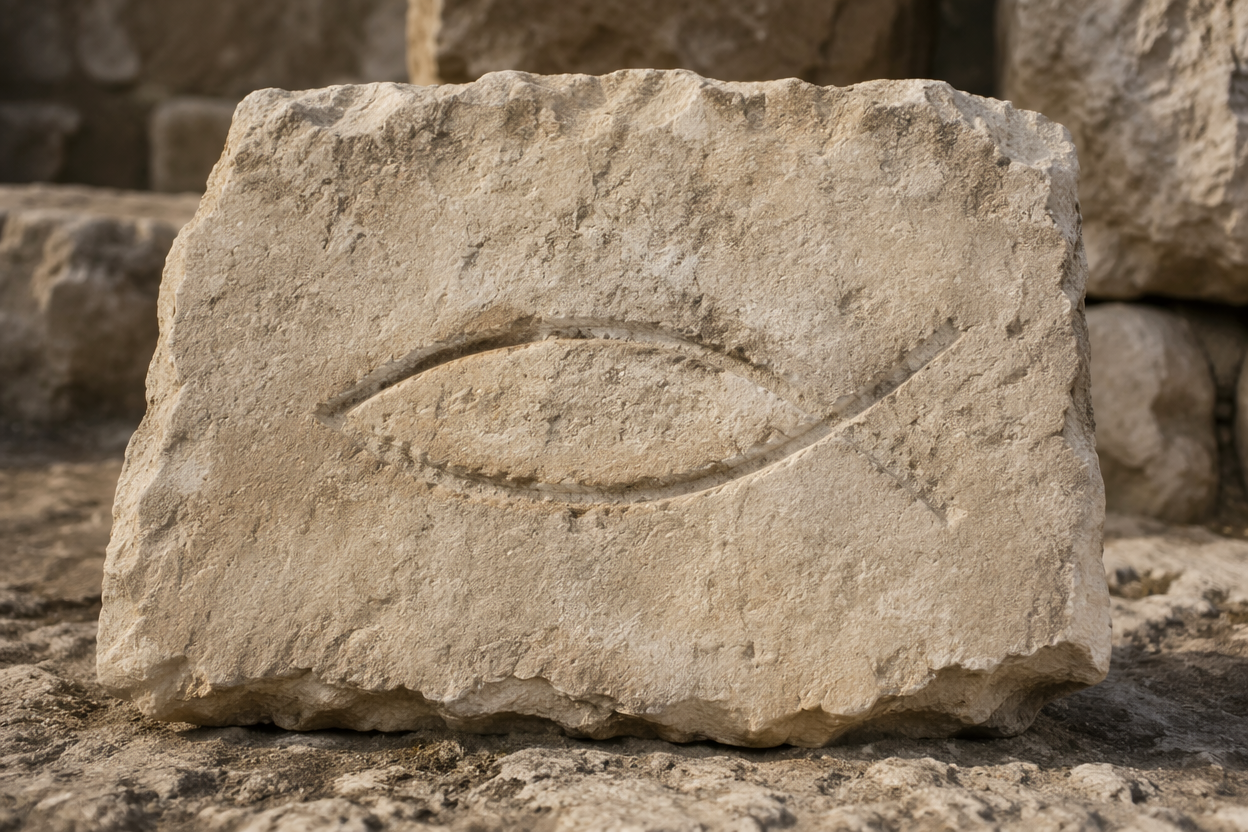
Across these scenes, ἰχθύς functions in three main ways: as a normal item of food, as a counted portion in a shared meal, and as the concrete result of fishing. In Matthew 7:10 the fish is a household staple, suitable for giving to someone who asks; the rhetorical force depends on fish being recognizably edible and appropriate. In the feeding narratives (Matthew 14:17, 14:19; Matthew 15:36; Mark 6:38, 6:41, 6:43; Luke 9:13, 9:16), fish are repeatedly paired with loaves, so that the meal is described as having more than one kind of food. The repeated mention of “two fish” highlights the small starting supply, while later details such as dividing the fish and collecting leftovers show fish moving through the crowd in portions and leaving remnants behind.
In Luke 5:6 and 5:9, ἰχθύς is not primarily about eating but about catching. The word belongs to the vocabulary of work on the water: nets, a catch, and the strain caused by quantity. Fish are tangible units of livelihood, the kind of haul that can be seen to stress equipment and that can be named as the object of amazement. Matthew 17:27 uses fish in a different concrete way: the fish is “the first” pulled up from the sea, and attention shifts to its “mouth,” from which a coin is obtained. Even there, ἰχθύς retains its ordinary sense—an actual fish caught from the sea—while the scene draws out what is found in connection with that fish.
Taken together, these passages keep ἰχθύς grounded in physical reality: a requested food, a limited supply that is counted, a portion that is divided, leftovers that are gathered, and a catch that fills and threatens to break a net. The word’s contribution is often numerical and practical—“two fish,” “a great multitude of fish,” “also of the fish”—because the narratives use fish to register scarcity and abundance in concrete terms.
Imagery
The imagery attached to ἰχθύς in these texts is consistently ordinary and tactile: a fish requested at home (Matthew 7:10), fish counted alongside loaves for feeding crowds seated on the grass (Matthew 14:19) or served through the disciples to a multitude (Luke 9:16), and fish hauled in quantities that strain a net (Luke 5:6). Even the unusual detail of a coin found when a fish’s mouth is opened (Matthew 17:27) depends on the same plain picture of a real fish drawn from the sea. In each scene, fish make the material stakes visible—what can be held, divided, gathered up, and carried away.
Sources: Lexical data from Strong’s Exhaustive Concordance and the Translators Brief Lexicon of Extended Strongs for Greek (STEPBible, CC BY). Occurrence data from the Translators Amalgamated Greek New Testament (STEPBible, CC BY). Scripture quotations from the World English Bible (public domain).