Exploring the Meaning of Iasis in Greek
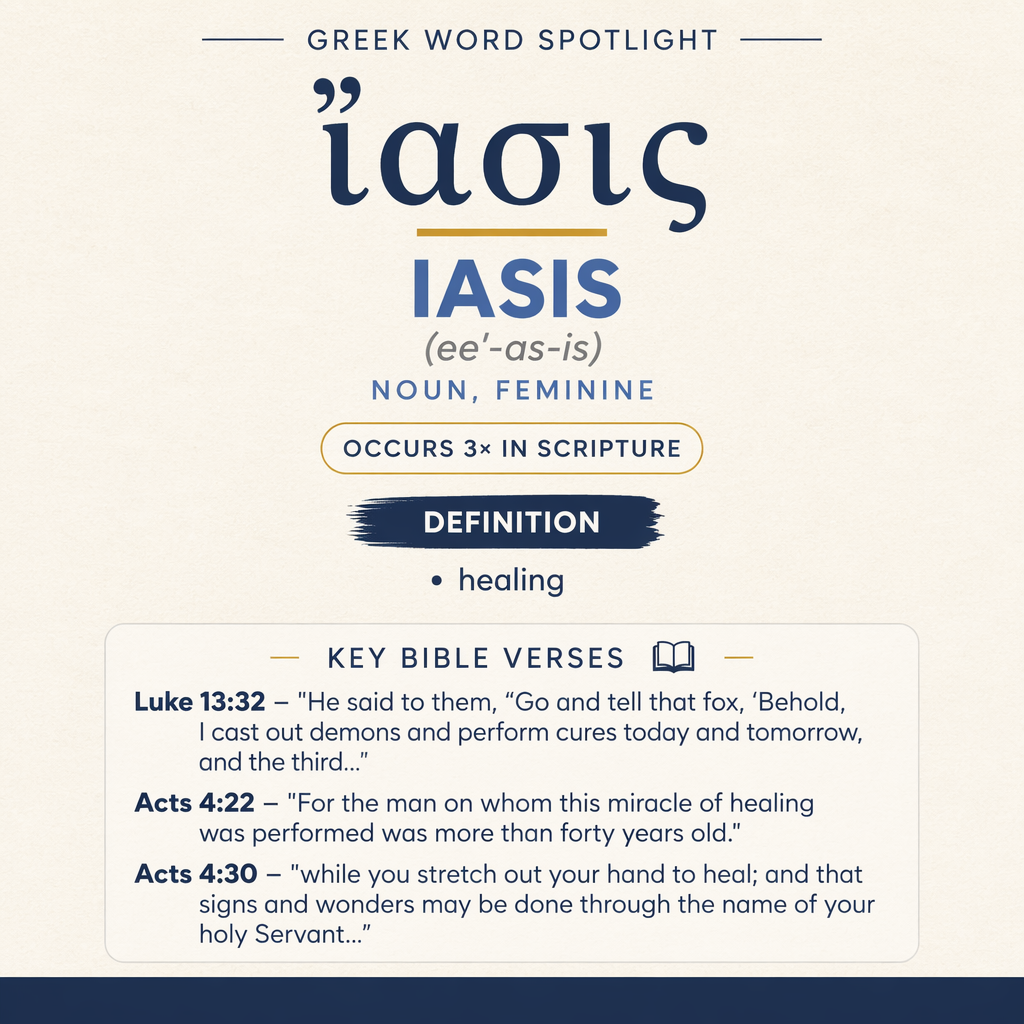
ἴασις means “healing” and appears three times in Scripture: Luke 13:32; Acts 4:22; Acts 4:30.
Scripture Occurrences
This noun occurs 3 times in Scripture. It appears in Luke 13:32, Acts 4:22, and Acts 4:30.
Learn More →Context Snapshots
In Luke 13:32 it is used of performing “cures.” In Acts 4:22 and 4:30 it refers to healing connected with a miracle and an outstretched hand to heal.
Learn More →ἴασις means “healing” and appears in three New Testament passages: one in Jesus’ travel narrative in Luke and two within the early Jerusalem church’s account in Acts. In each setting it names the concrete outcome of divine power at work in public view.
Root and Related Words
ἴασις is derived from the verb iaomai (ἰάομαι), “to heal” (Strong’s G2390). The noun names the result or event corresponding to that verbal action.
Occurrences
Luke 13:32: “He said to them, “Go and tell that fox, ‘Behold, I cast out demons and perform cures today and tomorrow, and the third day I complete my mission.”
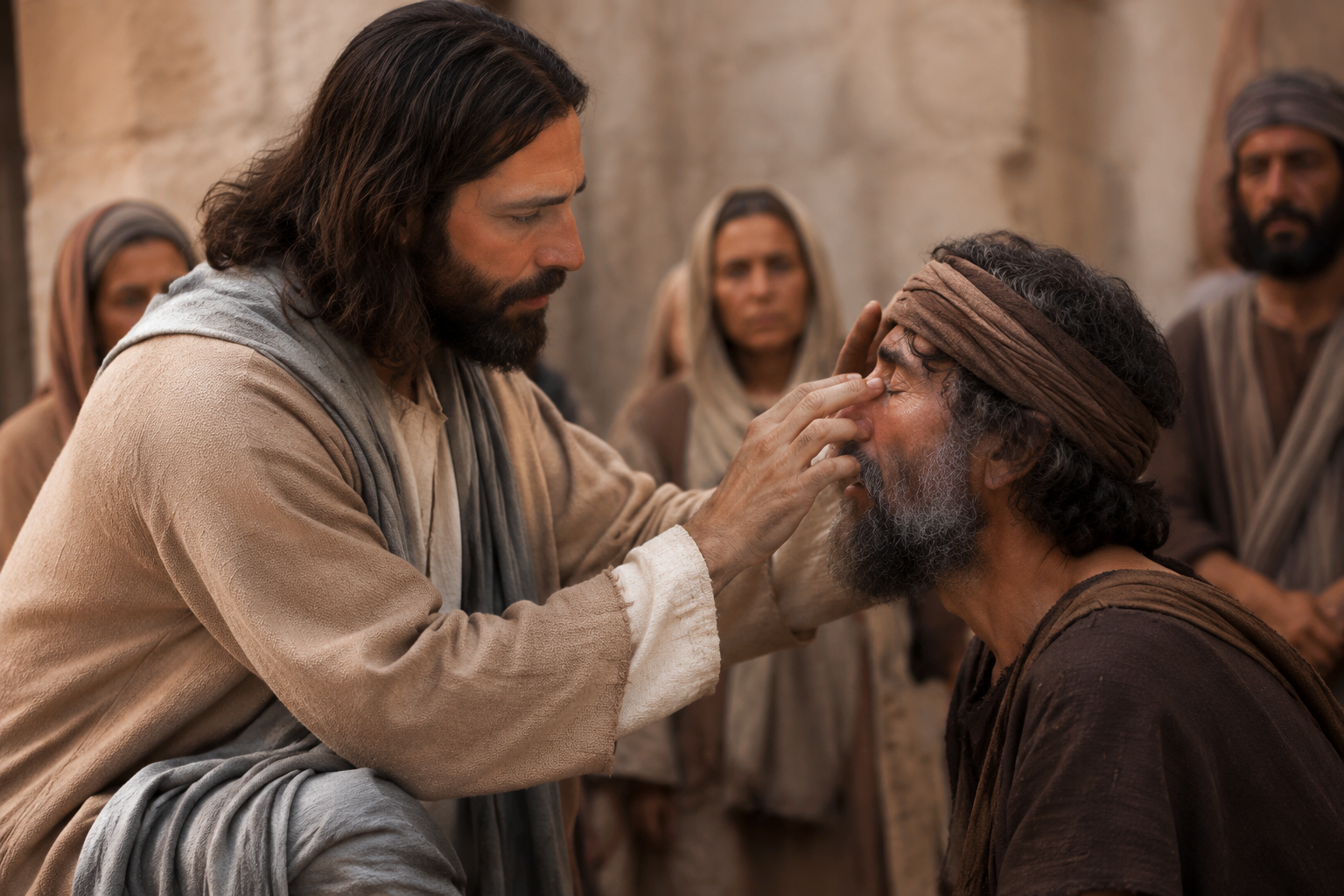
In Luke 13:32, “healing” belongs to a compact summary of Jesus’ ongoing work, set alongside exorcism and the completion of his mission. The wording places cures within a deliberate timetable—“today and tomorrow”—so the term functions as more than a general description of benevolence: it is part of a stated program of action that continues despite opposition. The pairing “cast out demons” and “perform cures” sets healing among works that are observable and reportable (“Go and tell”), implying that what is being discussed is publicly known and capable of being verified by those who hear the report. Healing here is not treated as an isolated incident but as a recurring activity counted among the defining marks of Jesus’ ministry during this period.
Acts 4:22: “For the man on whom this miracle of healing was performed was more than forty years old.”
In Acts 4:22, “healing” is the specific kind of “miracle” being discussed, and it is tied directly to a particular person (“the man on whom…”). The phrase “was performed” presents healing as an enacted deed with an identifiable recipient, and the detail that the man “was more than forty years old” pushes the reader toward the concreteness of the event: this is not a vague improvement but a notable change in the life of a known individual. The term helps frame the miracle’s weight by anchoring it in the person’s age and thus in his long-established condition and public identity. In the narrative logic of the sentence, healing is the category that explains why this man’s story matters for the community’s assessment of what has happened.
Acts 4:30: “while you stretch out your hand to heal; and that signs and wonders may be done through the name of your holy Servant Jesus.”
In Acts 4:30, “healing” appears within a prayer addressed to God, expressed as a request for continued divine action. The imagery is bodily and active—“stretch out your hand to heal”—so healing is pictured as the direct effect of God’s intervention. The sentence links healing with “signs and wonders,” placing it among acts that demonstrate power and that, in this context, occur “through the name of your holy Servant Jesus.” The noun therefore serves as one of the concrete expressions of what the community is asking for: not merely inward encouragement or general help, but actions that can be recognized as extraordinary works associated with Jesus’ name. Healing is treated as a form of divine activity that accompanies and confirms the public witness implied by “signs and wonders.”
Sense and Usage
Across these three passages, ἴασις consistently refers to healing as a tangible outcome—something done, performed, and observed. In Luke, it stands as part of a forward-moving schedule of ministry activity: it belongs with Jesus’ decisive works and is placed on a timeline that culminates in the completion of his mission. This gives the term a sense of ongoing practice rather than a one-time anomaly; healing is presented as a repeated, purposeful act occurring in the flow of days.
In Acts, the term is situated within the life of the early community and their public circumstances. Acts 4:22 speaks retrospectively of a “miracle of healing,” treating the healing as the defining feature of a specific miracle and using personal detail to underscore its seriousness and credibility. Acts 4:30 looks prospectively, requesting that God continue to bring about healing in a manner that is visibly connected to “signs and wonders” and explicitly associated with Jesus’ name. Taken together, these two uses show healing functioning both as evidence already present (a performed miracle) and as an expected continuation of divine work (a prayed-for action).
The three scenes also show how healing relates to speech and report. In Luke 13:32, the healing is something that can be carried as a message (“Go and tell…”), suggesting that it has social presence: others can speak about it because others can see its effects. In Acts 4:22, the healing is described in a way that appeals to public knowledge of the healed man’s identity and age, strengthening the impression that the event is open to communal scrutiny. In Acts 4:30, healing is requested in parallel with “signs and wonders,” indicating that it is expected to function in the same public register—acts that draw attention not to the community’s ingenuity but to divine power working through the name of Jesus.
Imagery
The passages attach healing to vivid, concrete images: Jesus’ day-by-day continuation of cures despite hostile labeling (“that fox”), a known man whose healed state stands out against the background of his many years, and the prayer-image of a hand stretched out to heal. In these texts, ἴασις carries the feel of something enacted in real time and then left standing as a visible result—an outcome that can be told, measured in human biography, and sought again in prayer.
Sources: Lexical data from Strong’s Exhaustive Concordance and the Translators Brief Lexicon of Extended Strongs for Greek (STEPBible, CC BY). Occurrence data from the Translators Amalgamated Greek New Testament (STEPBible, CC BY). Scripture quotations from the World English Bible (public domain).