
Exploring the Meaning of Hupopleo in Greek
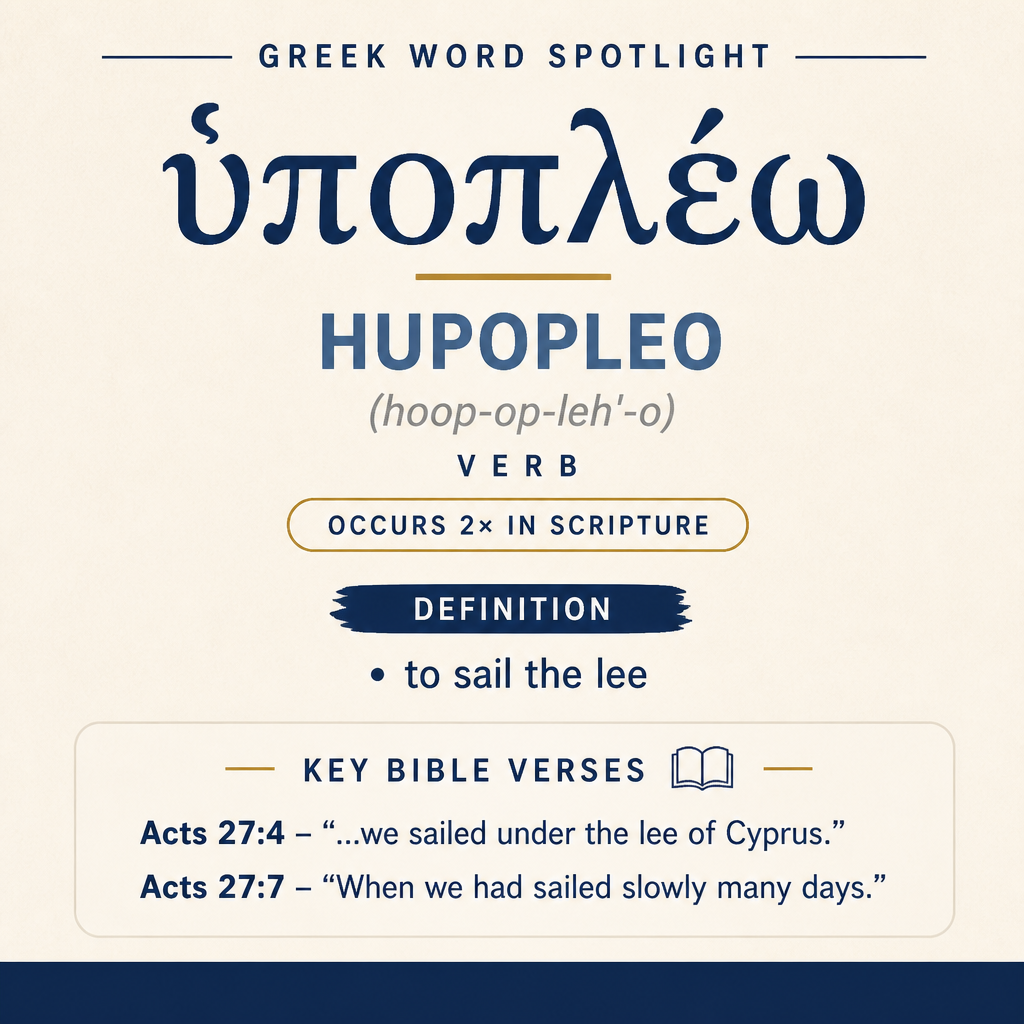
ὑποπλέω means “to sail the lee” and appears twice in Scripture, in Acts 27:4 and Acts 27:7.
Core Meaning
ὑποπλέω means “to sail the lee.” In Acts 27 it describes navigating under shelter because winds were contrary.
Learn More →Acts Context
Acts 27:4 uses it for sailing under the lee of Cyprus. Acts 27:7 uses it during slow progress and difficulty near Cnidus when the wind did not allow further travel.
Learn More →Scripture Occurrences
This verb occurs two times in Scripture. Both occurrences are in Acts 27 within the account of a sea voyage hindered by wind.
Learn More →ὑποπλέω means “to sail the lee,” and it appears in Luke’s narration of a storm-hindered voyage in Acts 27. In both places, the word marks a deliberate choice of route taken in response to unfriendly winds.
Root and Related Words
ὑποπλέω is built from πλέω (pleo), “to sail,” together with ὑπό (hypo), “by/under.” The compound’s form fits the concrete maritime setting in which it occurs: sailing is described with a directional element, expressed by ὑπό, that specifies how the ship passes in relation to a landmass.

Occurrences
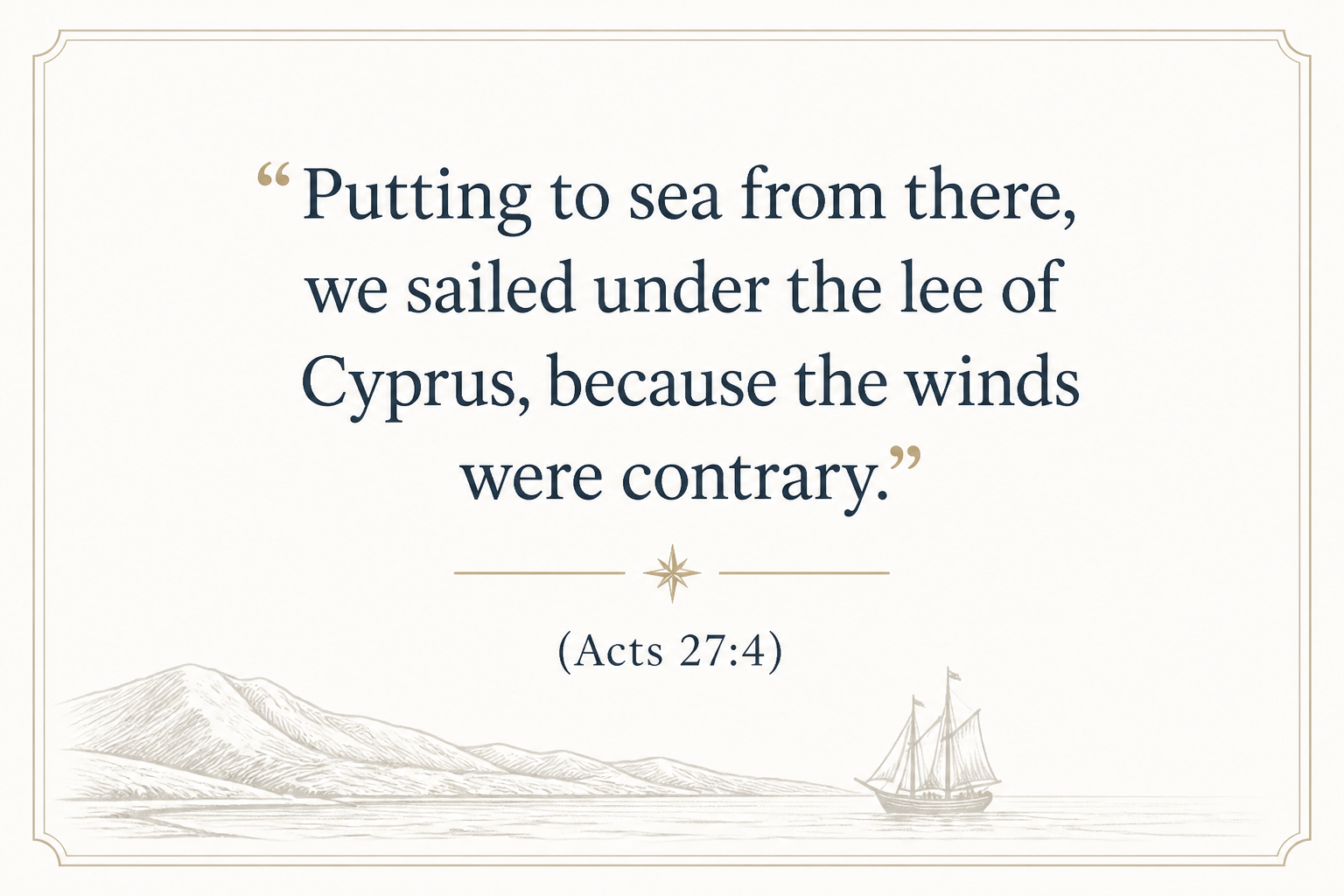
“Putting to sea from there, we sailed under the lee of Cyprus, because the winds were contrary.” (Acts 27:4)
Here ὑποπλέω describes the ship’s movement as it departs and immediately adjusts to conditions: “the winds were contrary.” The phrase “under the lee of Cyprus” presents Cyprus as a large, fixed feature that can be used in the ship’s favor. By choosing this line of travel, the voyage is not merely progressing from point to point; it is proceeding with an eye to shelter from opposing winds. The word therefore contributes a sense of skilled seamanship—an intentional course shaped by weather—without needing any additional explanation in the narrative.
“When we had sailed slowly many days, and had come with difficulty opposite Cnidus, the wind not allowing us further, we sailed under the lee of Crete, opposite Salmone.” (Acts 27:7)
In the second instance the same sailing choice is repeated, but under intensified pressure. The larger sentence stacks hardship upon hardship: “sailed slowly many days,” “come with difficulty,” and “the wind not allowing us further.” Against that backdrop, ὑποπλέω marks the pivot from being impeded to finding a practicable route: they “sailed under the lee of Crete.” Crete functions much like Cyprus did earlier, but now the text explicitly frames the action as the answer to an impasse—the wind “not allowing” progress on the previous heading. The added geographical detail, “opposite Salmone,” anchors the maneuver in a specific coastal stretch, keeping the reader’s attention on route and exposure rather than on destination alone. In this scene, the word contributes the idea of hugging the sheltered side of land as a way of continuing the voyage when open-water sailing is blocked.
Sense and Usage
Across Acts 27:4 and 27:7, “to sail the lee” operates as a technical, situational verb: it expresses a way of sailing that is defined by relation to an island and by the problem of adverse wind. The narrative does not present it as a casual description of passing by Cyprus or Crete; it is a purposeful routing choice, made “because the winds were contrary” and because “the wind [was] not allowing us further.” In both verses, the object of the maneuver is an island named in the text, showing that the lee is not an abstract idea but a practical use of geography. The same action is applied to two different landmasses, suggesting that the verb can be used wherever a ship can take advantage of a substantial feature to reduce wind’s effect.
The repetition also shows how the word functions within a travel log. Acts 27 is attentive to how travel actually happens—speed (“sailed slowly”), difficulty (“with difficulty”), and constraint (“not allowing”). ὑποπλέω fits that texture by marking a change in exposure: rather than depicting the wind merely as background, the verb encodes the sailors’ response to it. The result is that the reader experiences the voyage as contested and tactical, with progress achieved by selecting a protected line of sail. The two occurrences together make the sense concrete: this is a way of proceeding under the sheltering side of something large enough to matter in a contrary wind.
Imagery
In these passages the imagery of ὑποπλέω is the imagery of seamanship under constraint. A ship does not force its way straight ahead when “the winds were contrary” or when “the wind [is] not allowing” further travel; instead it slips along the protected side of Cyprus and then along the protected side of Crete. The word therefore evokes the coastline as refuge and the voyage as a series of decisions made in response to the wind’s resistance.
Sources: Lexical data from Strong’s Exhaustive Concordance and the Translators Brief Lexicon of Extended Strongs for Greek (STEPBible, CC BY). Occurrence data from the Translators Amalgamated Greek New Testament (STEPBible, CC BY). Scripture quotations from the World English Bible (public domain).




