
Exploring the Meaning of Hupoleipo in Greek
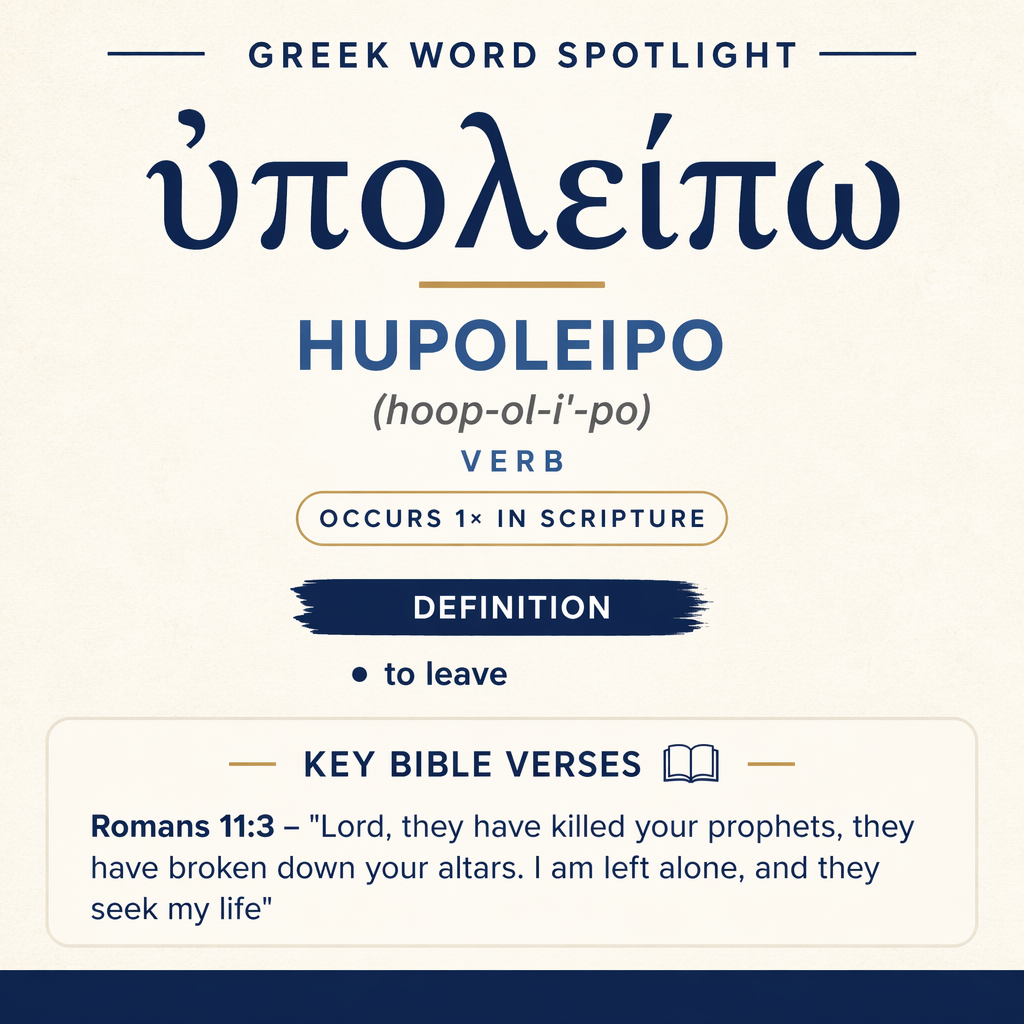
ὑπολείπω means “to leave” and appears once in Scripture, in Romans 11:3.
Scripture Occurrence
It occurs 1 time in Scripture. The occurrence is in Romans 11:3.
Learn More →ὑπολείπω means “to leave,” and it appears once in the New Testament, in Paul’s quotation in Romans 11:3. In that line, the verb frames the speaker’s isolation as the result of what remains after violent opposition.
Root and Related Words
ὑπολείπω is connected with λείπω (leipo), “to lack” (Strong’s G3007). It is also linked, per Strong’s, with ὑποτρέχω (hypotrecho), “to sail under” (Strong’s G5295).
Occurrences
“Lord, they have killed your prophets, they have broken down your altars. I am left alone, and they seek my life.” (Romans 11:3)
Here ὑπολείπω supplies the crucial statement “I am left alone,” set in a sequence of calamities: prophets killed, altars torn down, and finally a solitary survivor who is still under threat (“they seek my life”). The verb presents aloneness not as a chosen condition but as what is left after others have been removed. In the quoted sentence, the speaker places his being “left” between two pressures: behind him are acts of destruction (“killed,” “broken down”), and in front of him is continuing danger (“they seek my life”). The word therefore tightens the logic of the complaint: the same hostile “they” who destroyed prophets and altars has also produced the outcome that only one remains, and even that remainder is targeted.
The construction “I am left alone” has a strong situational force because it is spoken to “Lord” and functions as testimony about the state of things in the community. The speaker’s isolation is pictured as a residue of persecution: prophets are gone, altars are gone, and the speaker himself stands as what is left. The verb thus helps the line move from public loss (prophets, altars) to personal vulnerability (“my life”), presenting the speaker’s loneliness as inseparable from the wider breakdown of religious life and safety described in the same breath.
Sense and Usage
In its lone New Testament appearance, ὑπολείπω depicts “leaving” as the production of a remainder: one person is left when others have been removed by hostile action. The surrounding verbs in Romans 11:3 give the act of leaving its emotional and narrative weight. The speaker does not simply state a private feeling of solitude; he interprets the situation as an outcome of public violence (“they have killed… they have broken down…”). Within that framing, “to leave” functions as an aftermath word: it names what remains when destructive acts have already done their work.
The phrase “I am left alone” also shows how the verb can describe a state that results from prior events rather than a deliberate act of setting something aside. The remainder is personal (“I”), singular (“alone”), and endangered (“they seek my life”). In this usage, the verb binds together the themes of loss and persistence: loss, because the prophets and altars have been removed; persistence, because at least one person still remains, even while threatened. The word’s contribution is to mark that persistence as precarious—what is left is not secure, but exposed.
Because the sentence is addressed to “Lord,” the claim “I am left alone” operates like an appeal grounded in observable conditions. The verb thus carries a relational edge in this setting: the speaker describes himself as what has been left within a covenant community whose visible supports (“prophets,” “altars”) have been attacked. The resulting solitude is not merely social isolation; it is presented as the narrowing of communal life down to a single endangered witness. In Romans 11:3, then, “to leave” is the language of remnant existence under pressure, expressed in the starkest possible terms: one remains, and that one is hunted.
Imagery
The imagery attached to ὑπολείπω in Romans 11:3 is the picture of one person standing after devastation. The line moves from ruined institutions (“broken down… altars”) to a lone survivor (“I am left alone”), and then to an active pursuit (“they seek my life”), so the “leaving” is not quiet or peaceful but the residue of conflict. The word evokes the stark scene of being the only one left in a place where worship has been dismantled and where danger still closes in.
Sources: Lexical data from Strong’s Exhaustive Concordance and the Translators Brief Lexicon of Extended Strongs for Greek (STEPBible, CC BY). Occurrence data from the Translators Amalgamated Greek New Testament (STEPBible, CC BY). Scripture quotations from the World English Bible (public domain).




