
Exploring the Meaning of Hupodema in Greek
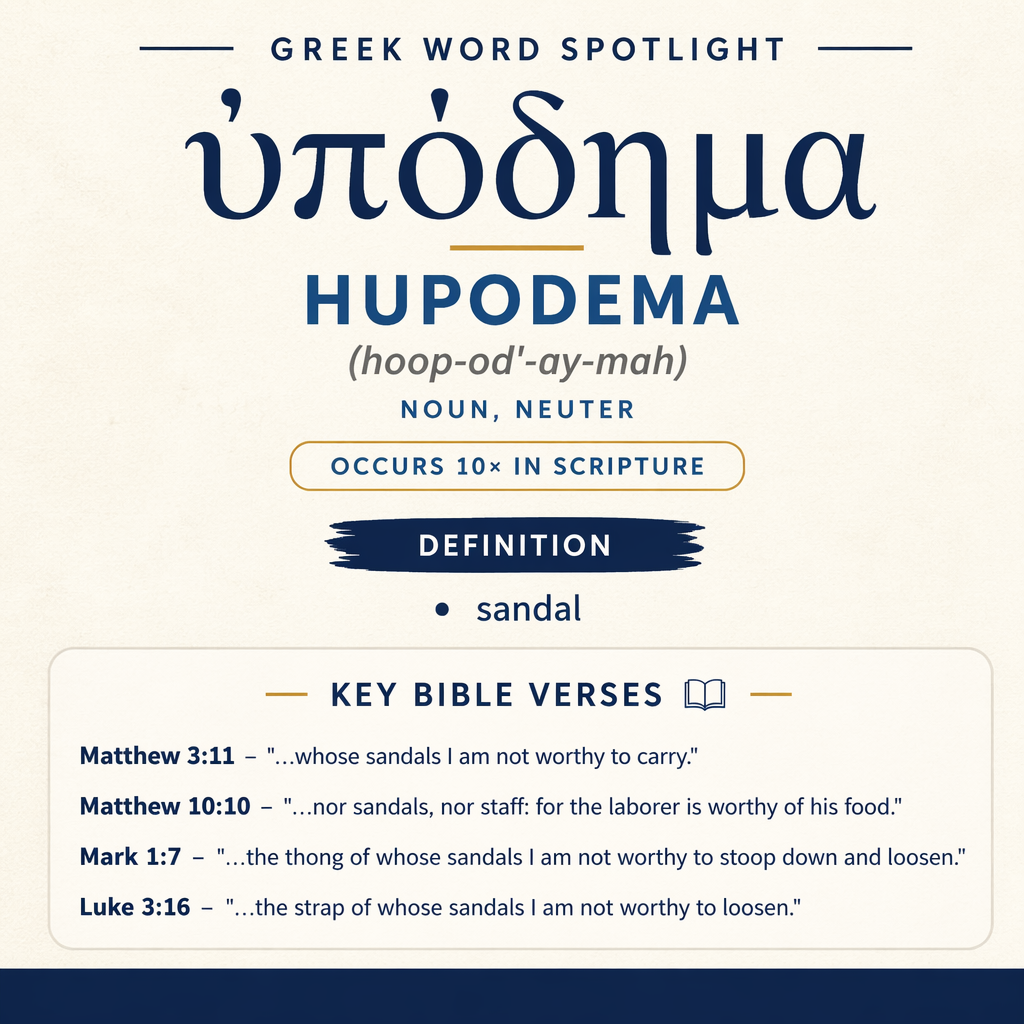
ὑπόδημα means “sandal” and occurs 10 times in Scripture, including Matthew, Mark, Luke, and John.
Basic Meaning
ὑπόδημα is the Greek word for “sandal.” It is used of footwear in the Gospel narratives.
Learn More →Gospel Occurrences
It appears in Matthew 3:11 and 10:10; Mark 1:7; Luke 3:16, 10:4, 15:22, and 22:35; and John 1:27. In these texts it appears in teaching and narrative contexts.
Learn More →Strap and Thong
Several occurrences mention the sandal’s thong or strap in statements about John’s unworthiness to stoop down or loosen it. Another occurrence is in Luke 15:22, where sandals are put on the restored son.
Learn More →ὑπόδημα refers to a “sandal,” the ordinary footwear of travel and daily life. In the Gospels and Acts it appears in scenes of mission, humility, restoration, and holiness, where something as common as footwear becomes a vivid marker of status, readiness, and place.
Occurrences
Matthew 3:11: “I indeed baptize you in water for repentance, but he who comes after me is mightier than I, whose sandals I am not worthy to carry. He will baptize you in the Holy Spirit.”
Here sandals function as a point of comparison for greatness. John sets the coming one’s might over against his own unworthiness by speaking of carrying sandals—an action associated with attending to another’s basic needs. The sandal, a lowly object, sharpens the contrast: even handling what touches the ground is presented as beyond John’s worthiness.

Matthew 10:10: “Take no bag for your journey, neither two coats, nor sandals, nor staff: for the laborer is worthy of his food.”
In this instruction for travel, sandals appear among the basic items one would ordinarily take. The prohibition places sandals alongside bag, coats, and staff—gear for provision and security on the road. The word contributes to the concrete feel of the command: the mission is undertaken without the usual preparations, with the laborer instead sustained by what is provided.
Mark 1:7: “He preached, saying, “After me comes he who is mightier than I, the thong of whose sandals I am not worthy to stoop down and loosen.”
The sandal is again used to express John’s humility, but with a different action: loosening the thong. The detail of stooping down focuses attention on posture and service. The word anchors the image in something tangible—footwear fastened by a thong—so that unworthiness is pictured in a specific, menial task.
Luke 3:16: “John answered them all, “I indeed baptize you with water, but he comes who is mightier than I, the strap of whose sandals I am not worthy to loosen. He will baptize you in the Holy Spirit and fire,”
Luke keeps the same humility motif while phrasing the fastening as a strap. Sandals here stand at the boundary between person and ground; speaking of the strap underscores the intimacy of service at someone’s feet. In the flow of the verse, the sandal image supports the larger claim about the coming one’s superior baptism: John’s role is preparatory, and his status is beneath even the task of unfastening footwear.
Luke 10:4: “Carry no purse, nor wallet, nor sandals. Greet no one on the way.”
Sandals occur within a compact list of travel necessities to be left behind. The command creates urgency and dependence: even what protects the feet for the journey is included. By naming sandals specifically, the verse evokes the physicality of traveling roads and the surprising minimalism expected of those sent out.
Luke 15:22: ““But the father said to his servants, ‘Bring out the best robe, and put it on him. Put a ring on his hand, and sandals on his feet.”
In this scene of restoration, sandals are part of an ordered set of gifts: robe, ring, and sandals. The father’s directives are practical—put them on him—and the sandals locate the son’s renewal in embodied, visible change. Footwear, like robe and ring, marks a return to full standing within the household, expressed through items that others can see and that the son can wear.
Luke 22:35: “He said to them, “When I sent you out without purse, wallet, and sandals, did you lack anything?” They said, “Nothing.”
Sandals here recall earlier mission instructions and become part of a remembered test of provision. The question ties sandals to the experience of going without ordinary equipment; the reply “Nothing” frames that deprivation as not resulting in lack. The word therefore contributes to the concrete inventory of what was absent, reinforcing the theme of being supplied despite missing the normal means for travel.
John 1:27: “He is the one who comes after me, who is preferred before me, whose sandal strap I’m not worthy to loosen.”
Once more sandals serve as the setting for an unworthiness statement, now with the phrase “sandal strap.” The focus is not on travel or clothing but on relative honor: the coming one is “preferred before” John, and even the small, close-up task of loosening a strap is presented as beyond John’s place. The sandal contributes a sharply concrete image for a ranking otherwise expressed in abstract terms.
Acts 7:33: “The Lord said to him, ‘Take off your sandals, for the place where you stand is holy ground.”
In Acts, sandals appear in a command of reverence: remove them because the ground is holy. The sandal here is the material boundary that must be taken away in response to the place’s holiness. The word thus participates in a contrast between ordinary footwear and extraordinary ground; removing sandals signals an appropriate bodily response to where one is standing.
Acts 13:25: “As John was fulfilling his course, he said, ‘What do you suppose that I am? I am not he. But behold, one comes after me, the sandals of whose feet I am not worthy to untie.’”
This retelling returns to John’s self-definition and again uses sandals to express humility. The phrase “the sandals of whose feet” explicitly connects the object to the person it serves, and “not worthy to untie” echoes earlier language about loosening. The sandal imagery reinforces John’s denial that he is the expected figure: his role is subordinate, captured in the lowest kind of service.

Sense and Usage
Across these passages, “sandal” is consistently literal: an item worn, carried, loosened, untied, taken off, or withheld. Yet its narrative weight shifts with setting.
In John’s preaching and testimony (Matthew 3:11; Mark 1:7; Luke 3:16; John 1:27; Acts 13:25), sandals are invoked through the actions of carrying or unfastening. These are not grand gestures; they are tasks done near the ground, involving another person’s feet. The recurring association between sandals and unworthiness makes the object a stable reference point for humility: the coming one’s superiority is so great that even service concerning his sandals is portrayed as too high an honor. Each version chooses a slightly different fastening term—thong, strap—keeping the imagery concrete and domestic rather than ceremonial.
In mission instructions (Matthew 10:10; Luke 10:4) and their later recollection (Luke 22:35), sandals belong to a list of practical supplies. Their mention assumes travel and the need for basic protection, so the command not to take them intensifies the sense of exposure and dependence. Luke 22:35 turns that earlier deprivation into a question about outcome: despite going out without sandals (along with purse and wallet), the disciples affirm they lacked nothing. Thus sandals help frame a lived experience of sending and support, not merely a metaphor.
In the parable-like restoration scene (Luke 15:22), sandals are not about travel but about re-clothing someone who has returned. They work with robe and ring to signal a full, visible reintegration. Sandals, placed specifically “on his feet,” emphasize that restoration is not only spoken but enacted through fitting someone with what is appropriate to wear.
Acts 7:33 uses sandals in a different register: the presence of holy ground requires their removal. The sandal here is not a marker of unworthiness compared to another person, but a marker of ordinary contact with the earth. Taking sandals off becomes a bodily acknowledgment that the place demands a different posture than everyday walking.
Taken together, these uses show how a common item can anchor major themes—status, service, mission, provision, restoration, and reverence—without ever leaving its ordinary, physical sense. The repeated focus on straps and untying keeps the reader’s attention on the smallness of the object, which in turn heightens whatever the scene is emphasizing: the greatness of the coming one, the austerity of being sent, the completeness of being restored, or the sanctity of the ground beneath one’s feet.
Imagery
Because sandals sit at the meeting point of body and ground, they naturally carry strong visual force in these texts. John’s language repeatedly places attention near the feet—carrying sandals, loosening a thong, untying a strap—so that humility is pictured as downward movement and lowly service (Matthew 3:11; Mark 1:7; Luke 3:16; John 1:27; Acts 13:25). Mission sayings turn sandals into shorthand for travel readiness and the choice to go without customary safeguards (Matthew 10:10; Luke 10:4; Luke 22:35). Luke 15:22 reverses the image: sandals are not removed or refused but given, placed on feet as part of renewed belonging. Acts 7:33 gives perhaps the starkest scene—sandals taken off because the ground is holy—so that footwear becomes the removable layer between ordinary life and a place set apart.
Sources: Lexical data from Strong’s Exhaustive Concordance and the Translators Brief Lexicon of Extended Strongs for Greek (STEPBible, CC BY). Occurrence data from the Translators Amalgamated Greek New Testament (STEPBible, CC BY). Scripture quotations from the World English Bible (public domain).




