Exploring the Meaning of Hugros in Greek
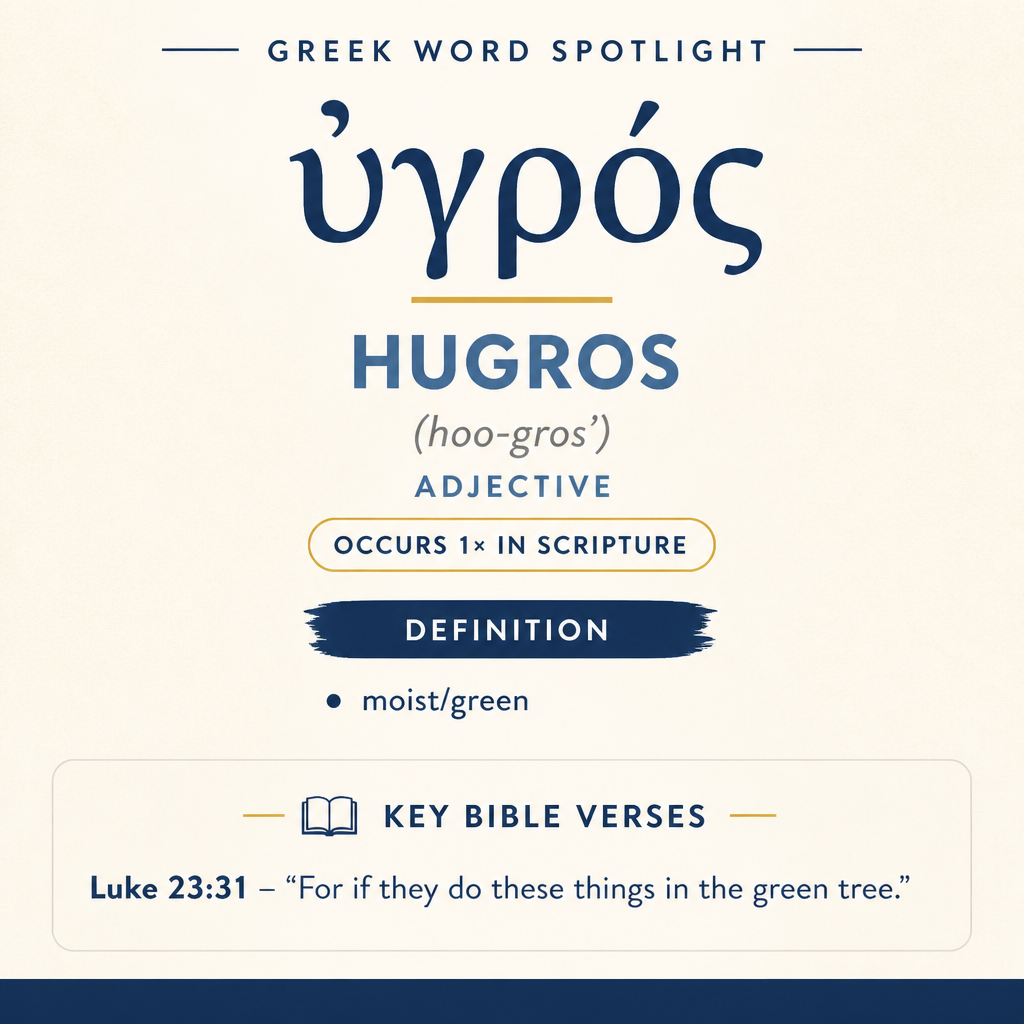
ὑγρός means “moist/green” and appears once in Scripture, in Luke 23:31.
Verse Context
In Luke 23:31 it describes “the green tree,” contrasted with “the dry.”
Learn More →ὑγρός means “moist/green” and appears once in the New Testament, in Jesus’ saying about a “green tree” and a “dry” one (Luke 23:31). In that single context it functions as a vivid adjective that frames a comparison through vegetation imagery.
Root and Related Words
ὑγρός is related to hyetos (ὑετός), “rain” (Strong’s G5205). The association with “rain” places ὑγρός naturally within the sphere of conditions produced by wetness—language suited to describing plant life that is still fresh rather than withered.

Occurrences
“For if they do these things in the green tree, what will be done in the dry?” (Luke 23:31)
Here ὑγρός modifies “tree” with the sense “moist/green,” setting the tree in a state of living freshness. The verse itself presents a paired contrast: a “green tree” over against a “dry” one. Within that compact comparison, the adjective does more than supply a color; it depicts a condition. A “moist/green” tree evokes a plant that still has sap and vitality, the sort of wood that is not naturally associated with being consumed quickly because it is not dried out. By placing this adjective in the first half of the comparison (“if they do these things in the green tree”), the saying makes the “green” side the surprising or striking case, and then turns the listener’s attention to the second half (“what will be done in the dry?”). The rhetorical force depends on the vividness of the contrast: what happens to something still “moist/green” becomes the basis for inferring what might happen when the object is “dry.”
Because the verse does not expand the image further, ὑγρός functions economically. It anchors the analogy in a concrete, observable state of a tree—one that would be recognized as not yet desiccated. The adjective therefore carries the weight of making the first scenario feel counterintuitive: action taken against something “moist/green” implies an even more severe outcome when the contrasting condition (“dry”) is in view. In Luke 23:31, then, ὑγρός is the key descriptor that makes the comparison sharp and memorable.
Sense and Usage
The definition “moist/green” points to two closely linked ways of describing the same physical reality. “Moist” speaks to the presence of wetness; “green” speaks to the visible result of that wetness in plant life. In Luke 23:31, the phrase “the green tree” draws on the everyday connection between moisture and vegetation: what is “moist” remains “green,” and what has lost moisture becomes “dry.” The single attested use shows ὑγρός operating as an adjective of condition rather than an abstract quality. It is not presented as an inward attribute but as an outwardly evident state that can be contrasted with its opposite.
Within the verse’s parallel structure, ὑγρός contributes to a logic of comparison. The first clause (“if they do these things in the green tree”) is framed as a premise; the second clause (“what will be done in the dry?”) is framed as a conclusion drawn by contrast. The adjective therefore supports a “from lesser to greater” kind of inference as the saying is heard: if an action occurs even where the tree is still “moist/green,” then the implied result for the “dry” case is more ominous. The power of the saying is rooted in the physical intuition the words evoke: green, moisture-bearing wood is not what one expects to be subjected to the same treatment as dry wood. The adjective’s contribution is to make that intuition immediate.
Because ὑγρός is paired in Luke 23:31 with “dry,” its sense is constrained by that opposition. The verse does not require technical precision about botany; it relies on the ordinary observation that a tree in one state is fresh and not dried out, while in the other state it is dried and vulnerable. Thus “moist/green” functions as a compact descriptor that gathers up the notion of freshness, living condition, and the presence of moisture into a single word picture. The related term hyetos (ὑετός), “rain,” reinforces how naturally such a word belongs to the realm of wetness that sustains greenness, even though Luke 23:31 itself keeps the imagery focused on the tree’s condition rather than on the source of its moisture.
Imagery
Luke 23:31 gives ὑγρός a strong visual role. The phrase “green tree” places the listener before an image of living wood, while “dry” evokes the opposite condition. In one short line, the adjective helps create a stark two-part scene—freshness versus dryness—so that the comparison can be felt as well as understood. The word’s force lies in how quickly it calls to mind the difference between what is still “moist/green” and what has become “dry,” and in how that difference supports the question the verse presses: “what will be done” under the harsher condition?
Sources: Lexical data from Strong’s Exhaustive Concordance and the Translators Brief Lexicon of Extended Strongs for Greek (STEPBible, CC BY). Occurrence data from the Translators Amalgamated Greek New Testament (STEPBible, CC BY). Scripture quotations from the World English Bible (public domain).