Exploring the Meaning of Hote in Greek
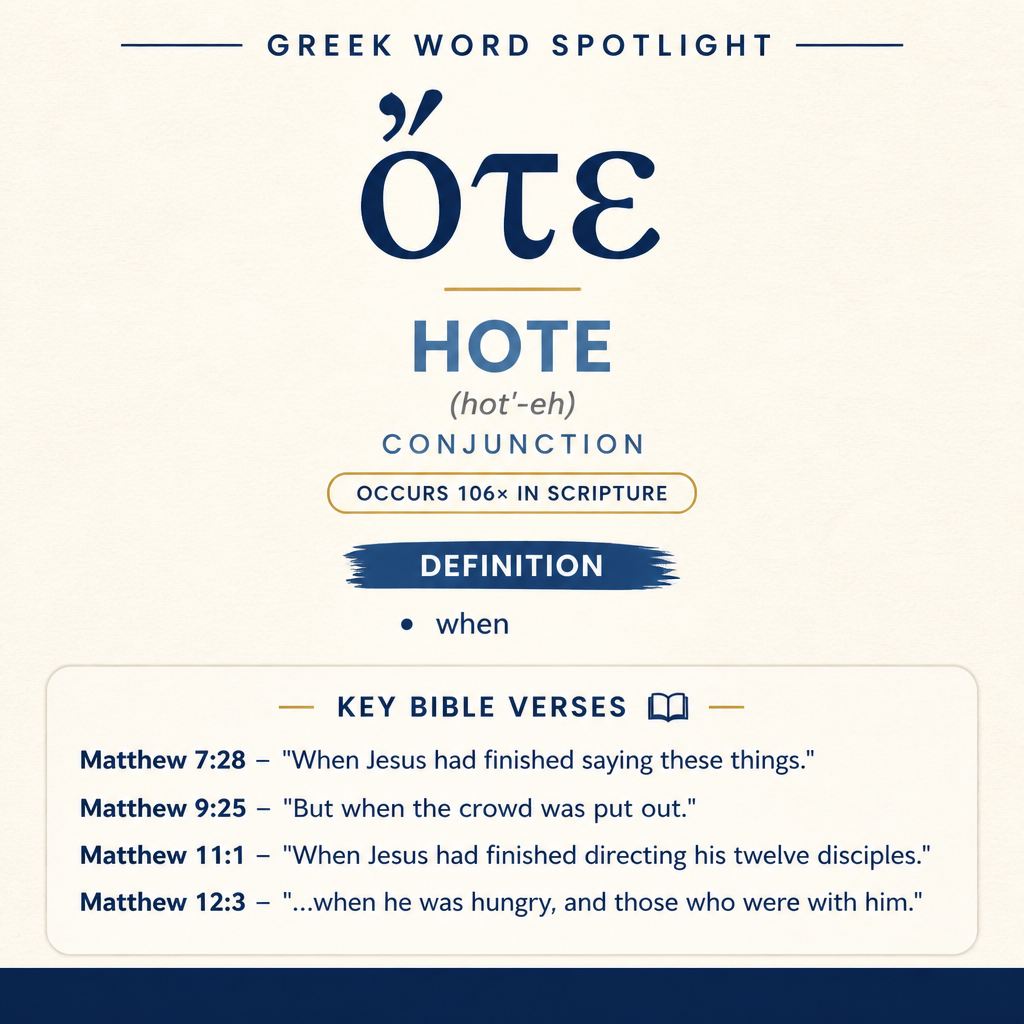
ὅτε (Hote) means “when” and occurs 106 times in Scripture, including in Matthew 7:28 and Matthew 13:53.
Core Meaning
ὅτε is defined as “when.” In the listed passages, it introduces a time setting for what follows.
Learn More →Matthew Examples
It appears in Matthew in narrative transitions such as Matthew 7:28 and Matthew 11:1. It also occurs in parable contexts like Matthew 13:26 and Matthew 13:48.
Learn More →Scripture Frequency
ὅτε occurs 106 times in Scripture. The provided examples include Matthew 9:25, Matthew 12:3, and Matthew 17:25.
Learn More →ὅτε marks time: it situates an action or saying at the point when another event occurs. In the passages below it regularly introduces a clause that frames what follows, whether in narrative transitions, reported speech, or parabolic description.
Occurrences
“When Jesus had finished saying these things, the multitudes were astonished at his teaching,” (Matthew 7:28)
ὅτε introduces a temporal setting that links the crowd’s reaction to the moment Jesus completes “saying these things.” The astonishment is not presented as a general impression but as the response that arises at that point in the discourse’s completion, making the finish of Jesus’ speech the hinge into the narrative consequence.
“But when the crowd was put out, he entered in, took her by the hand, and the girl arose.” (Matthew 9:25)
Here ὅτε anchors the sequence of events to a specific precondition: the crowd’s removal. The actions that follow (“he entered in, took her by the hand”) are presented as occurring at the time the crowd has been put out, so the temporal marker tightly coordinates the change in situation with Jesus’ entry and the girl’s rising.
“When Jesus had finished directing his twelve disciples, he departed from there to teach and preach in their cities.” (Matthew 11:1)
ὅτε functions as a narrative connector: the end of Jesus’ “directing his twelve disciples” becomes the time-reference for his subsequent departure. The conjunction frames the departure as following immediately in the story’s flow from one phase of activity (directing) to another (teaching and preaching).
“But he said to them, “Haven’t you read what David did, when he was hungry, and those who were with him;” (Matthew 12:3)
In this sentence ὅτε is nested within a question and points back to a remembered moment in the account being invoked: David’s action is located at the time “he was hungry” along with “those who were with him.” The temporal clause supplies the circumstance under which the cited deed took place, shaping how that deed is to be heard in the argument Jesus is making.
“But when the blade sprang up and produced fruit, then the darnel weeds appeared also.” (Matthew 13:26)
ὅτε marks the point in the growth cycle at which a new development becomes visible. The appearance of “the darnel weeds” is keyed to the time when the blade has both “sprang up” and “produced fruit,” so the conjunction sets the weeds’ manifestation in relation to the crop’s maturation, emphasizing timing as part of the parable’s logic.
“which, when it was filled, they drew up on the beach. They sat down, and gathered the good into containers, but the bad they threw away.” (Matthew 13:48)
ὅτε introduces the condition of fullness as the time for action: the net is drawn up “when it was filled.” The conjunction helps the reader see a clear threshold moment—fullness—after which the fishermen’s sorting activity begins, giving a temporal rhythm to the parabolic scene (fill → draw up → sit down → gather/throw away).
“When Jesus had finished these parables, he departed from there.” (Matthew 13:53)
Again ὅτε marks a transition at the completion of speech. The departure is narrated as occurring at the time Jesus has “finished these parables,” so the conjunction punctuates the close of a teaching segment and moves the narrative forward by tying movement (“he departed”) to the finishing point.
“He said, “Yes.” When he came into the house, Jesus anticipated him, saying, “What do you think, Simon? From whom do the kings of the earth receive toll or tribute? From their children, or from strangers?”” (Matthew 17:25)
ὅτε sets the scene for Jesus’ words by locating them at the time of arrival “into the house.” The temporal clause indicates that Jesus’ anticipation and ensuing question are not abstract teaching but speech delivered at a precise moment within an encounter, as the setting changes from outside to inside.
“When Jesus had finished these words, he departed from Galilee, and came into the borders of Judea beyond the Jordan.” (Matthew 19:1)
ὅτε frames a major narrative movement geographically (“departed from Galilee… came… beyond the Jordan”) as occurring at the time when Jesus completes “these words.” The conjunction again makes the finishing of discourse the temporal pivot that releases the next travel sequence, binding speech and journey within one timeline.
“When they came near to Jerusalem, and came to Bethsphage, to the Mount of Olives, then Jesus sent two disciples,” (Matthew 21:1)
Here ὅτε is attached to the group’s approach and arrival near specific locations (“near to Jerusalem… to Bethsphage… to the Mount of Olives”). The sending of “two disciples” is thereby anchored to that arrival-time: the temporal marker defines the point at which Jesus initiates the next action in the narrative.
“When the season for the fruit came near, he sent his servants to the farmers, to receive his fruit.” (Matthew 21:34)
ὅτε ties the landowner’s sending of servants to a particular time in the agricultural calendar: “the season for the fruit.” The conjunction makes the sending an action appropriate to that time, not arbitrary; it situates the mission of the servants as triggered by the season’s nearness and the expectation of receiving fruit.
“When Jesus had finished all these words, he said to his disciples,” (Matthew 26:1)
ὅτε introduces the moment that opens a new stage in Jesus’ interaction with his disciples: after finishing “all these words,” he speaks again. The conjunction marks the boundary between one block of speech and the next act of address, guiding the reader to hear what follows as timed precisely to the completion of what precedes.

Sense and Usage
Across these passages ὅτε consistently performs a time-framing function: it points to the moment when one event occurs and uses that moment to situate another action, reaction, or statement. Several patterns stand out.
1) Speech-completion as a narrative hinge. Multiple occurrences connect the end of Jesus’ speaking with what happens next: “When Jesus had finished saying these things…” (Matthew 7:28), “When Jesus had finished directing…” (Matthew 11:1), “When Jesus had finished these parables…” (Matthew 13:53), “When Jesus had finished these words…” (Matthew 19:1), and “When Jesus had finished all these words…” (Matthew 26:1). In each, ὅτε helps structure the storyline by treating the completion of teaching as a definable time-point. The result is a repeated cadence: completion of words becomes the moment for astonishment, departure, relocation, or renewed instruction.
2) Timing that controls access and setting. In Matthew 9:25 the temporal clause “when the crowd was put out” functions like a gate: only once that occurs do the next actions proceed. Likewise, in Matthew 17:25 the moment of coming “into the house” is the time when Jesus speaks, marking a shift in setting that matters for the conversation. ὅτε in these cases is not merely chronological; it delineates the circumstances under which the subsequent action takes place.
3) Temporal markers within parabolic processes. In the parables (Matthew 13:26; 13:48; 21:34), ὅτε ties action to stages: growth leading to visibility of weeds, a net reaching fullness before being hauled up, and a fruit season nearing before servants are sent. The conjunction highlights that in these stories, outcomes and decisions occur at certain times within an unfolding process. The word thereby supports the internal logic of the parables: certain developments become apparent only at particular moments, and certain actions are appropriate only when the relevant time arrives.
4) Recollection of a moment as part of an argument. In Matthew 12:3 ὅτε introduces a time clause inside a remembered account (“when he was hungry”). The temporal framing supplies context for the deed being referenced, tying the action to a specific situation. In this way, ὅτε helps locate the cited behavior in time and circumstance, making the recollection more precise within the exchange.
In all these uses, ὅτε acts as a guide for reading events in sequence. It signals that what follows should be heard against a temporal backdrop—after a completion, upon an arrival, as a season nears, at the stage when something becomes full or fruitful. The conjunction thus contributes to clarity of progression: it draws a line between “at that time” and the event that takes place in that timed setting.
Imagery in Context
The passages where ὅτε appears often point to visible thresholds: a crowd put out, a blade producing fruit, a net filled, a season nearing, a group arriving near Jerusalem. Even when the marker is tied to speech (“finished saying these things”), the effect is similar: a recognizable endpoint becomes the time for a new response or action. ὅτε repeatedly places the reader at such turning points, where one phase closes and the next begins.
Sources: Lexical data from Strong’s Exhaustive Concordance and the Translators Brief Lexicon of Extended Strongs for Greek (STEPBible, CC BY). Occurrence data from the Translators Amalgamated Greek New Testament (STEPBible, CC BY). Scripture quotations from the World English Bible (public domain).