
Exploring the Meaning of Horkomosia in Greek
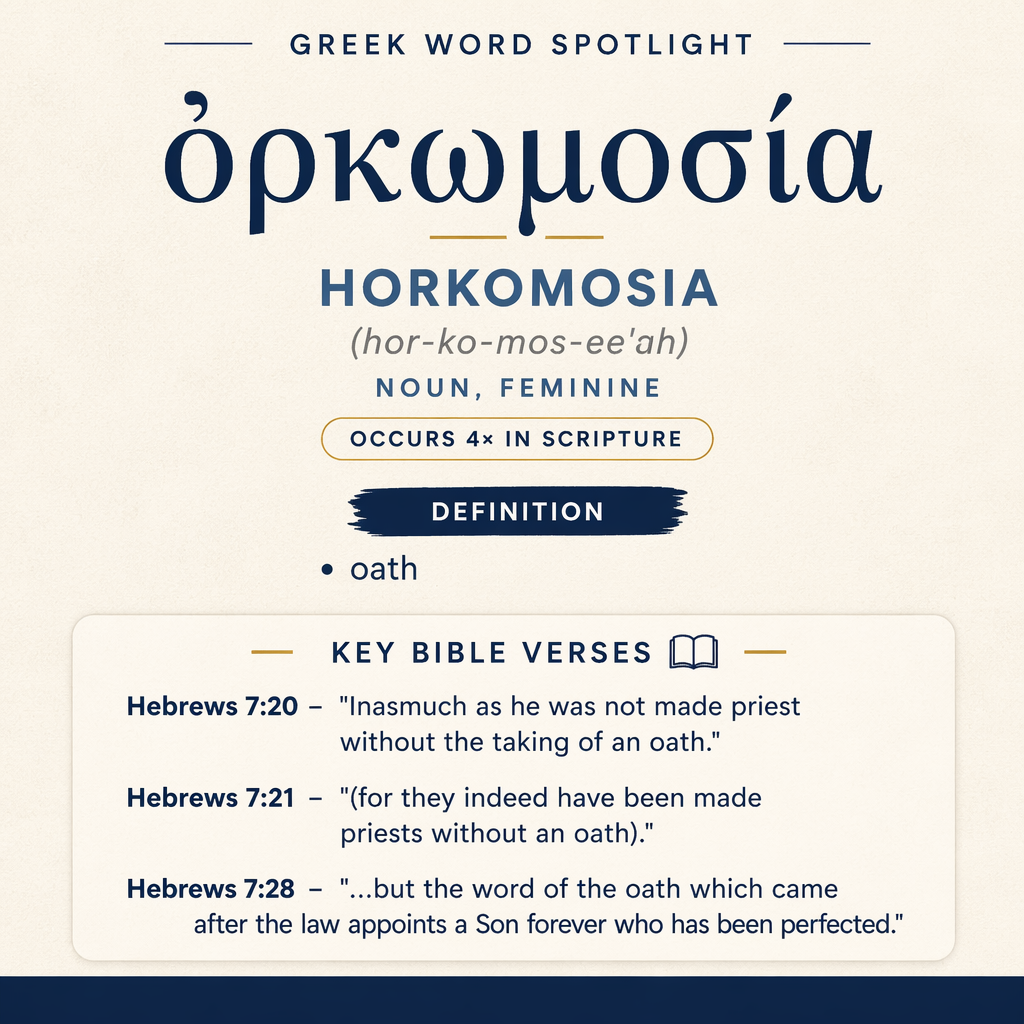
ὁρκωμοσία means “oath” and appears in Hebrews 7:20–21 and 7:28.
Scripture Occurrences
This word occurs 4 times in Scripture. It is found in Hebrews 7:20–21 and Hebrews 7:28.
Learn More →Hebrews Context
In Hebrews 7, ὁρκωμοσία is used for the taking of an oath connected with priestly appointment. It appears in contrast to priests made without an oath.
Learn More →ὁρκωμοσία means “oath” and is used in Hebrews 7 to discuss how priesthood and divine appointment are confirmed. In these verses it marks a solemn swearing that distinguishes one appointment from another and anchors the argument in what has been sworn.
Root and Related Words
ὁρκωμοσία (Horkomosia) is connected with ὄμνυμι (omnyo), “to swear” (Strong’s G3660), and with ὅρκος (horkos), “oath” (Strong’s G3727). These related terms place ὁρκωμοσία within the vocabulary of swearing and sworn commitment.

Occurrences
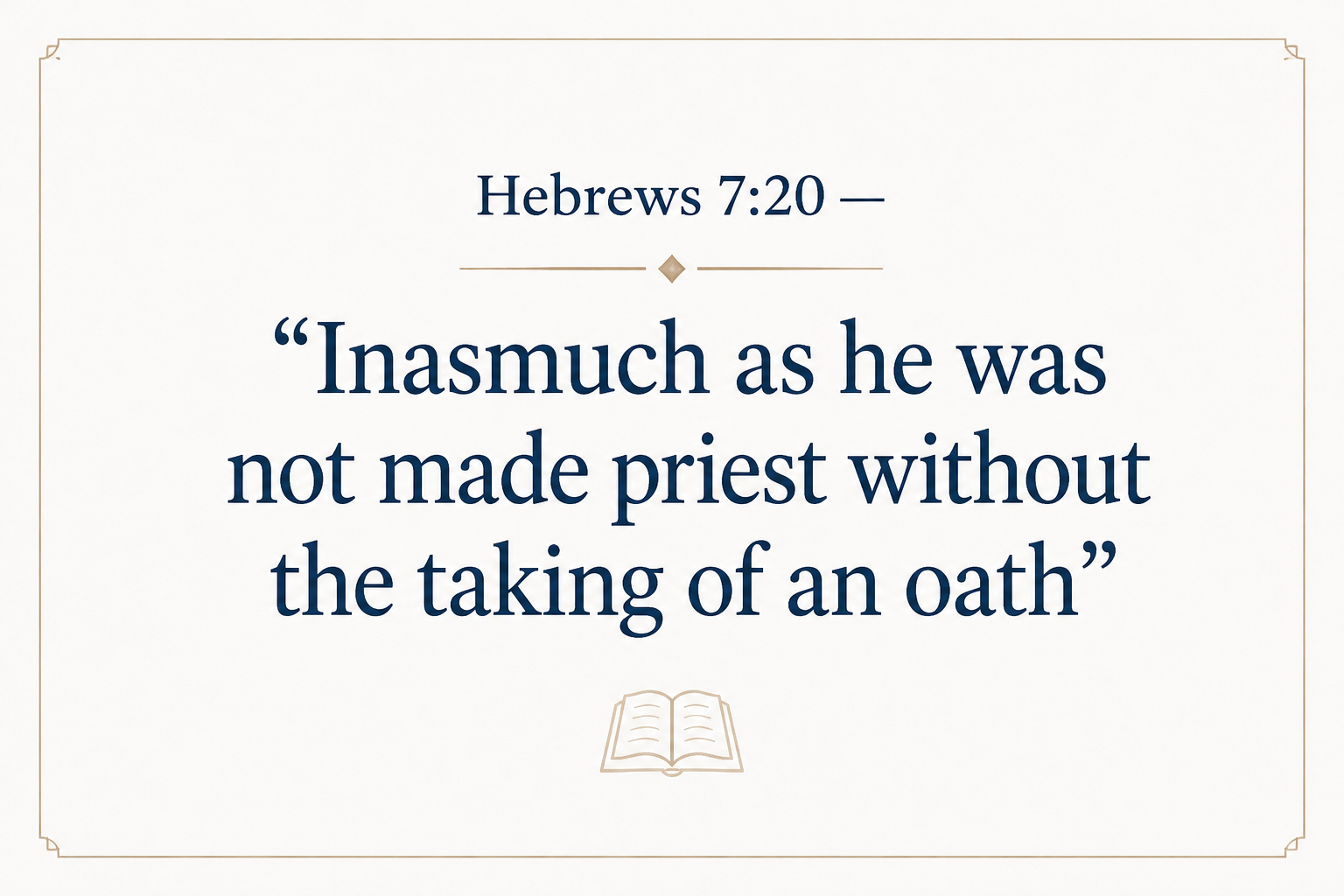
Hebrews 7:20 — “Inasmuch as he was not made priest without the taking of an oath”
Here ὁρκωμοσία is the stated condition attached to the making of a priest: the appointment is described as not occurring “without the taking of an oath.” The word highlights that something formal and binding accompanies the priestly installation in view. By putting the oath alongside the making of the priest, the sentence treats swearing as an essential feature of this particular appointment, not a mere accessory; the priesthood is framed as coming into being through an act of sworn declaration.
Hebrews 7:21 — “(for they indeed have been made priests without an oath), but he with an oath by him that says of him, “The Lord swore and will not change his mind, ‘You are a priest forever, according to the order of Melchizedek.’ ””
This occurrence places ὁρκωμοσία inside a contrast. On one side are priests “made priests without an oath”; on the other is one made priest “with an oath.” The text then specifies the speaker and content of that oath: “The Lord swore and will not change his mind,” followed by the declared outcome, “You are a priest forever.” In this scene, the word “oath” is not left abstract; it is immediately anchored in the divine act of swearing and in the statement of unchanging resolve. The oath functions as a public, spoken commitment that secures the permanence implied by “forever,” and the clause “will not change his mind” underscores the steadfastness attached to what is sworn.
Hebrews 7:28 — “For the law appoints men as high priests who have weakness, but the word of the oath which came after the law appoints a Son forever who has been perfected.”
In Hebrews 7:28, ὁρκωμοσία is linked to “the word of the oath.” The verse sets two appointing forces in parallel: “the law” appoints certain high priests, and “the word of the oath” appoints “a Son forever.” The oath is presented as having verbal form (“word”) and as having a temporal relationship (“came after the law”), and it is portrayed as active in appointing. Within the sentence, “word of the oath” stands as a decisive appointing utterance, contrasted with appointments of men “who have weakness.” The oath-related word is tied to an enduring result (“forever”) and to an outcome described as perfected, so the oath here functions as a spoken basis for an appointment with permanence and completeness in view.
Sense and Usage
Across these occurrences, “oath” is used as a defining feature of priestly appointment, not merely as a personal promise. In Hebrews 7 the oath is something “taken,” something by which a person is made priest, and something with identifiable speech-content (“The Lord swore…”; “the word of the oath”). The contrast between being made priest “without an oath” and “with an oath” shows that ὁρκωμοσία can mark an official act that differentiates one kind of appointment from another.
The word also carries the sense of a settled commitment attached to what is sworn. That is expressed directly when the oath is narrated: “The Lord swore and will not change his mind.” In these passages, the oath is presented not as uncertain or conditional but as fixed in intention and effect, supporting the claims of permanence (“forever”) that accompany the priesthood being discussed. Thus ὁρκωμοσία in Hebrews 7 is repeatedly placed where formal authorization and enduring validity are at stake: it is the sworn element that undergirds appointment and frames it as stable.
Finally, ὁρκωμοσία is closely associated with speech and proclamation in these verses. Hebrews 7:21 makes the oath audible by quoting it, and Hebrews 7:28 names it as a “word.” This usage emphasizes that the oath is not only an inward resolve but a declared statement that stands as a basis for what follows—here, a priesthood described in lasting terms.
Imagery in Hebrews
The imagery surrounding ὁρκωμοσία in Hebrews 7 is courtroom-like and declarative: an oath is taken, a speaker swears, a word appoints. The repeated pairing of “oath” with “made priest” and “appoints” portrays the oath as a solemn spoken act that establishes an office and secures its continuing force, especially where the text stresses “will not change his mind” and “forever.”
Sources: Lexical data from Strong’s Exhaustive Concordance and the Translators Brief Lexicon of Extended Strongs for Greek (STEPBible, CC BY). Occurrence data from the Translators Amalgamated Greek New Testament (STEPBible, CC BY). Scripture quotations from the World English Bible (public domain).




