Exploring the Meaning of Horion in Greek
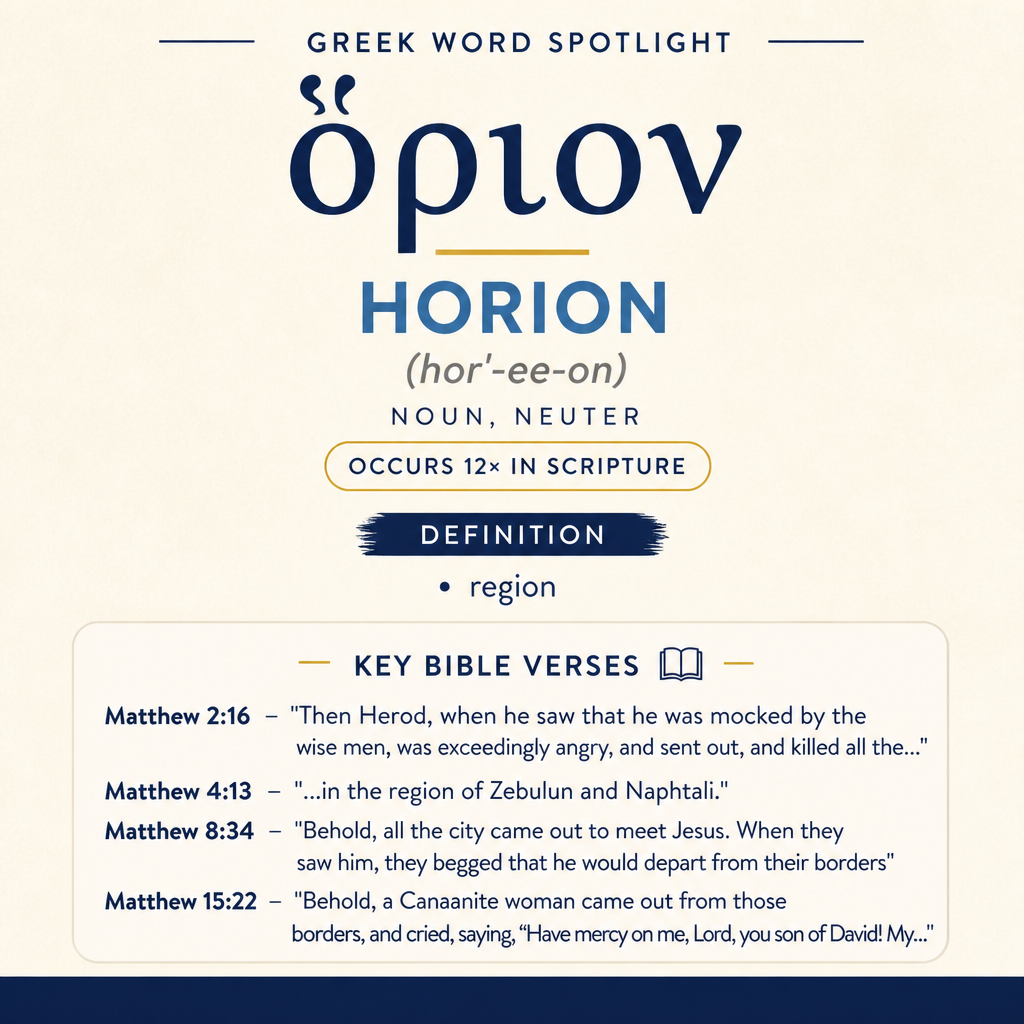
ὅριον means “region” and appears 12 times in Scripture, including several occurrences in Matthew and Mark.
Core Meaning
ὅριον is defined as “region.” In the listed verses, it is rendered as “region” or “borders.”
Learn More →Gospel Occurrences
It occurs in Matthew (2:16; 4:13; 8:34; 15:22; 15:39; 19:1) and Mark (5:17; 7:24). These references speak of geographic areas tied to places like Zebulun and Naphtali, Judea, Magdala, Tyre, and Sidon.
Learn More →Usage In Context
In Matthew 8:34 and Mark 5:17, people beg Jesus to depart from their region. In Matthew 15:39 and Matthew 19:1, it marks where Jesus traveled into particular borders.
Learn More →ὅριον means “region,” and in the New Testament it commonly marks the geographic setting where events unfold and where people move, gather, or draw lines of inclusion and exclusion. In the passages where it appears, it frames journeys, the reach of authority, and the felt edges of community space.
Occurrences
Matthew 2:16 — “Then Herod, when he saw that he was mocked by the wise men, was exceedingly angry, and sent out, and killed all the male children who were in Bethlehem and in all the surrounding countryside, from two years old and under, according to the exact time which he had learned from the wise men.”
Here ὅριον locates the violence not only “in Bethlehem” but extending outward into “all the surrounding countryside.” The word widens the scene from a town-center action to a broader area around it, emphasizing the extent of Herod’s reach as it spreads across the region connected to Bethlehem.
Matthew 4:13 — “Leaving Nazareth, he came and lived in Capernaum, which is by the sea, in the region of Zebulun and Naphtali,”
In this transition, ὅριον situates Capernaum within a named regional frame: “the region of Zebulun and Naphtali.” The narrative uses regional identification to anchor Jesus’ relocation, describing not merely a point on a map (“by the sea”) but the larger area to which the town belongs.
Matthew 8:34 — “Behold, all the city came out to meet Jesus. When they saw him, they begged that he would depart from their borders.”
Here ὅριον appears as “their borders,” highlighting the community’s desire to have Jesus leave the space they consider their own. The word marks a boundary of regional belonging: the city collectively meets him and then asks for his departure beyond the limits of their region.
Matthew 15:22 — “Behold, a Canaanite woman came out from those borders, and cried, saying, “Have mercy on me, Lord, you son of David! My daughter is severely possessed by a demon!””
ὅριον describes the setting from which the woman comes: she comes “out from those borders.” The word draws attention to movement across a regional edge—she emerges from a defined area into the place where Jesus is, and her plea begins at that threshold of regions.
Matthew 15:39 — “Then he sent away the multitudes, got into the boat, and came into the borders of Magdala.”
This travel notice uses ὅριον to name a destination as a region: “the borders of Magdala.” The wording presents arrival not only at a single locality but into the area associated with Magdala, setting the next stage of the narrative within that regional space.
Matthew 19:1 — “When Jesus had finished these words, he departed from Galilee, and came into the borders of Judea beyond the Jordan.”
ὅριον marks the shift from one broad area (“Galilee”) to another (“the borders of Judea beyond the Jordan”). The phrase combines region-language with a directional locator (“beyond the Jordan”), portraying a move into a recognizable territorial area, not merely to an isolated point.
Mark 5:17 — “They began to beg him to depart from their region.”
As in Matthew 8:34, ὅριον describes the space the people claim as “their region.” Their request is spatial: they want Jesus removed from the area they inhabit and control. The word sharpens the social action of begging by specifying the object of the request—his absence from their regional domain.
Mark 7:24 — “From there he arose, and went away into the borders of Tyre and Sidon. He entered into a house, and didn’t want anyone to know it, but he couldn’t escape notice.”
ὅριον functions as a travel boundary marker, “into the borders of Tyre and Sidon.” The narrative then contrasts intended privacy (“didn’t want anyone to know it”) with the reality of being noticed. The regional label helps the reader track the move into a distinct area, while the subsequent house-scene unfolds within that regional setting.
Mark 7:31 — “Again he departed from the borders of Tyre and Sidon, and came to the sea of Galilee, through the middle of the region of Decapolis.”
This verse uses ὅριον twice in the flow of movement: departure “from the borders of Tyre and Sidon” and travel “through the middle of the region of Decapolis.” The word supports a route description, presenting regions as traversable spaces with edges (borders) and interiors (“the middle”), and it positions the journey as moving through defined regional fields on the way to “the sea of Galilee.”
Mark 10:1 — “He arose from there and came into the borders of Judea and beyond the Jordan. Multitudes came together to him again. As he usually did, he was again teaching them.”
Here ὅριον again introduces a new setting—“the borders of Judea and beyond the Jordan”—and the story immediately shows what happens in that region: “Multitudes came together to him again,” and he teaches. The regional marker therefore does more than locate; it frames a context in which gathering and instruction occur.
Acts 13:50 — “But the Jews stirred up the devout and prominent women and the chief men of the city, and stirred up a persecution against Paul and Barnabas, and threw them out of their borders.”
In Acts, ὅριον appears with civic force: Paul and Barnabas are “threw… out of their borders.” The word delineates the space from which the missionaries are expelled, conveying a decisive exclusion—removal beyond the region’s limits as part of an organized persecution involving “the chief men of the city.”

Sense and Usage
Across these passages, ὅριον consistently organizes space as a recognizable region with an “inside” that can be entered, inhabited, traversed, or left, and an “outside” beyond its limits. It frequently appears with verbs of movement: people come “into” a region (Matthew 15:39; Matthew 19:1; Mark 7:24; Mark 10:1), depart “from” it (Mark 7:31), or are forced out of it (Acts 13:50). This regular pairing with motion makes the word a narrative tool for tracking transitions in place and for segmenting the storyline into geographic scenes.
The word also carries a social dimension in the way regions are possessed or defended. In Matthew 8:34 and Mark 5:17 the people ask Jesus to depart from “their” region; in Acts 13:50 the city’s leadership drives Paul and Barnabas out of “their borders.” In both cases, the region is treated as controlled space, a communal area with boundaries that can be policed by request or by force. ὅριον thus supplies a vocabulary for exclusion: it gives language to the idea that someone’s presence can be unwelcome within a defined region and that the appropriate remedy, in the eyes of the locals, is removal beyond the border.
At other times ὅριον serves primarily to situate a setting within a larger geographic identity. Matthew 4:13 places Capernaum in “the region of Zebulun and Naphtali,” and Matthew 19:1 / Mark 10:1 speak of “the borders of Judea beyond the Jordan.” These uses show how regions can be named and recognized, not merely as vague surroundings but as established areas that can be referenced for orientation. Mark 7:31 adds an internal perspective—travel “through the middle of the region of Decapolis”—showing that a region can be conceived not only by its edge (“borders”) but also by its interior space, the part one passes through en route to another destination.
Finally, ὅριον can widen the scope of action beyond a single town. In Matthew 2:16, the mention of “all the surrounding countryside” makes the scene broader and more sweeping, extending the narrative impact outward from Bethlehem. In several of the travel summaries (Matthew 15:39; Mark 7:24; Mark 7:31), the word gives the reader a larger frame for what might otherwise be a terse itinerary. The region becomes the container for subsequent action—crowds gathering, teaching taking place, or privacy being sought and disrupted.
Regional Imagery
The recurring image attached to ὅριον in these texts is the edge of a place: a border that can be crossed (Matthew 15:22), entered (Mark 7:24), departed (Mark 7:31), or enforced (Acts 13:50). Regions in these narratives are not abstract map units; they are lived spaces where people meet, plead, travel, gather, and at times push others away. ὅριον gives the storyline a sense of shape—places have contours, and those contours matter for what happens within them and at their margins.
Sources: Lexical data from Strong’s Exhaustive Concordance and the Translators Brief Lexicon of Extended Strongs for Greek (STEPBible, CC BY). Occurrence data from the Translators Amalgamated Greek New Testament (STEPBible, CC BY). Scripture quotations from the World English Bible (public domain).