Exploring the Meaning of Homologoumenos in Greek
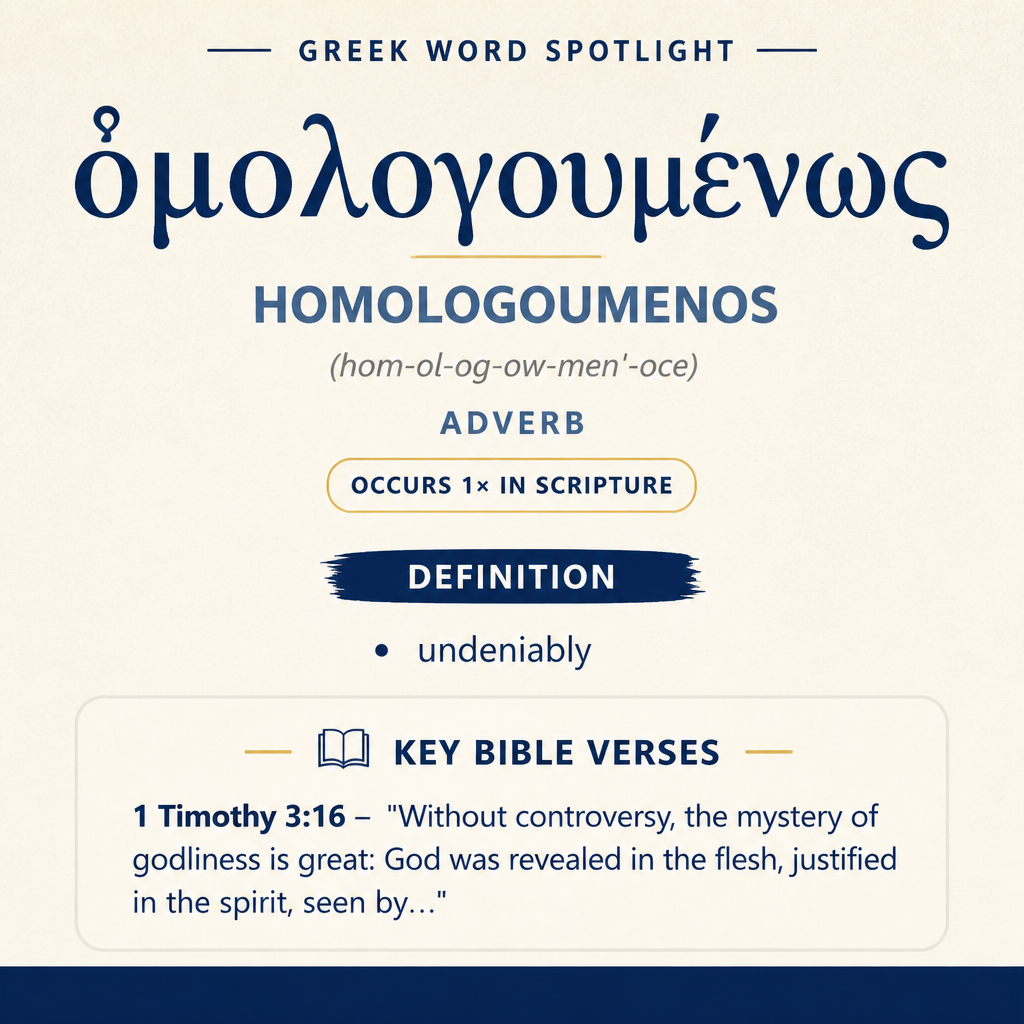
ὁμολογουμένως means “undeniably” and appears once in Scripture at 1 Timothy 3:16.
Scripture Occurrence
This word occurs one time in Scripture. Its single occurrence is in 1 Timothy 3:16.
Learn More →Verse Context
In 1 Timothy 3:16 it is rendered “Without controversy,” introducing the statement about “the mystery of godliness.”
Learn More →ὁμολογουμένως means “undeniably” and appears in a single New Testament verse, where it frames a compact confession about the “mystery of godliness.” In that setting it marks the statement as one that stands beyond dispute within the community being addressed.
Root and Related Words
ὁμολογουμένως is derived from homologeō (ὁμολογέω), “to confess/profess” (Strong’s G3670). As an adverbial form, it carries the force of what is acknowledged openly and agreed upon in confession.

Occurrences
“Without controversy, the mystery of godliness is great: God was revealed in the flesh, justified in the spirit, seen by angels, preached among the nations, believed on in the world, and received up in glory.” (1 Timothy 3:16)
Here ὁμολογουμένως functions as a framing adverb for the entire declaration that follows. The verse opens by establishing the manner in which the writer presents what comes next: not as a tentative proposal, but as something that is to be received as indisputable. That initial force (“Without controversy”) gives the sentence a public, communal tone—language suited to something recited, affirmed, or held as a shared confession.
Because the statement is introduced as undeniable, the reader is prepared for a summary that does not argue its points but announces them. The verse then moves through a sequence of affirmations: “revealed in the flesh,” “justified in the spirit,” “seen by angels,” “preached among the nations,” “believed on in the world,” and “received up in glory.” ὁμολογουμένως does not alter the content of any single clause; rather, it sets the rhetorical posture for the whole series. Each clause is presented as belonging to a unified “mystery of godliness” that is “great,” and the adverb underscores that this greatness is being asserted as a settled conviction rather than a contested claim.
The placement at the head of the verse is significant for how the passage reads. The adverb does not merely strengthen one adjective (“great”) or one event (“revealed,” “preached,” “received”); it signals that the confession as a whole is being set forth as something that stands. In effect, it invites the reader to hear the following lines in the register of agreed testimony: a compact recital of what is confessed about God’s action and recognition (“seen by angels”), God’s proclamation (“preached among the nations”), God’s reception (“believed on in the world”), and God’s exaltation (“received up in glory”).
Sense and Usage
The definition “undeniably” fits this context by marking the statement as beyond dispute. In 1 Timothy 3:16 the adverb establishes a tone of certainty that precedes and governs the confession-like sequence. It does not contribute new factual content; it governs how the content is to be taken—namely, as something that is to be acknowledged rather than debated.
In this verse, the word’s force also interacts with the noun “mystery.” A “mystery” can suggest something that requires disclosure, and the passage immediately speaks of revelation (“God was revealed in the flesh”). ὁμολογουμένως does not redefine “mystery,” but it clarifies the stance of the speaker toward it: whatever is called “the mystery of godliness” is not being treated as uncertain. The adverb places the confession in the category of accepted proclamation—something that can be stated plainly because it is already confessed as true.
The series of clauses that follows is tightly linked by rhythm and parallel structure, moving from manifestation to vindication, witness, proclamation, belief, and reception in glory. “Undeniably” signals that this chain is not offered as a speculative interpretation of events but as a cohesive summary that the community is meant to recognize. In that way the adverb functions like a hinge between the community’s shared acknowledgment and the content of what is acknowledged: it bridges confession and recital.
Because the passage itself contains no explicit opponents or objections, the adverb’s value is not in rebuttal but in affirmation. It establishes that the confession stands on common ground: the mystery is “great,” and that greatness is introduced as uncontested. The result is a line that reads as a formal declaration—one whose authority is asserted by the manner of its introduction (“Without controversy”) and reinforced by its compact, declarative clauses.
Imagery in Context
Although ὁμολογουμένως is an adverb, it carries a distinct kind of verbal imagery in this verse: the atmosphere of an uncontested confession spoken aloud. The word sets the scene for a statement that moves across realms—flesh and spirit, angels, nations, the world, and glory—while maintaining the same unargued certainty from start to finish. The confession’s sweep is broad, and “undeniably” marks that sweep as something to be received with settled agreement rather than hesitation.
Sources: Lexical data from Strong’s Exhaustive Concordance and the Translators Brief Lexicon of Extended Strongs for Greek (STEPBible, CC BY). Occurrence data from the Translators Amalgamated Greek New Testament (STEPBible, CC BY). Scripture quotations from the World English Bible (public domain).