
Exploring the Meaning of Helisso in Greek
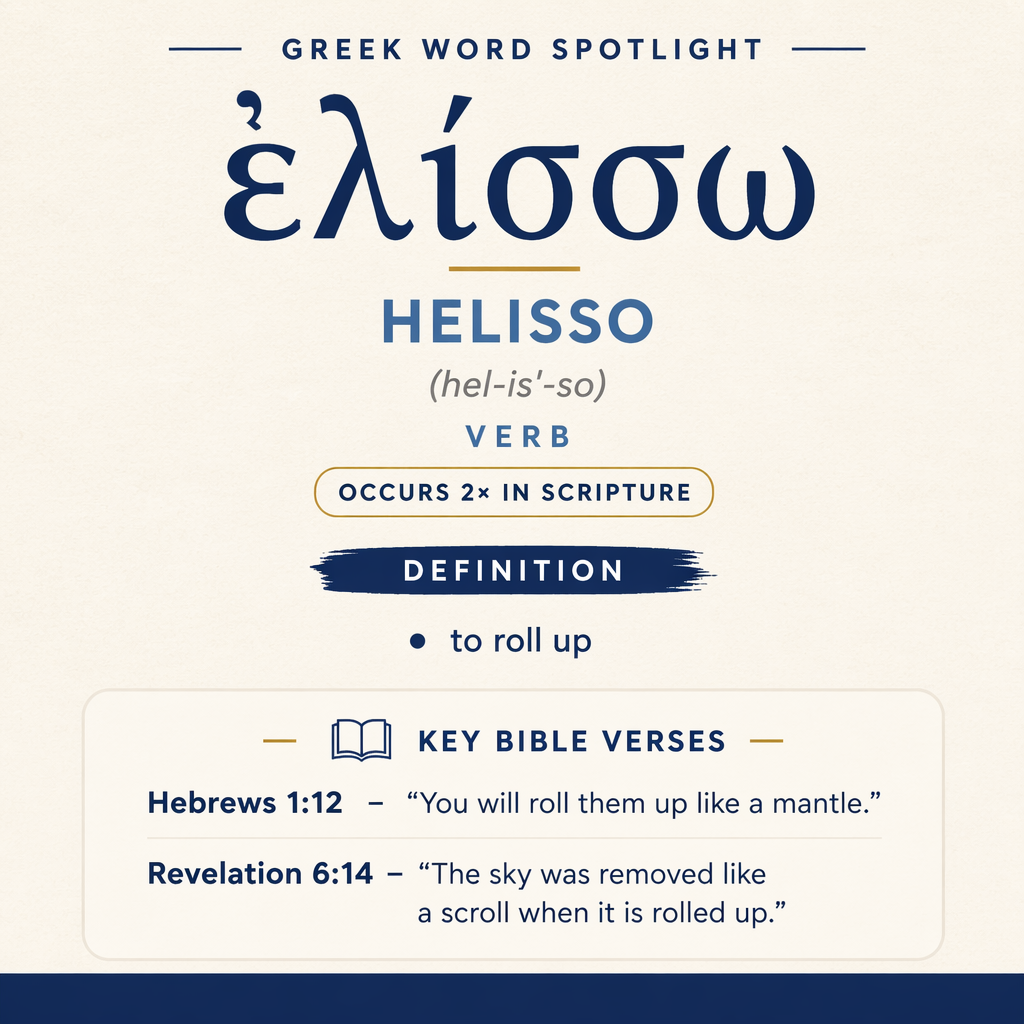
ἑλίσσω means “to roll up” and appears in Hebrews 1:12 and Revelation 6:14.
Biblical Occurrences
It occurs 2 times in Scripture: Hebrews 1:12 and Revelation 6:14.
Learn More →Textual Imagery
Hebrews 1:12 speaks of rolling them up like a mantle. Revelation 6:14 describes the sky removed like a scroll when rolled up.
Learn More →ἑλίσσω means “to roll up.” It appears in two striking images: the Son “roll[ing]” creation “up like a mantle” (Hebrews 1:12) and the sky being removed “like a scroll” as it is “rolled up” (Revelation 6:14).
Root and Related Words
ἑλίσσω (Helisso) derives from the related verb εἱλίσσω (heilisso), “to roll up” (Strong’s G1507).

Occurrences
“You will roll them up like a mantle, and they will be changed; but you are the same. Your years won’t fail.” (Hebrews 1:12)
Here ἑλίσσω is framed as a deliberate action performed on “them,” immediately followed by the result: “and they will be changed.” The comparison “like a mantle” places the verb in the world of handling a garment—something flexible that can be gathered and folded in on itself. The sentence sets two realities side by side: what can be rolled up and altered, and the one addressed as unchanging: “but you are the same. Your years won’t fail.” In this context, the verb serves to highlight ease and decisiveness: just as a mantle can be rolled up by hand, so “them” can be rolled up, with change as the outcome. The image does not linger on the mechanics of folding; it uses the familiar gesture of rolling fabric to express the transition of what is subject to alteration.

“The sky was removed like a scroll when it is rolled up. Every mountain and island were moved out of their places.” (Revelation 6:14)
In Revelation, ἑλίσσω belongs to a scene of cosmic displacement. The line ties “removed” to a vivid comparison: “like a scroll when it is rolled up.” A scroll, unlike a flat codex page, is taken out of view precisely by rolling; the comparison makes “removal” concrete by invoking a familiar object that disappears into its own winding. The verb therefore supplies a visual model for how the sky’s removal is to be imagined—not by tearing or fading, but by being taken up into a rolled state. The verse then widens the scale of upheaval: “Every mountain and island were moved out of their places.” The rolling-up image stands at the head of a chain of disruptions, presenting the sky’s change as part of a larger reordering of the visible world.
Sense and Usage
Across its two occurrences, ἑλίσσω consistently communicates a movement from spread-out visibility into gathered compactness. In Hebrews, what is rolled up is compared to a mantle: the act implies control over something that can be handled, gathered, and set aside, and the text links that act directly to transformation (“and they will be changed”). The gesture of rolling up functions as a picture of decisive transition: what is present in one form can be taken up and become other than it was.
In Revelation, the same action is applied by analogy to the sky. The scroll comparison supplies a specific way to conceive the sky’s “removal.” Rolling up a scroll does not destroy it; it changes its state from open and readable to wound and out of view. That movement—from open expanse to rolled form—fits the verse’s language of removal while leaving the emphasis on the event’s effect: the sky is no longer in its former place as the scene moves forward into further dislocations (“Every mountain and island were moved out of their places”).
Because the verb appears in comparisons (“like a mantle,” “like a scroll”), its force in both passages is strongly imagistic. The act of rolling up is a concrete, graspable motion, and the comparisons anchor the reader’s imagination in everyday objects—garment and scroll—so that the described change can be pictured rather than merely asserted. In Hebrews, this imagery supports the contrast between what changes and the one who remains the same; in Revelation, it supports the portrayal of the sky’s removal as something that happens in a recognizable, almost tactile way, even as the scale is cosmic.
Imagery
The two settings together give ἑλίσσω a distinctive profile: a small human action (rolling up cloth, rolling up a scroll) used to speak about realities beyond ordinary scale. Hebrews uses the simplicity of rolling a mantle to intensify the contrast between created things that can be gathered up and changed, and the enduring sameness of the one addressed: “but you are the same. Your years won’t fail.” Revelation uses the same familiar motion to render an otherwise overwhelming event—“The sky was removed”—in a form the mind can picture: the expanse above becoming like a rolled scroll, followed by the moving of “Every mountain and island.”
Sources: Lexical data from Strong’s Exhaustive Concordance and the Translators Brief Lexicon of Extended Strongs for Greek (STEPBible, CC BY). Occurrence data from the Translators Amalgamated Greek New Testament (STEPBible, CC BY). Scripture quotations from the World English Bible (public domain).





