
Deciphering the Meaning of Halieuo in Greek
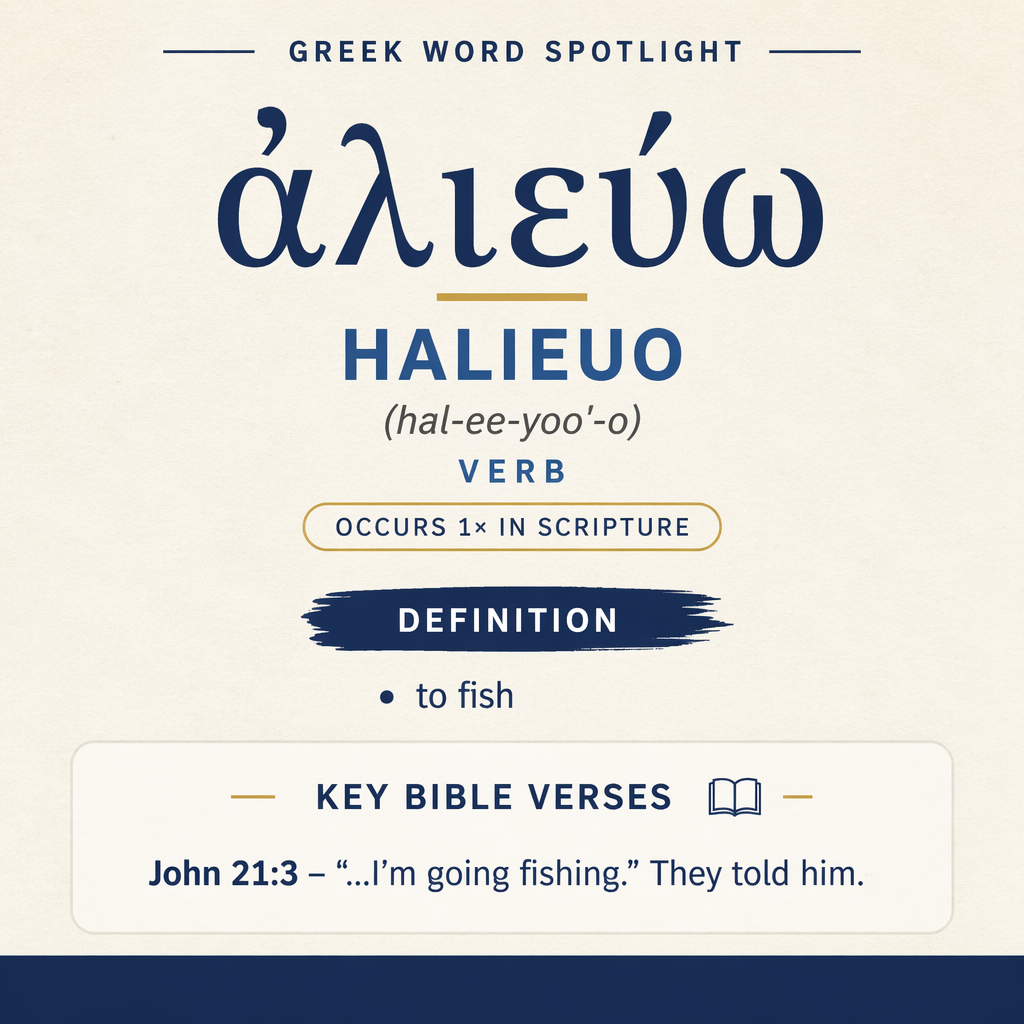
ἁλιεύω means “to fish” and appears once in Scripture, in John 21:3.
Biblical Occurrence
This verb occurs 1 time in Scripture. Its single occurrence is in John 21:3.
Learn More →Context in John
In John 21:3, Simon Peter says, “I’m going fishing.” The others respond, “We are also coming with you.”
Learn More →ἁλιεύω means “to fish” and appears in the closing scene of John, where Simon Peter announces his return to the work of the sea. In that brief line the verb frames the night’s activity and sets the stage for the outcome that follows.
Root and Related Words
ἁλιεύω is connected with the noun halieus (ἁλιεύς), “fisherman” (Strong’s G231). The verb expresses the characteristic action associated with the fisherman as a person.

Occurrences
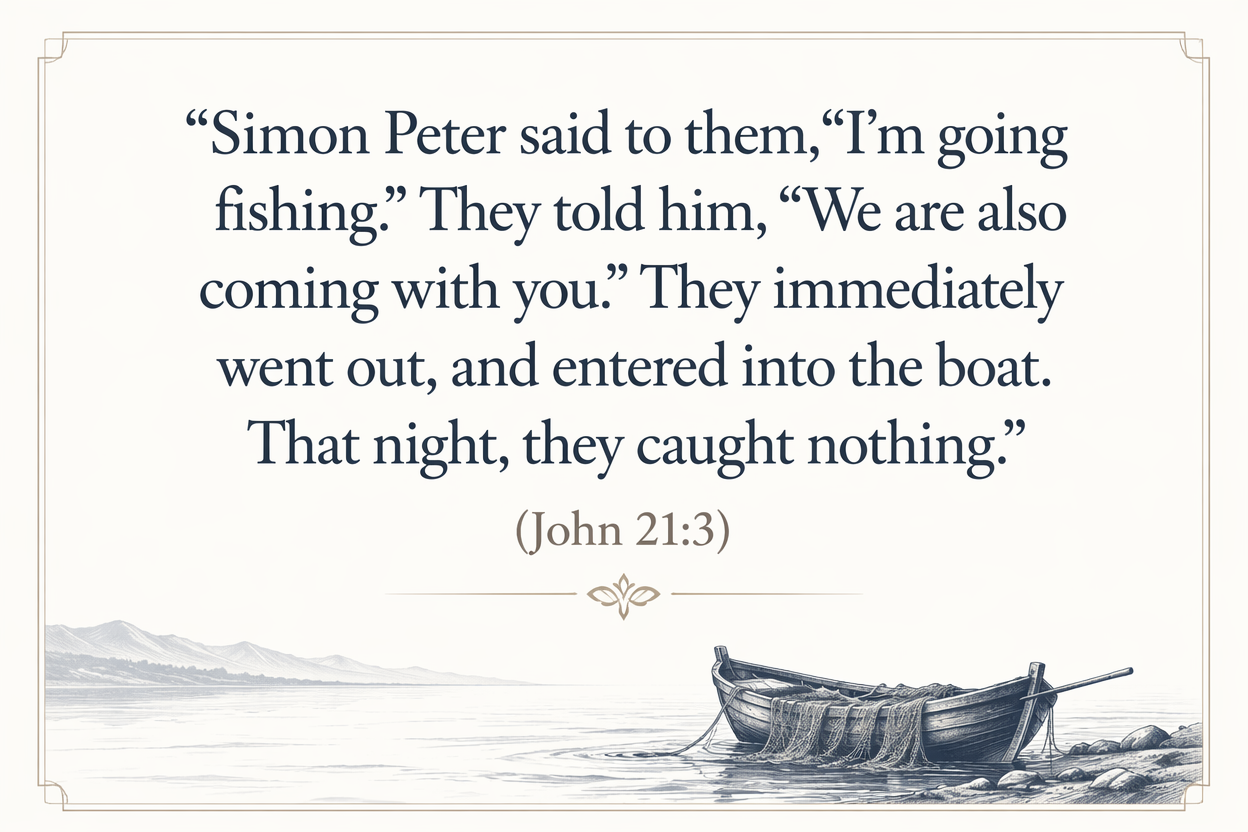
“Simon Peter said to them, “I’m going fishing.” They told him, “We are also coming with you.” They immediately went out, and entered into the boat. That night, they caught nothing.” (John 21:3)
Here ἁλιεύω is placed on Peter’s lips as a straightforward declaration of intent: “I’m going fishing.” The sentence is not only about a plan but about an identifiable kind of work—an activity that naturally leads to a boat, a nighttime outing, and the expectation of a catch. The verb gathers these implied elements into one compact statement, and the narrative immediately unfolds in steps that match the action: others join him (“We are also coming with you”), they depart without delay (“They immediately went out”), and they take the appropriate means (“entered into the boat”).
The verse then narrates the results of the fishing itself: “That night, they caught nothing.” Because the verb has already established that their purpose is to fish, the emptiness of the night becomes sharply defined: the action was carried out over the full span of “that night,” yet it produced no fish. In this scene, ἁλιεύω therefore sets the expectation of harvest from labor at sea, which the final clause overturns with a concise report of failure. The movement from intention (“going fishing”) to communal participation (“also coming with you”) to sustained effort (“that night”) to outcome (“caught nothing”) gives the verb a narrative weight beyond mere description; it anchors the whole episode’s activity and makes the final disappointment intelligible.
Sense and Usage
The definition “to fish” in John 21:3 is expressed as an immediate, practical choice and as an organized undertaking: it is something one can decide to do, invite others into, and perform with the ordinary equipment of the task. The surrounding clauses show how the verb operates in real life: it implies going out, embarking in a boat, and working through the night with the aim of catching. Within the verse, fishing is not presented as a momentary gesture but as a sustained labor that naturally seeks a tangible result.
At the same time, the verse’s final report—“they caught nothing”—clarifies that the action denoted by ἁλιεύω does not guarantee success. The verb describes the activity itself, while the narrative distinguishes between doing the work and receiving the catch. That distinction is important for the way the verse reads: the group fully participates in the fishing (they go, they enter the boat, they spend the night), yet the expected product does not materialize. Thus, in this attested use, ἁλιεύω carries the ordinary sense of the task while leaving room for the story to comment on its outcome by separate wording.
Because the verb is introduced as direct speech (“Simon Peter said to them”), its force is also interpersonal: it becomes a summons of sorts, prompting an immediate response and shared action. The others’ reply mirrors the practicality of the verb—fishing is something they can join without explanation—and the sequence “They immediately went out” depicts it as a familiar routine that can be resumed at once. Even without any added description of method, the verb supplies enough specificity to explain why a boat is involved and why the time frame is “that night.”
Imagery
In John 21:3 the imagery of ἁλιεύω is plain and physical: leaving shore, entering a boat, and working through darkness toward the hoped-for catch. The stark line “they caught nothing” leaves the picture of empty hands after a full night on the water, an image of effort expended without the reward that fishing ordinarily seeks.
Sources: Lexical data from Strong’s Exhaustive Concordance and the Translators Brief Lexicon of Extended Strongs for Greek (STEPBible, CC BY). Occurrence data from the Translators Amalgamated Greek New Testament (STEPBible, CC BY). Scripture quotations from the World English Bible (public domain).





