Exploring the Meaning of Glossokomon in Greek
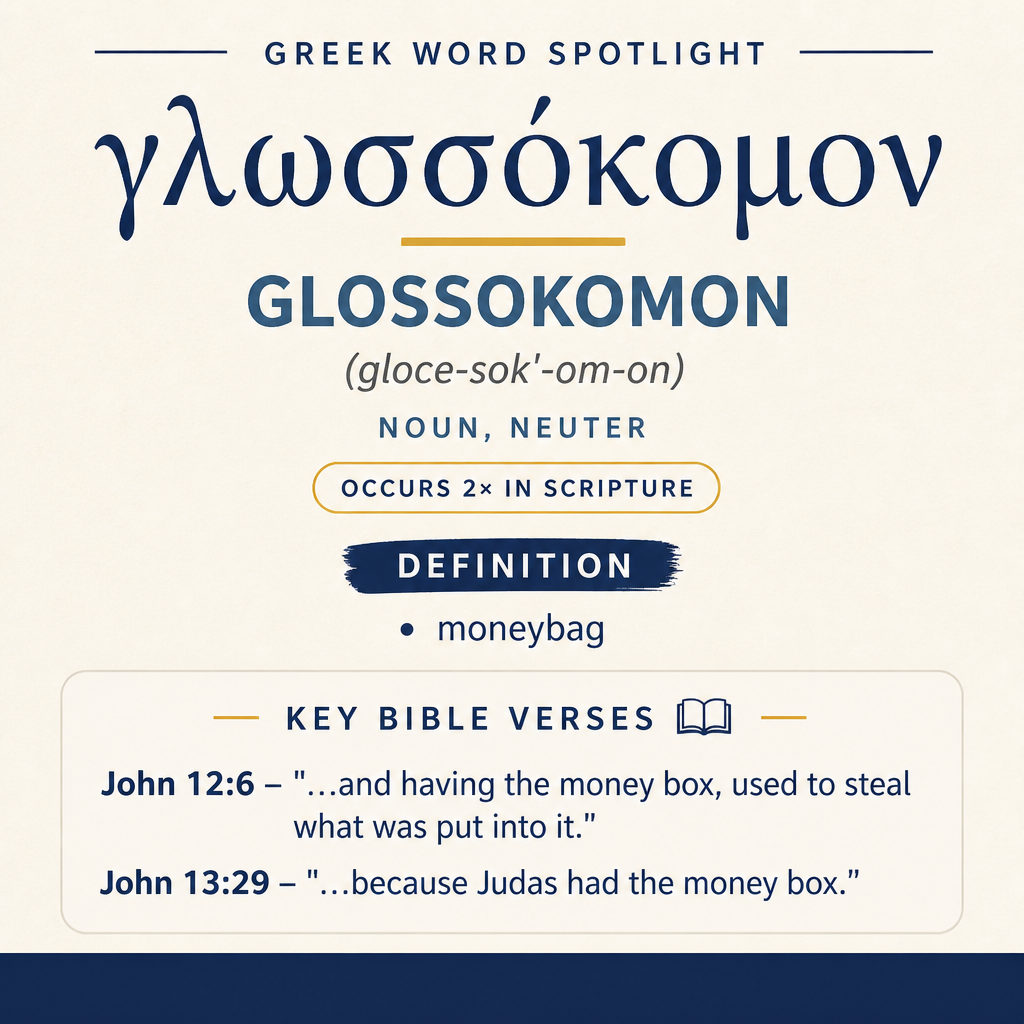
γλωσσόκομον means “moneybag” and appears twice in Scripture, in John 12:6 and John 13:29.
Johannine Usage
In John 12:6, Judas has the money box and used to steal from it. In John 13:29, some assumed Judas was told to buy what was needed for the feast because he had it.
Learn More →Occurrences
This word occurs 2 times in Scripture. Both occurrences are in the Gospel of John.
Learn More →γλωσσόκομον means “moneybag” and appears in two scenes in John’s Gospel, each connected with Judas and the group’s shared funds. In both places it functions as a concrete object that explains how purchases and gifts to the poor might be handled within Jesus’ circle.
Root and Related Words
γλωσσόκομον is connected (per Strong’s) with γλῶσσα (glōssa, “tongue,” Strong’s G1100) and κόσμος (kosmos, “world,” Strong’s G2889). These related terms help situate the word within Greek word-formation, where compounds can link distinct ideas into a single item-name.

Occurrences
“Now he said this, not because he cared for the poor, but because he was a thief, and having the money box, used to steal what was put into it.” (John 12:6)
Here γλωσσόκομον names the group’s money-holding container, described as something Judas “had,” in the sense of being its handler or custodian. The verse places the object in a moral and practical frame: it is the receptacle for funds (“what was put into it”), and its very function—receiving deposits—creates an opportunity for misuse. The narrative logic of the sentence depends on the moneybag being a recognized point of access: the explanation of Judas’s speech and motives turns on the fact that he controlled the container into which contributions were placed. The word therefore anchors the statement in an ordinary administrative reality (shared funds are collected and stored) even as it exposes the vulnerability of that arrangement when entrusted to someone acting dishonestly.
The phrasing also highlights the moneybag’s role as a boundary object between intention and action. The verse contrasts a stated concern (“he cared for the poor”) with an underlying practice (“used to steal what was put into it”). The moneybag is the hinge: it is the means by which talk about the poor can be weaponized into a cover story, because money for the poor would naturally be associated with what the bag contains. By naming the container explicitly, the text makes the mechanism of theft concrete—stealing is not an abstract vice but a repeated taking from a specific place where the community’s resources accumulate.
“For some thought, because Judas had the money box, that Jesus said to him, “Buy what things we need for the feast,” or that he should give something to the poor.” (John 13:29)
In this later scene, γλωσσόκομον again appears as the reason certain listeners draw their inference. The verse reports a chain of reasoning: “because Judas had the money box,” some assumed that a directive to him would concern ordinary financial tasks. Two possibilities are mentioned, both of which presuppose that the moneybag serves as the practical channel for spending and giving: purchasing needed items “for the feast” and giving “something to the poor.” The word thus carries explanatory force: it supplies the social context that makes the bystanders’ misunderstanding plausible.
Within the verse, the moneybag sits at the intersection of communal logistics and charitable expectation. The first assumption (“Buy what things we need for the feast”) presents the bag as funding routine necessities; the second (“give something to the poor”) presents it as the source from which alms could be distributed. By naming the object rather than merely stating that Judas was in charge of money, the text keeps the reader’s attention on the concrete instrument through which these actions would occur. The moneybag is not presented as incidental property but as part of how the group’s life is organized: needs arise, purchases are made, and assistance may be given, all through the funds associated with this container.
Sense and Usage
Across John 12:6 and John 13:29, γλωσσόκομον functions as a straightforward term for a container of money within a traveling circle. Its presence in the narrative establishes that the group’s finances were handled in an identifiable, centralized way: money is “put into it,” and one person “had” it. This setup makes sense of several kinds of action without additional explanation—receiving contributions, paying for necessities, and making gifts to the poor—because a moneybag is the natural locus for all of those transactions.
At the same time, the two occurrences show how a single object can bear different narrative weight depending on context. In John 12:6 the moneybag is tied to hidden wrongdoing; it is the place from which theft occurs. The object’s role is largely retrospective and diagnostic: it helps explain character and motive, linking speech about the poor to a pattern of stealing. In John 13:29 the moneybag is tied to public expectation; it is the basis for what “some thought” Jesus meant. Here the object’s role is prospective and practical: it frames plausible tasks that might be assigned to its holder at a moment of preparation for a feast or charitable giving.
These uses also show how γλωσσόκομον can carry an implied social script. If someone “has the money box,” others naturally assume he will be the one to purchase supplies or distribute funds. The word therefore signals an assigned responsibility within the group. That implied responsibility cuts both ways in the two passages: it enables ordinary care (meeting needs, giving to the poor) and, when held by a thief, it enables exploitation (stealing what is placed inside). The word’s sense stays concrete, but the surrounding clauses determine whether the emphasis falls on stewardship, suspicion, or mistaken interpretation.
Finally, in both verses the moneybag is connected with “the poor,” though in different ways. John 12:6 sets “the poor” in a contrast between professed concern and actual theft; the moneybag is the channel through which the theft is carried out. John 13:29 presents giving to the poor as an expected and reasonable use of the funds; the moneybag is the presumed source for such a gift. Without expanding the word beyond its definition, the two contexts show that the container’s contents are socially meaningful: money in the bag is not only for internal expenses but is also thought of as potentially available for acts of generosity.
Imagery
In these Johannine scenes, γλωσσόκομον evokes a small but weighty object: a shared repository whose contents can be added to (“what was put into it”) and drawn from for competing ends. It can sit quietly within the group’s daily life as the means of purchase and giving, yet the same object can become the unseen site of recurring theft, and the silent reason others misread what is happening around them.
Sources: Lexical data from Strong’s Exhaustive Concordance and the Translators Brief Lexicon of Extended Strongs for Greek (STEPBible, CC BY). Occurrence data from the Translators Amalgamated Greek New Testament (STEPBible, CC BY). Scripture quotations from the World English Bible (public domain).