
Exploring the Meaning of Gennetos in Greek
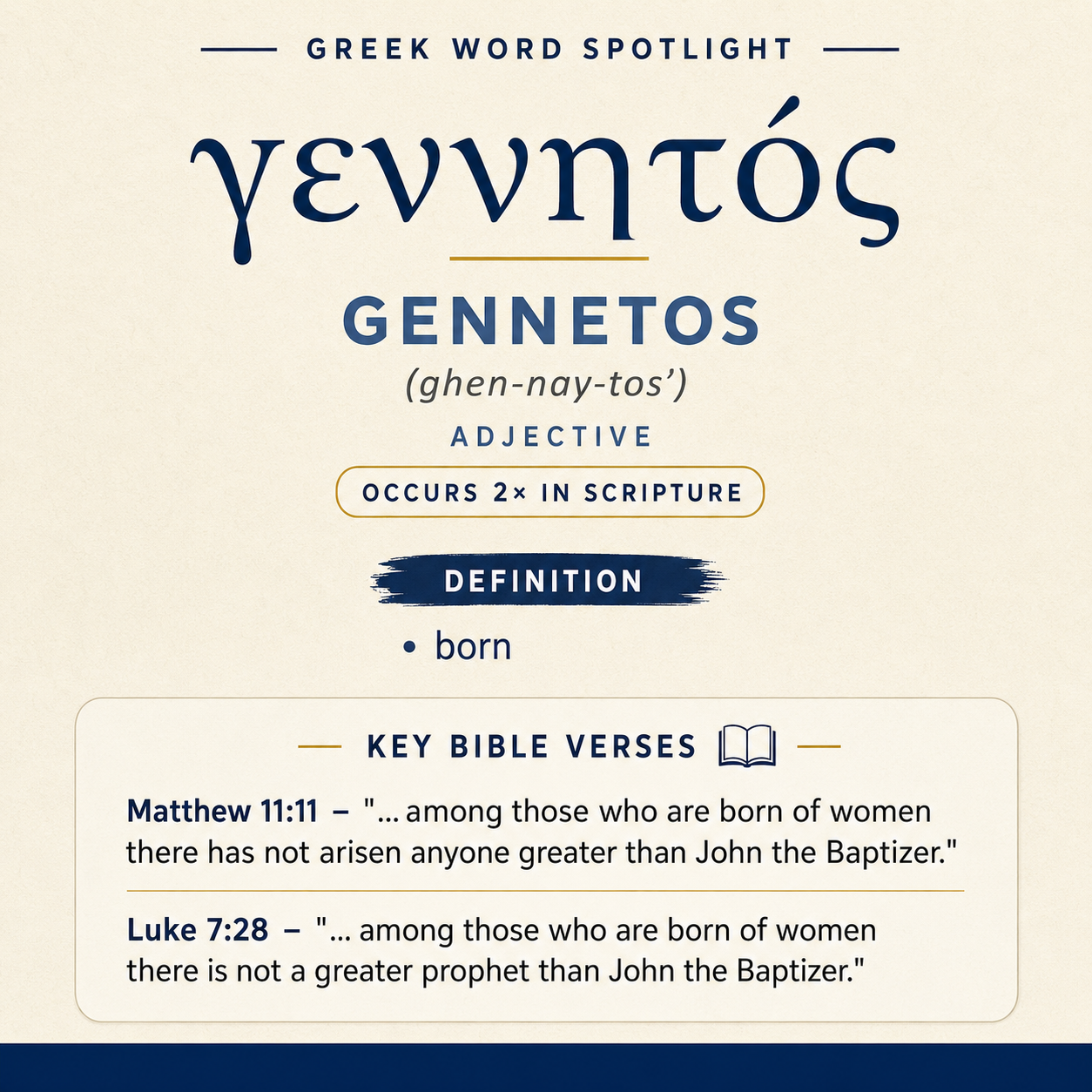
γεννητός means “born” and appears in Matthew 11:11 and Luke 7:28.
Scripture Occurrences
γεννητός occurs 2 times in Scripture: Matthew 11:11 and Luke 7:28.
Learn More →Context In Verses
Both verses use it in the phrase “born of women” in sayings about John the Baptizer.
Learn More →γεννητός means “born,” and it appears in two sayings of Jesus that compare John the Baptizer with the least member of the Kingdom. In both contexts the word marks out the shared human condition “of women,” setting a baseline from which a further Kingdom comparison is made.
Root and Related Words
γεννητός is related to the verb gennaō (γεννάω), “to beget” (Strong’s G1080). The adjective form frames the idea of being “born” as a describable state or category, suitable for grouping people under a common description.

Occurrences
“Most certainly I tell you, among those who are born of women there has not arisen anyone greater than John the Baptizer; yet he who is least in the Kingdom of Heaven is greater than he.” (Matthew 11:11)
Here γεννητός functions inside a broad qualifier: “among those who are born of women.” The phrase does more than locate John’s origin; it gathers a whole class of people under a single, ordinary marker of human birth. Within that class, Jesus gives a superlative assessment—“there has not arisen anyone greater than John the Baptizer.” The word “born” therefore helps establish the scale of comparison: John is measured against the entire range of those who share this human beginning. Against that large backdrop, the saying turns sharply to “yet,” introducing a different reference point—“he who is least in the Kingdom of Heaven.” The first clause uses γεννητός to set the widest possible human field; the second clause contrasts that field with Kingdom standing, where even the “least” is said to be “greater than he.” In this setting, “born” is the ordinary boundary marker for human life, while the Kingdom introduces a different order of evaluation.
“For I tell you, among those who are born of women there is not a greater prophet than John the Baptizer, yet he who is least in God’s Kingdom is greater than he.” (Luke 7:28)
Luke’s wording parallels Matthew’s but tightens the comparison by naming John’s role: “there is not a greater prophet than John the Baptizer.” γεννητός again appears in the same grouping phrase, “among those who are born of women,” defining the pool from which the comparison is drawn. It places John within the realm of human birth and human vocation, including the highest prophetic stature. The word “born” anchors the statement in a universally shared entry into life—“of women”—so that John’s greatness is described as the peak within that familiar human category. As in Matthew, the contrast arrives with “yet,” shifting from human categories (even the prophetic pinnacle) to “God’s Kingdom,” where the least person within that sphere is declared “greater than he.” In this scene, “born” supplies the common denominator that makes the claim expansive: the assessment spans everyone encompassed by the phrase, not a narrow subset.
Sense and Usage
Across these two sayings, “born” is used as a descriptive label that sorts people by the manner of their beginning: “born of women.” The phrasing is deliberately broad and concrete. It does not spotlight exceptional births or unusual origins; it points to what is shared, ordinary, and recognizable. That makes the superlative about John (“not arisen anyone greater” / “not a greater prophet”) rhetorically weighty, because it places him at the summit of an immense, inclusive category defined by birth.
At the same time, the sayings do not leave “born” as the ultimate frame for understanding greatness. In both texts the category “born of women” serves as the first horizon of comparison, and then the Kingdom clause revises the scale. The point is not that “born” is irrelevant; rather, it is the starting set against which the surprising Kingdom claim is heard. By setting John’s rank within the class of the “born,” the statements make clear how strong the contrast is when the least in the Kingdom is called greater than John. γεννητός thus helps the sayings move from what can be measured within human life to a second, Kingdom-centered measure that overturns expectations built on human birth and human accomplishment.
The repeated construction “among those who are born of women” also gives the word a collective force. It is not merely an individual descriptor (“John is born”) but a way to speak about populations and comparisons (“among those who are born…”). In these uses, “born” is the shared human baseline: it gathers many into one class so that a single person (John) can be located within it, and then the whole class can be contrasted with the Kingdom.
Imagery
The imagery of γεννητός in these passages is domestic and bodily—life beginning “of women”—and then immediately set alongside royal imagery: “the Kingdom of Heaven” and “God’s Kingdom.” The word “born” evokes the common entrance into human life, while the Kingdom language introduces a realm where greatness is recalculated. The sayings hold these images together so that the most exalted figure within the “born of women” class can still be surpassed by the least within the Kingdom.
Sources: Lexical data from Strong’s Exhaustive Concordance and the Translators Brief Lexicon of Extended Strongs for Greek (STEPBible, CC BY). Occurrence data from the Translators Amalgamated Greek New Testament (STEPBible, CC BY). Scripture quotations from the World English Bible (public domain).




