Understanding the Significance of Gadarenos in Greek
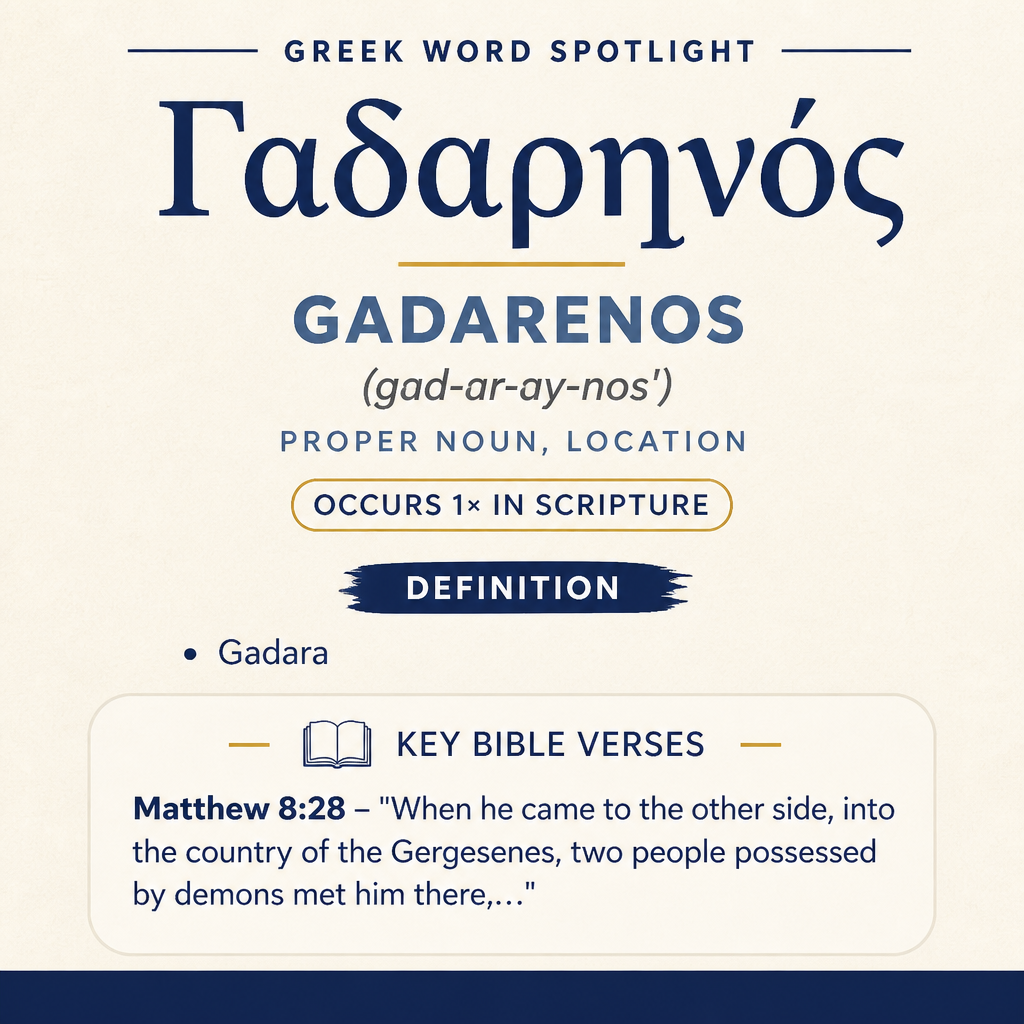
Γαδαρηνός (Gadarenos) means “Gadara” and appears once in Scripture, in Matthew 8:28.
Scripture Occurrence
It occurs 1 time in Scripture. The occurrence is in Matthew 8:28.
Learn More →Verse Context
In Matthew 8:28, it refers to a country on the other side where two demon-possessed people met Jesus.
Learn More →Γαδαρηνός refers to Gadara and appears once in the New Testament. In its single narrative setting, it functions as a geographic pointer that locates an episode immediately after a crossing “to the other side.”
Occurrences
“When he came to the other side, into the country of the Gergesenes, two people possessed by demons met him there, coming out of the tombs, exceedingly fierce, so that nobody could pass that way.” (Matthew 8:28)
Here Γαδαρηνός identifies a place—Gadara—within a larger regional description: “the country of the Gergesenes.” The wording frames the action as a transition in space (“to the other side”) followed by an arrival within a defined territory (“into the country”). That arrival is not presented as a neutral change of scenery. The place is immediately characterized by what happens there: “two people possessed by demons met him there,” and their presence is tied to a particular local feature—“coming out of the tombs.” In the scene as narrated, the toponym is part of the narrative’s staging: it marks the boundary across which the travel occurs, and it situates the encounter within a distinct locale that has become dangerous enough that “nobody could pass that way.”
The place-reference also helps shape the rhythm of the verse. The account moves from travel (“came to the other side”) to location (“into the country”) to confrontation (“met him there”). The toponym anchors the “there” that follows: the meeting is not abstract or merely incidental but located in a specific area, and the ensuing details about tombs and impassable passageways take on the force of a description of what this locality has come to represent within the story’s world.

Sense and Usage
As a proper place-name, Γαδαρηνός functions to specify where the narrated events occur rather than to describe an action or quality. Its defined sense, “Gadara,” is therefore realized by its ability to locate an episode precisely within the travel narrative: the subject “came to the other side” and is then placed within a named territory. The name’s narrative work is to make the episode geographically concrete—an encounter in a particular “country,” not an encounter in an undefined space.
In Matthew 8:28, this concreteness matters because the verse emphasizes spatial and social constraints. The demon-possessed individuals are associated with the tombs, and their fierceness affects movement through the area: “so that nobody could pass that way.” A named place in such a context does more than fill in a map; it sets the episode within a recognizable kind of human landscape—one where routes exist, where people ordinarily pass, and where the normal patterns of travel have been disrupted. The place-name thus supports the sense of crossing into a region marked by danger and exclusion, as measured by the inability of ordinary travelers to go through.
The verse also juxtaposes broad and specific spatial terms: “the other side” (a relative description), “the country” (a regional label), and “the tombs” (a particular feature within the area). Γαδαρηνός belongs to that middle layer of spatial reference—more definite than “the other side,” yet still describing a larger territory than a single landmark. Within the narrative, this layered geography helps the reader follow the movement from one side to another and then into a particular locality where the immediate confrontation occurs.
Because it is a proper noun for a location, Γαδαρηνός also carries the typical discourse function of place-names in narrative: it can signal that what follows is an event attached to a specific setting. In Matthew 8:28, the setting is not described in scenic terms (fields, streets, or buildings), but by its human and ritual margins (“tombs”) and by the social consequence of fear (“nobody could pass that way”). The place-name stands at the threshold of these descriptions and helps the verse read as the report of something that happened in a particular territory rather than as a generalized statement about danger.
Imagery
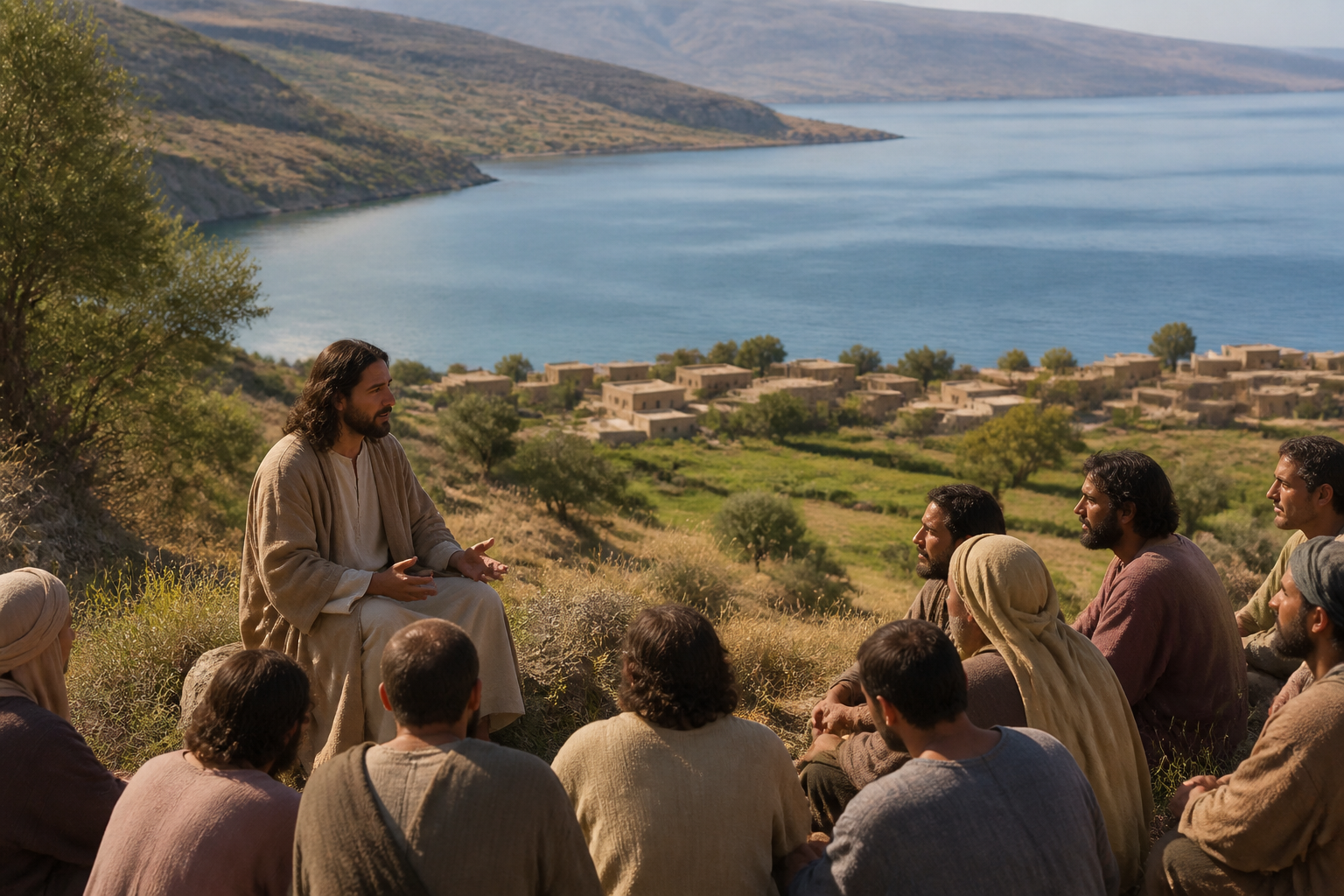
The lone occurrence of Γαδαρηνός is bound to a stark picture: arrival in a named “country,” a sudden meeting, and figures emerging “out of the tombs,” with the result that a route has become impassable. The name Gadara is therefore linked, in this passage, to the imagery of a border crossed, a locality entered, and a landscape whose tombs and fearsome inhabitants define what “there” feels like for anyone who would pass by.
Sources: Lexical data from Strong’s Exhaustive Concordance and the Translators Brief Lexicon of Extended Strongs for Greek (STEPBible, CC BY). Occurrence data from the Translators Amalgamated Greek New Testament (STEPBible, CC BY). Scripture quotations from the World English Bible (public domain).