Exploring the Meaning of Exousiazo in Greek
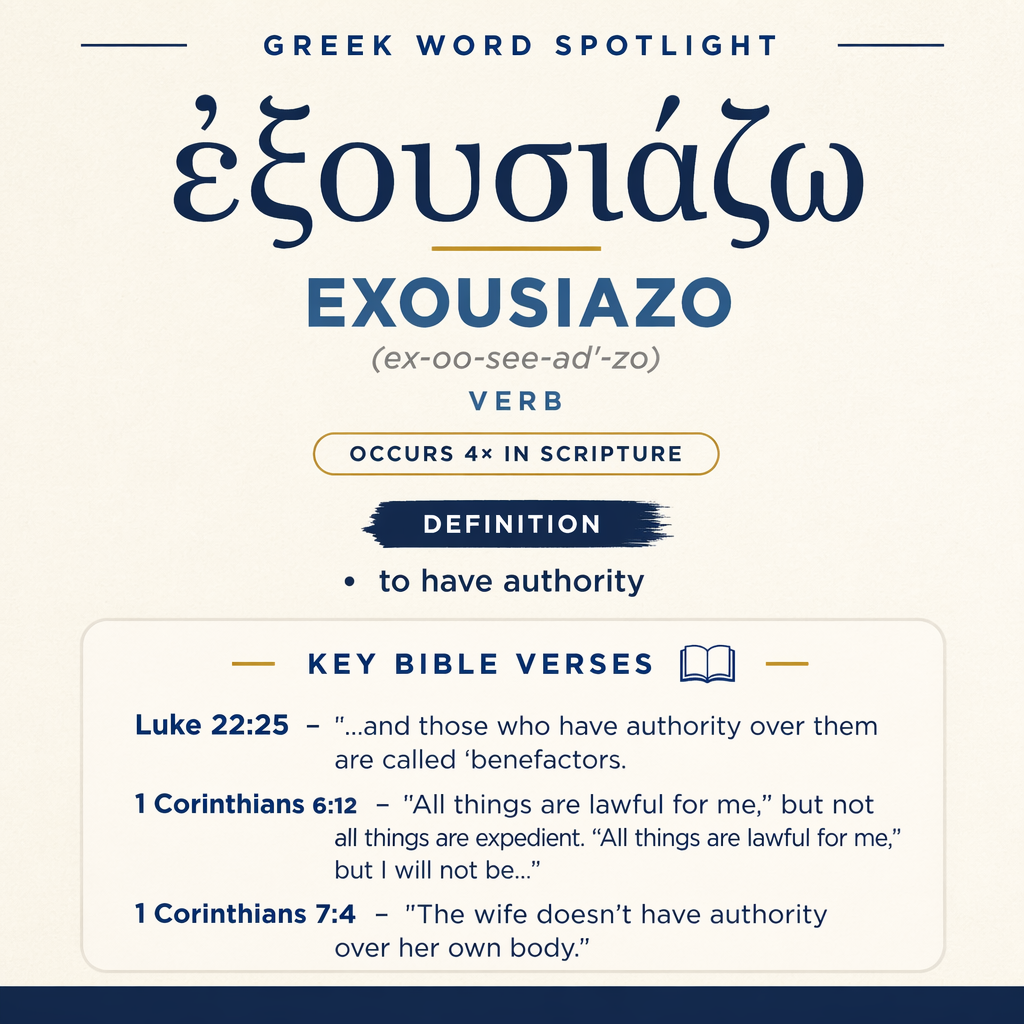
ἐξουσιάζω means “to have authority” and occurs 4 times in Scripture, including Luke 22:25 and 1 Corinthians 6:12; 7:4.
Core Meaning
ἐξουσιάζω means “to have authority.” It describes exercising authority over someone or something.
Learn More →Scripture Occurrences
This verb occurs 4 times in Scripture. It appears in Luke 22:25 and in 1 Corinthians 6:12 and 7:4.
Learn More →Context Snapshots
In Luke 22:25 it is used of those who have authority over others. In 1 Corinthians 7:4 it describes spouses having authority concerning each other’s bodies.
Learn More →ἐξουσιάζω expresses the exercise of authority. It appears in Jesus’ description of rulers and in Paul’s discussions of personal conduct and mutual marital claims over the body.
Root and Related Words
ἐξουσιάζω corresponds to the noun exousia (ἐξουσία), “authority” (Strong’s G1849).

Occurrences
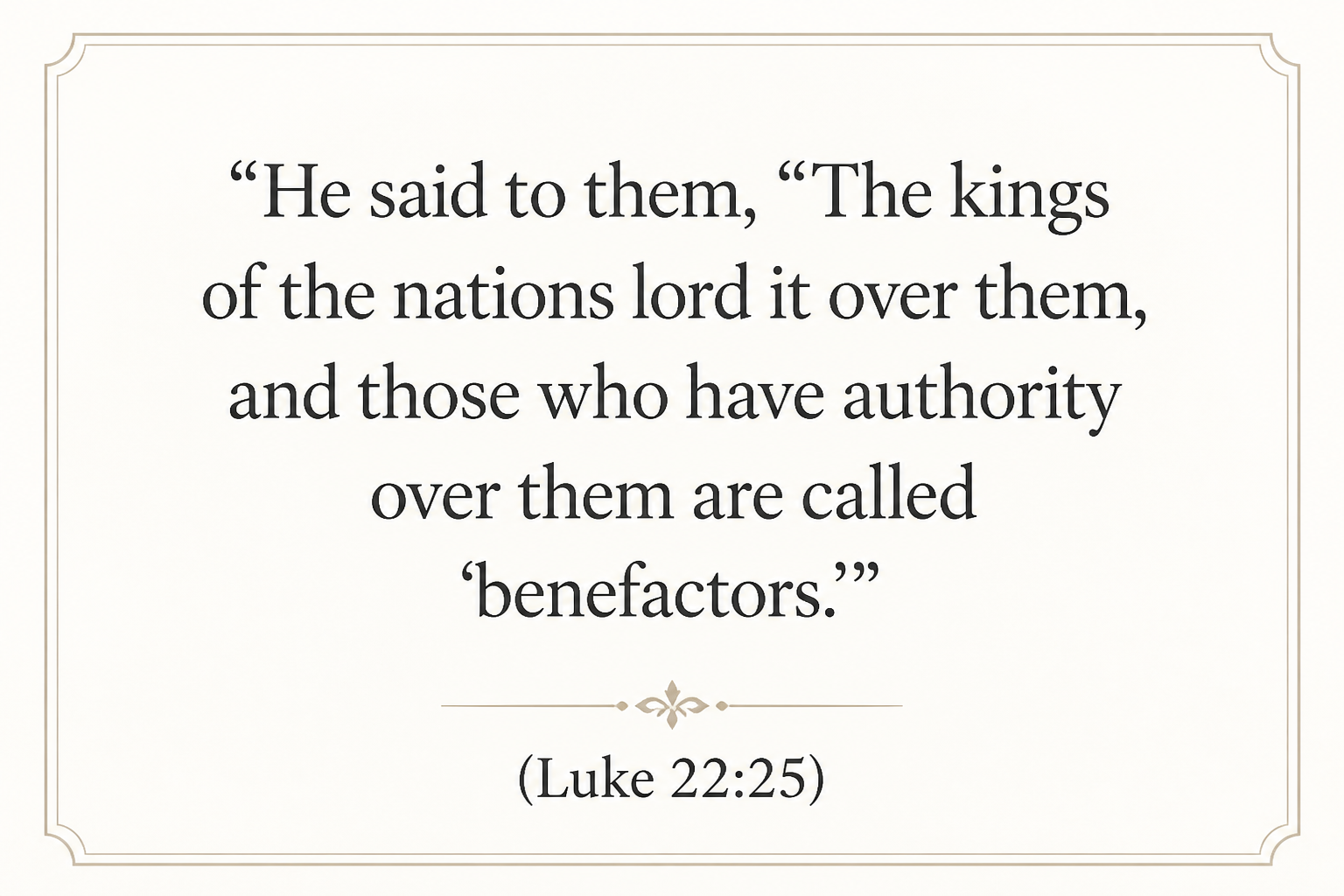
“He said to them, “The kings of the nations lord it over them, and those who have authority over them are called ‘benefactors.’” (Luke 22:25)
Here the word is set in a political setting: “kings of the nations” and those associated with them. Authority is presented as a real social power “over them,” that is, over other people, and the line places that authority alongside the more aggressive description “lord it over them.” The verse also shows how authority can be framed publicly: the ones exercising it “are called ‘benefactors,’” a title that casts their rule in a favorable light. Within Jesus’ sentence, having authority is not merely possessing a status; it is the active relation of superiors who stand over others and are recognized by an honorific name.
““All things are lawful for me,” but not all things are expedient. “All things are lawful for me,” but I will not be brought under the power of anything.” (1 Corinthians 6:12)
In this saying Paul contrasts what is “lawful” with what is “expedient,” then sharpens the issue by shifting to the language of being controlled: “I will not be brought under the power of anything.” Authority is pictured as something that can be exercised by “anything” over a person, placing the subject into a position of subordination. The expression “brought under” frames authority as mastery that can capture or govern one’s choices, so the concern is not legality alone but whether something gains a ruling position in one’s life. The verse therefore uses the verb for authority in a personal and moral arena rather than a governmental one: the question is what is allowed to function as a power over the individual.
“The wife doesn’t have authority over her own body, but the husband. Likewise also the husband doesn’t have authority over his own body, but the wife.” (1 Corinthians 7:4)
This occurrence places authority in the mutual obligations of marriage and anchors it specifically “over” the body. Paul states the point in two balanced clauses, first describing the wife’s lack of authority over her own body and attributing that authority to the husband, then reversing the direction for the husband. The symmetry is central: authority is not portrayed as one-sided control but as a reciprocal claim within the relationship—each spouse is said not to hold authority over his or her own body because the other spouse does. The wording treats authority as relational and concrete, tied to bodily rights and responsibilities rather than to public titles or social rank.
Sense and Usage
Across these passages, “to have authority” is applied to different spheres but keeps a consistent profile: it names an active superiority that places someone or something “over” another. In Luke 22:25 the social dimension is explicit—authority belongs to “kings” and those aligned with them, and it is connected to how rulers are perceived and labeled (“called ‘benefactors’”). The verb thus sits in a context of recognized power, exercised in a way that can be described as domination (“lord it over them”), even when wrapped in benevolent language.
In 1 Corinthians 6:12 the same idea moves inward: authority can be exercised not only by rulers but by “anything,” and the outcome is being “brought under” its power. Authority here functions as control that diminishes freedom, so the speaker refuses to allow any permitted thing to take the upper hand. The force of the line is that authority is not neutral; it establishes a governing relationship. Even in a setting where actions may be considered lawful, Paul’s concern is whether something becomes a master that rules the person.
In 1 Corinthians 7:4 authority is neither political nor abstractly moral but interpersonal and embodied. The repeated phrase “have authority over” gives the verb a precise relational direction: the authority is located in the spouse, and the object over which authority is held is “the body.” The verse’s paired structure shows that to have authority, in this context, is not to seize power but to acknowledge a shared bond in which each spouse’s body falls under the other’s rightful claim. This use underscores that authority can describe a recognized arrangement of rights between persons, not only a hierarchical structure where one dominates the many.
Read together, the occurrences show that ἐξουσιάζω can depict authority as public rule (Luke), as the controlling power exerted over an individual by whatever gains mastery (1 Corinthians 6), and as a reciprocal marital claim (1 Corinthians 7). The passages place the verb alongside different evaluative terms—“lord it over,” “expedient,” and the mutual “likewise”—which color how authority is experienced: it may be oppressive, resisted as enslaving, or structured as mutual belonging.
Imagery
The imagery surrounding ἐξουσιάζω ranges from thrones and titles to the quieter but weighty language of control and bodily claim. Luke 22:25 evokes rulers standing above their subjects and receiving public names like “benefactors,” while 1 Corinthians 6:12 pictures power as something that can bring a person “under” it. In 1 Corinthians 7:4 the verb is tied to the body itself, presenting authority in the intimate sphere where two people are bound to acknowledge one another’s rightful place “over” what would otherwise be considered strictly one’s own.
Sources: Lexical data from Strong’s Exhaustive Concordance and the Translators Brief Lexicon of Extended Strongs for Greek (STEPBible, CC BY). Occurrence data from the Translators Amalgamated Greek New Testament (STEPBible, CC BY). Scripture quotations from the World English Bible (public domain).