Exploring the Meaning of Ereido in Greek
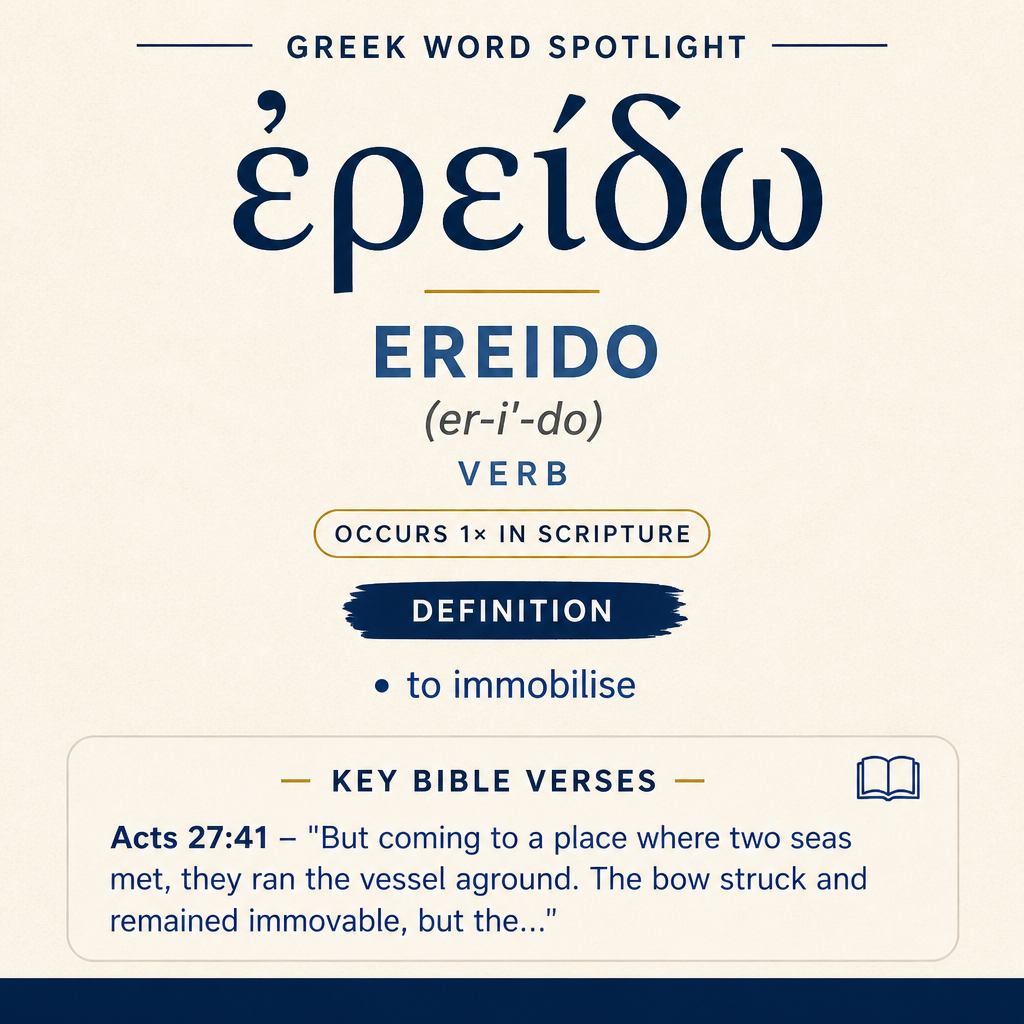
ἐρείδω means “to immobilise” and appears once in Scripture, in Acts 27:41.
Context in Acts
In Acts 27:41, the vessel runs aground, and the bow struck and remained immovable.
Learn More →ἐρείδω means “to immobilise.” It appears in the account of a ship running aground during a violent sea incident in Acts 27.
Occurrences
“But coming to a place where two seas met, they ran the vessel aground. The bow struck and remained immovable, but the stern began to break up by the violence of the waves.” (Acts 27:41)
In this scene the ship’s forward section meets an unseen obstruction at the point “where two seas met,” and the narrative marks a decisive change in the vessel’s condition. The clause “The bow struck and remained immovable” presents the moment when forward motion ceases and the ship becomes fixed in place. ἐρείδω supplies the idea of immobilising as a concrete outcome: the bow is not merely slowed or delayed but brought into a state where it cannot move on, even while the rest of the ship is still exposed to active forces. The verse sets this immovability in sharp contrast with what immediately happens aft: “but the stern began to break up by the violence of the waves.” That contrast makes the immobilising effect of the bow’s impact more than a descriptive detail; it becomes the condition that leaves the vessel unable to respond as a whole, with one end held fast and the other end increasingly damaged by wave action.
The wording also ties the immobilising to impact (“The bow struck”), so the immobilised state is presented as the direct and sudden result of collision. The narrative does not pause to explain the obstruction; instead, the immobilising itself functions as the turning point of the event. Once the bow remains immovable, the ship is effectively trapped at the meeting of the seas, positioned so that “the violence of the waves” can act on it without the relief of forward movement or escape from the location. Within the single verse, ἐρείδω therefore contributes a vivid, physical finality: the bow is held in place while destructive motion continues elsewhere.

Sense and Usage
The sense “to immobilise” is expressed here through an image of enforced stillness that results from external force. The ship does not choose to stop; the immobilising comes from the bow’s striking and then remaining fixed. In the verse’s compact description, immobilising is not presented as a gentle stabilising or a calm anchoring, but as the abrupt arrest of movement in a perilous setting.
Because the bow is immobilised while the stern “began to break up,” the immobilising effect carries practical consequences in the immediate context: it divides the vessel’s experience into two simultaneous realities—rigidity at the front and progressive destruction at the back. The verse depicts a situation where motion continues in the environment (“the violence of the waves”), yet the ship’s bow is rendered motionless. This pairing of stillness and violence heightens the force of the verb’s idea: immobilising is not mere inactivity; it is the condition of being held fast under pressure.
The location detail, “a place where two seas met,” frames the immobilising as occurring at a point of compounded forces. The meeting of seas suggests an unstable, conflicting movement of waters, and in that setting the ship’s bow “remained immovable.” The immobilising thus functions as a narrative marker of being caught: the vessel is lodged in a place of converging currents, unable to move away from the source of stress. Even without elaborating on the mechanics, the verse shows immobilising as a state that exposes what is immobilised to ongoing impact from outside forces.
Within this occurrence, “immovable” is also a temporal description—something that continues after the initial striking. The sequence is important: impact, then remaining. The immobilising is not simply the instant of collision; it is the sustained condition that follows, long enough for the stern to start breaking up. This gives the term a durable, persistent character in context: once immobilised, the bow stays fixed as events unfold.
Imagery
Acts 27:41 pairs immobilising with maritime danger in a way that is easy to picture: a ship driven into a spot where waters converge, its front end locked in place while waves keep battering the rear. The immobilised bow stands as an image of arrested progress—forward motion stopped at the most vulnerable moment—while the surrounding sea remains energetic and destructive. The verse’s tight contrast between “remained immovable” and “began to break up” lets the reader feel the tension of something held fast under relentless external force.
Sources: Lexical data from Strong’s Exhaustive Concordance and the Translators Brief Lexicon of Extended Strongs for Greek (STEPBible, CC BY). Occurrence data from the Translators Amalgamated Greek New Testament (STEPBible, CC BY). Scripture quotations from the World English Bible (public domain).