Exploring the Meaning of Epipothetos in Greek
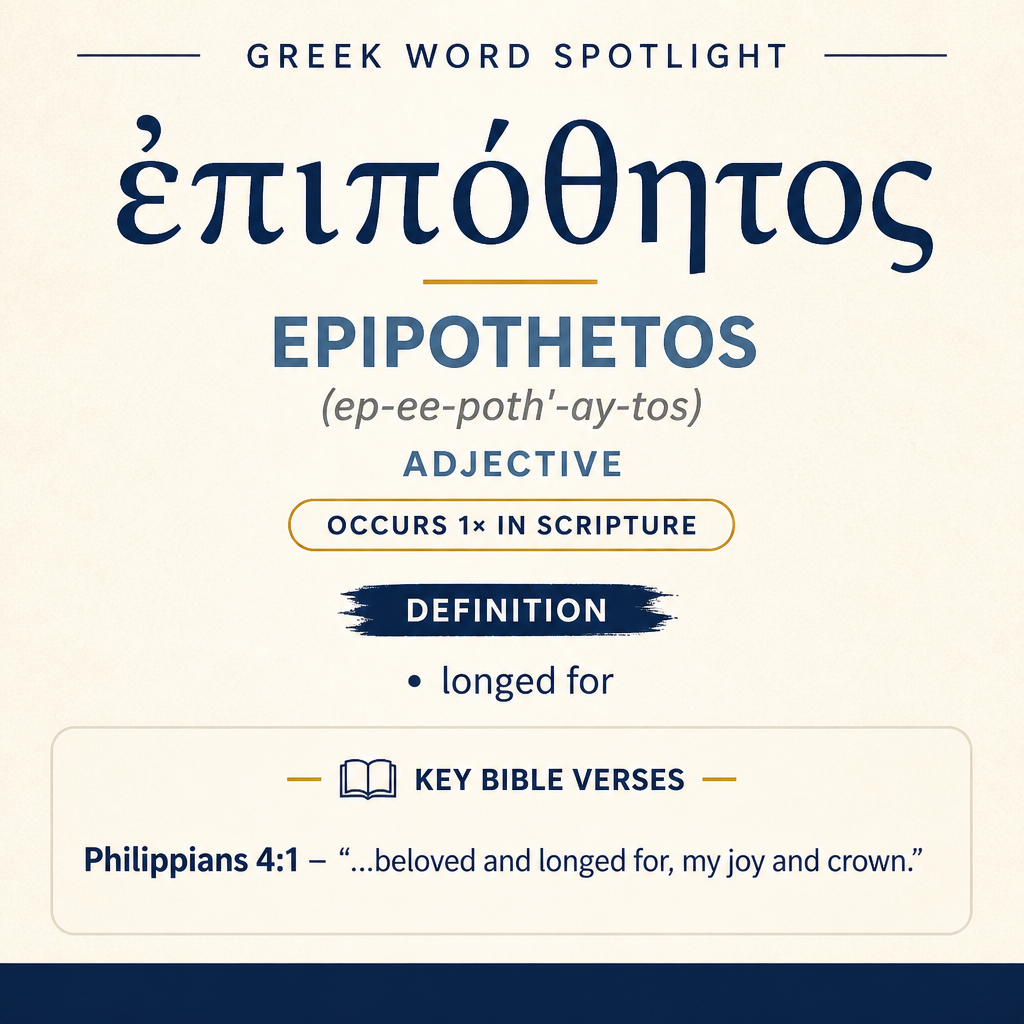
ἐπιπόθητος means “longed for” and appears once in Scripture, in Philippians 4:1.
Biblical Occurrence
It occurs 1 time in Scripture. The occurrence is in Philippians 4:1.
Learn More →Verse Context
In Philippians 4:1, Paul addresses believers as “beloved and longed for,” calling them his “joy and crown.”
Learn More →ἐπιπόθητος means “longed for,” and it appears in Paul’s address to the Philippian believers as he urges them to remain steady in the Lord. In that single use, it functions as a relational descriptor inside a cluster of affectionate titles.
Root and Related Words
ἐπιπόθητος is built on ἐπιποθέω (epipotheō), “to long for” (Strong’s G1971), and it includes the prepositional element ἐπί (epi), “upon/to/against” (Strong’s G1909). The resulting adjective form expresses the state of being the object of longing.

Occurrences
“Therefore, my brothers, beloved and longed for, my joy and crown, stand firm in the Lord in this way, my beloved.” (Philippians 4:1)
Here ἐπιπόθητος stands alongside “beloved,” “my joy,” and “crown” as part of Paul’s direct address: “my brothers, beloved and longed for.” The word marks the Philippians not merely as recipients of goodwill, but as people whose presence and fellowship are desired. In the flow of the sentence, this longing is not presented as an abstract emotion detached from action; it frames a concrete exhortation—“stand firm in the Lord in this way.” Paul’s longing intensifies the personal weight of the appeal: the ones he calls to steadiness are the very ones he yearns for.
The placement of “longed for” between “beloved” and the pair “my joy and crown” makes it part of a tightly bound set of relational affirmations. The phrase “Therefore… stand firm” shows the longing functioning rhetorically: Paul’s yearning for them supports his pastoral urgency. At the same time, the language remains communal and familial (“my brothers”), so the longing is situated within an existing relationship rather than implying a distant admiration. The final “my beloved” closes the verse with renewed affection, so ἐπιπόθητος belongs to an inclusio-like pattern of warm address enclosing a call to perseverance.
Sense and Usage
In Philippians 4:1, “longed for” identifies a person—or, here, a community—as the object of earnest desire for renewed presence, closeness, or fellowship. The adjective does not operate in isolation; it is coordinated with other relational nouns and adjectives (“beloved,” “joy,” “crown”), so its sense is colored by affection and honor. The longing implied is not possessive in tone within the verse’s wording; rather, it is bound to familial language (“brothers”) and to the shared center of life “in the Lord.”
The word also functions as a bridge between affection and instruction. Paul does not merely report his inner feeling; he names the Philippians as “longed for” at the moment he commands them to “stand firm.” In this way, the adjective supports an appeal that could otherwise sound purely directive. Because it appears in direct address, it is performative: Paul is not describing them to someone else but speaking to them, treating them as people whose absence would be felt and whose continued faithfulness matters deeply to him.
Since ἐπιπόθητος appears in a list, it contributes a particular shade of emphasis within that list: “beloved” speaks to established affection, “joy and crown” to value and honor, and “longed for” to yearning. Together, these titles communicate that Paul’s relationship to the Philippians includes emotional attachment, esteem, and desire for continued connection. The result is that the exhortation “stand firm” is heard not as cold instruction but as counsel coming from a heart that yearns toward its recipients.
Imagery
The verse’s imagery is compact but vivid: the Philippians are “my joy and crown,” and in that same breath they are “longed for.” The longing implied by ἐπιπόθητος therefore sits within a scene of celebration and commitment. The community is pictured as a source of joy and as an honored wreath-like emblem, and the adjective “longed for” adds the sense that this “crown” is not set aside at a distance but is desired close at hand as Paul calls them to stand firm “in the Lord.”
Sources: Lexical data from Strong’s Exhaustive Concordance and the Translators Brief Lexicon of Extended Strongs for Greek (STEPBible, CC BY). Occurrence data from the Translators Amalgamated Greek New Testament (STEPBible, CC BY). Scripture quotations from the World English Bible (public domain).