Exploring the Meaning of Enarchomai in Greek
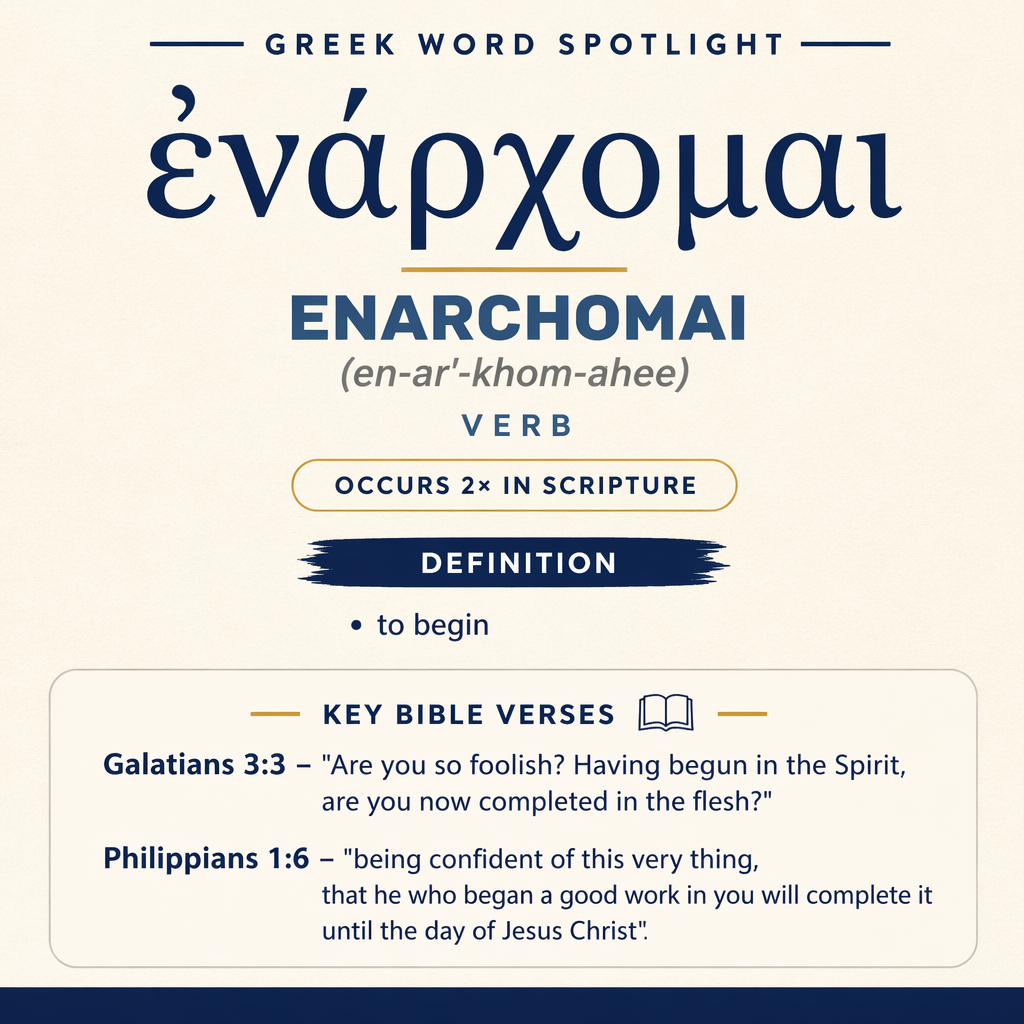
ἐνάρχομαι means “to begin” and occurs twice in Scripture: Galatians 3:3 and Philippians 1:6.
Core Meaning
ἐνάρχομαι means “to begin.” In both occurrences it refers to the start of an action or work.
Learn More →Galatians Context
In Galatians 3:3, it describes having “begun in the Spirit.” The verse contrasts that beginning with being “completed in the flesh.”
Learn More →Philippians Context
In Philippians 1:6, it describes God beginning “a good work in you.” The verse connects that beginning with completing it until the day of Jesus Christ.
Learn More →ἐνάρχομαι means “to begin.” It appears in Paul’s letters in two different pastoral settings: a rebuke in Galatians and a confidence-filled assurance in Philippians.
Root and Related Words
ἐνάρχομαι is associated with the preposition en (ἐν), “in/on/among” (Strong’s G1722), and with archomai (ἄρχομαι), “to rule/begin” (Strong’s G756). These relationships place the verb within a family of terms that speak about initiating something, with en (ἐν) contributing the idea of being “in” a sphere or setting.

Occurrences
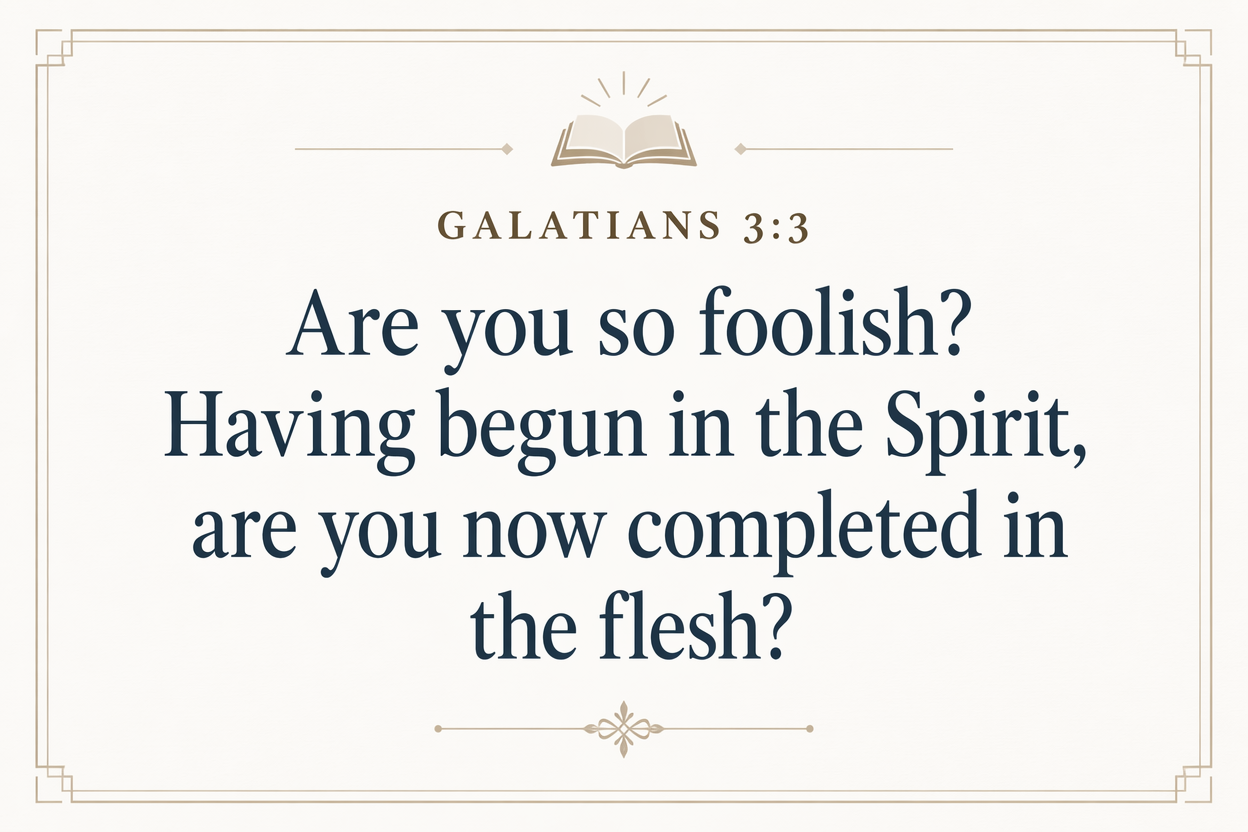
Galatians 3:3 Are you so foolish? Having begun in the Spirit, are you now completed in the flesh?
Here ἐνάρχομαι (“having begun”) is framed by two contrasting spheres: “in the Spirit” and “in the flesh.” The verb points to the inception of the Galatians’ experience, and that inception is explicitly located “in the Spirit.” Paul’s question presses the logic of the beginning: if their start was in one realm (“the Spirit”), the proposed trajectory of being “completed” in another realm (“the flesh”) appears to him as incoherent. In this sentence the beginning is not merely a first moment in time; it functions as a controlling premise for how the process should be understood. The participial form (“Having begun…”) makes the beginning a settled fact that grounds the present challenge Paul raises.
The rhetorical structure intensifies the force of ἐνάρχομαι. Paul does not simply ask whether they began; he treats it as granted and uses it to expose what he labels “foolish” reasoning. The contrast between “begun” and “completed” makes the beginning the first pole in a start-to-finish sequence, so that a shift in the basis of completion would amount to changing the basis of the whole course. The verb therefore contributes to Paul’s argument by fixing the origin point of their life and practice as something already established “in the Spirit,” and by making that origin point relevant to what follows.
Philippians 1:6 being confident of this very thing, that he who began a good work in you will complete it until the day of Jesus Christ.
In Philippians 1:6 ἐνάρχομαι (“began”) sits within a statement of confidence: Paul is “being confident” about the One who initiated something and will also bring it to completion. The verb identifies the start of “a good work in you,” and the phrase “in you” specifies the location or sphere in which that beginning took place. The beginning is assigned to an agent (“he who began”), not to the Philippians themselves, and this agency becomes the basis for Paul’s assurance that the same agent “will complete it.”
The verse also places the beginning within a timeline: completion is expected “until the day of Jesus Christ.” Against that horizon, ἐνάρχομαι marks the initial act that sets an ongoing work in motion. The start is not portrayed as isolated; it is the first act of a continuing project whose endpoint is fixed by “the day of Jesus Christ.” In this scene, the verb supports a pastoral tone that stabilizes the Philippians: the good work has an identifiable starter, a defined object (“a good work”), a specified sphere (“in you”), and a promised continuation toward completion.
Sense and Usage
Across these two occurrences, “to begin” functions as more than a simple marker of when something happened. In Galatians 3:3, the beginning is invoked to evaluate a present course: the way something started (“in the Spirit”) is treated as decisive for how it can coherently be carried forward toward being “completed.” The verb anchors an argument about consistency across a process: beginning and completion belong together, and Paul’s question challenges any attempt to divide them between incompatible bases (“Spirit” versus “flesh”).
In Philippians 1:6, the beginning grounds confidence rather than rebuke. The starter of the work is explicitly identified (“he who began”), and the fact of that initiating act becomes a warrant for expecting the same work to reach its intended completion. Here, beginning is the first visible point of an ongoing, purposeful action that extends forward “until the day of Jesus Christ.” The initiation is portrayed as intentional (“a good work”) and personal in its sphere (“in you”), so that the start signals not only a timeline but also the character and direction of what follows.
Read together, these uses show how ἐνάρχομαι can carry argumentative weight: a beginning can function as a premise (Galatians) or as a pledge-like foundation for confidence (Philippians). Both passages place the beginning within a larger movement toward completion, and both attach that beginning to a defined sphere—“in the Spirit” and “in you”—so that the start is located, not abstract. The verb thus helps each writerly moment speak about direction and continuity: what has been initiated is meant to be understood in relation to its ongoing course and anticipated completion.
Imagery
Both verses portray beginnings as the first step of a work moving toward completion. Galatians images a process whose starting point (“in the Spirit”) is set against an attempted finishing “in the flesh,” creating a sharp contrast within the same start-to-finish line. Philippians images the same kind of process, but with steady assurance: the One who “began a good work” is also the One who “will complete it” along a defined horizon, “until the day of Jesus Christ.”
Sources: Lexical data from Strong’s Exhaustive Concordance and the Translators Brief Lexicon of Extended Strongs for Greek (STEPBible, CC BY). Occurrence data from the Translators Amalgamated Greek New Testament (STEPBible, CC BY). Scripture quotations from the World English Bible (public domain).