
Exploring the Meaning of Eleazar in Greek
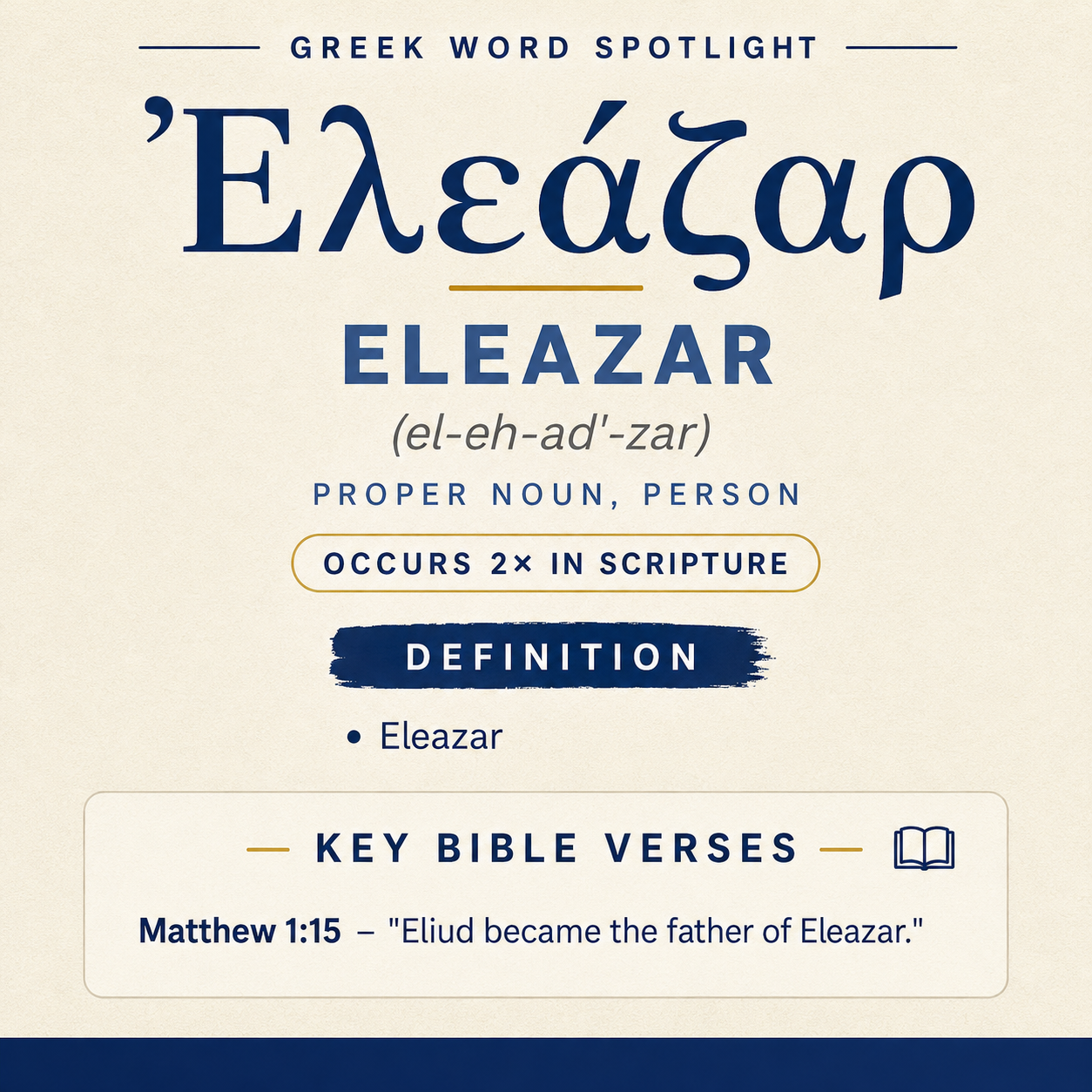
Ἐλεάζαρ (Eleazar) means “Eleazar” and appears twice in Scripture, including in Matthew 1:15.
Scripture Occurrences
This name occurs 2 times in Scripture. One occurrence is in Matthew 1:15.
Learn More →Matthew Genealogy
In Matthew 1:15, Eleazar is listed in the genealogy: Eliud fathered Eleazar, and Eleazar fathered Matthan.
Learn More →Eleazar is a personal name appearing in the genealogy of Jesus in Matthew. In this context it functions as a link in a chain of father–son relationships, identifying one generation and the generation that follows.
Occurrences
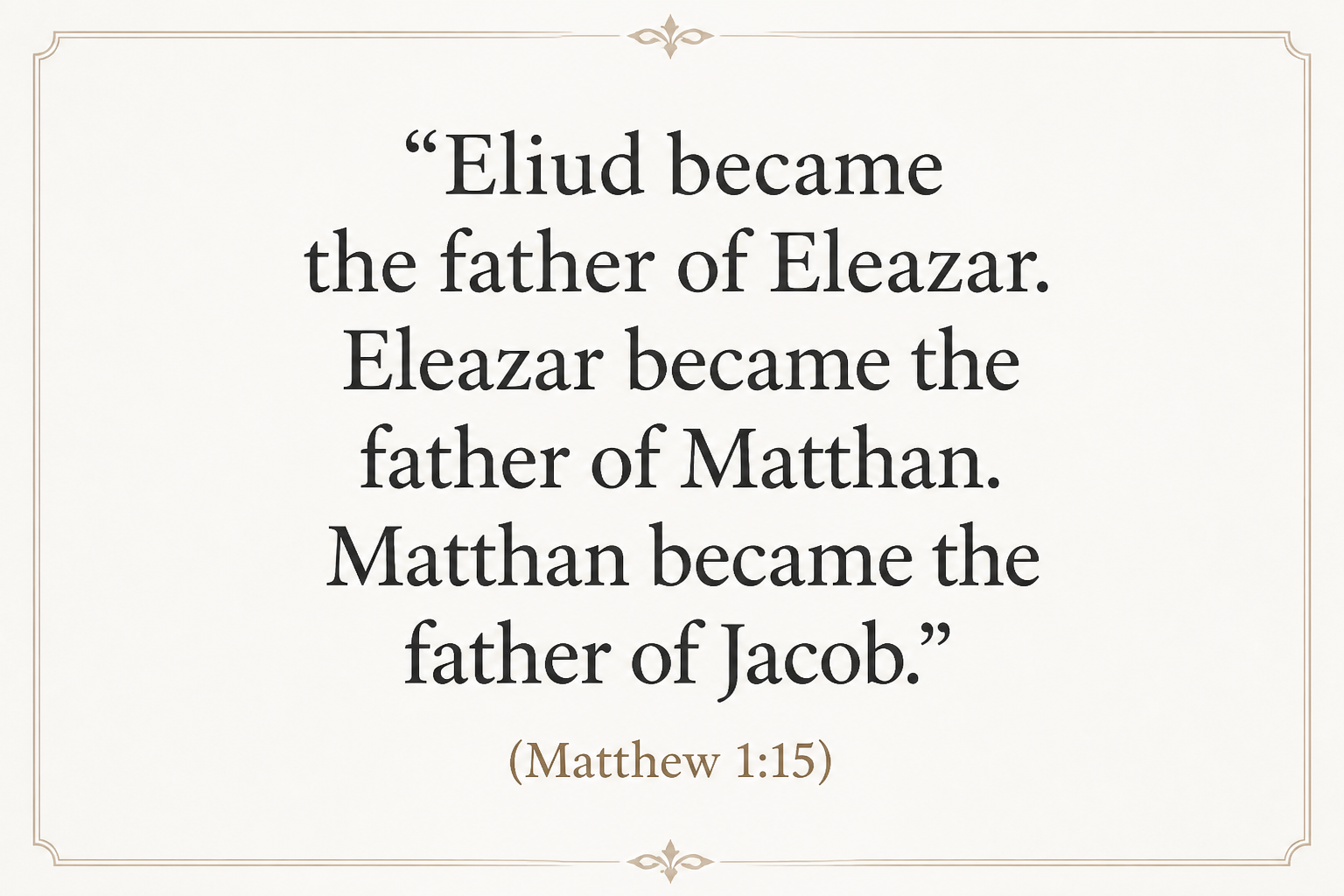
“Eliud became the father of Eleazar. Eleazar became the father of Matthan. Matthan became the father of Jacob.” (Matthew 1:15)
Here Eleazar stands in the middle of a tightly structured sequence of begetting: one man fathers the next, and the next in turn fathers another. The name marks a specific generational handoff in the line: Eleazar is presented first as the son of Eliud (“Eliud became the father of Eleazar”), then immediately as the father of Matthan (“Eleazar became the father of Matthan”). Matthew’s wording frames Eleazar as both receiver and transmitter of lineage within a single verse. Because the sentence repeats the same genealogical formula across successive names, Eleazar’s role is not developed through narrative action or speech; instead, the name functions as an identifying node whose significance is located in placement—between Eliud above and Matthan below—within the ancestral record.
The verse’s paired statements about Eleazar also show how the name operates grammatically in genealogical prose. It appears as the object of “became the father of” in the first clause and as the subject of that same formula in the second clause. The repetition underscores continuity: the line does not pause at Eleazar but moves through him. The effect is to keep the reader oriented to the progression of generations, with Eleazar serving as one necessary step in the verse’s forward movement from earlier ancestors toward later ones.

Sense and Usage
In Matthew 1:15, Eleazar is used straightforwardly as a proper name, with no additional title, epithet, or descriptive phrase attached. The definition “Eleazar” is realized as simple identification: the text relies on the name itself to distinguish one figure from the adjacent figures in the list. This is characteristic of a genealogy where the emphasis rests on succession and connection rather than on biographical detail. The meaning of the entry as a personal name is therefore expressed by how it anchors relationships: Eleazar is defined in context by who fathers him and whom he fathers.
The immediate repetition of the name (“…father of Eleazar. Eleazar became the father…”) also highlights a common feature of genealogical style: names are repeated at the transition point between clauses so that the chain remains clear. In that pattern, Eleazar serves as a pivot, closing one link (“Eliud” → “Eleazar”) and opening the next (“Eleazar” → “Matthan”). The usage is functional and referential: the name exists to keep the lineage intelligible, ensuring that each generational connection is explicit rather than implied.
Within the verse’s triad of clauses, Eleazar occupies the central position, and that placement carries the main contextual force the name bears here. The reader encounters Eleazar not as an isolated individual but as embedded in a relational sequence. In this way, Eleazar’s usage emphasizes continuity across generations: each named person is presented as both descendant and ancestor (except at the edges of a given excerpt), and Eleazar exemplifies that two-directional role in a single, compact line.
Genealogical Imagery
Matthew 1:15 evokes the imagery of a lineage carefully traced from father to son, where each name is like a link in a chain. Eleazar contributes to that imagery by standing at the point where the chain visibly connects in both directions—receiving from Eliud and passing on to Matthan—so that the verse reads as an unbroken succession of named generations.
Sources: Lexical data from Strong’s Exhaustive Concordance and the Translators Brief Lexicon of Extended Strongs for Greek (STEPBible, CC BY). Occurrence data from the Translators Amalgamated Greek New Testament (STEPBible, CC BY). Scripture quotations from the World English Bible (public domain).




