Exploring the Meaning of Eiserchomai in Greek
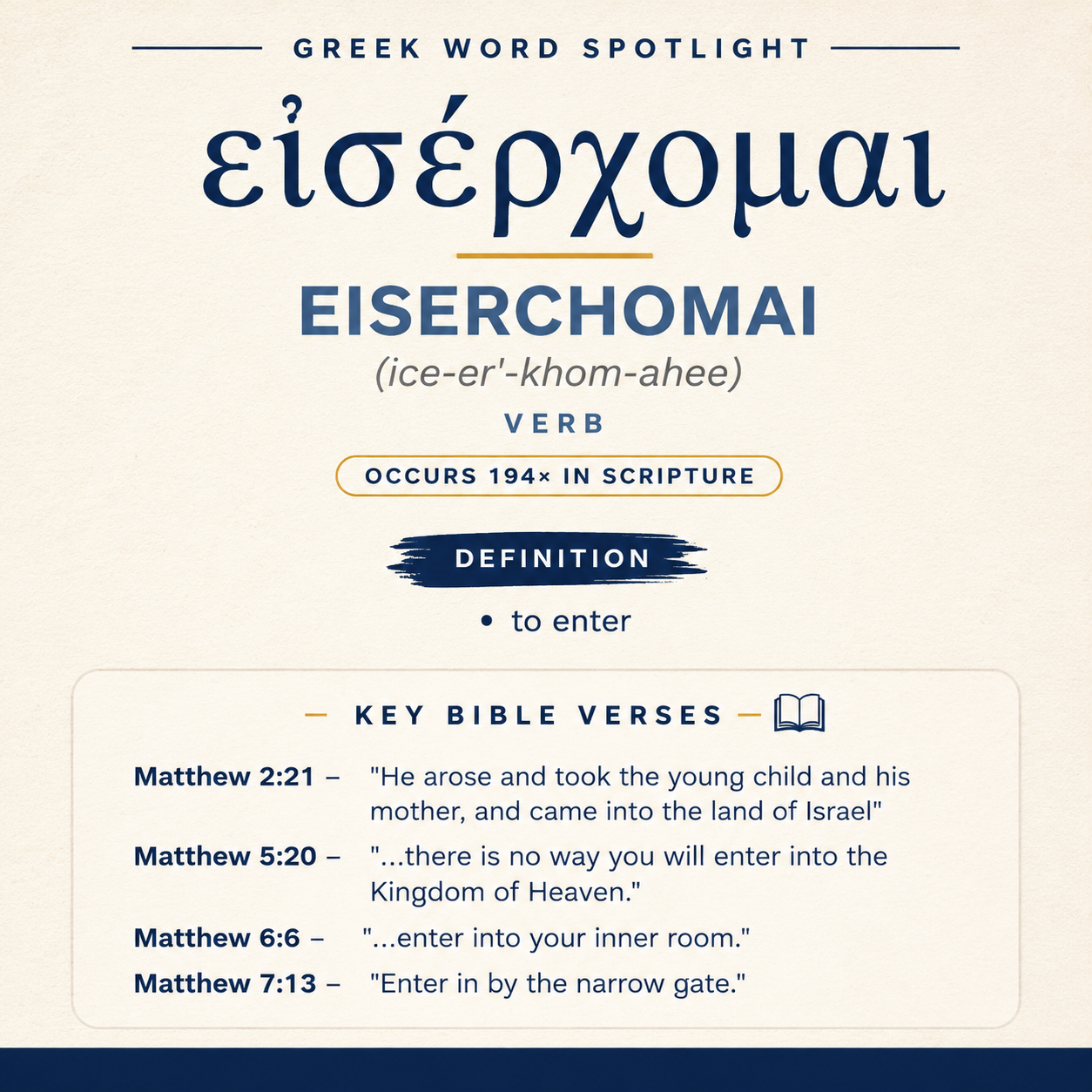
εἰσέρχομαι means “to enter” and appears 194 times in Scripture, including passages in Matthew.
Matthew Examples
In Matthew it describes entering places: the land of Israel (Matthew 2:21) and Capernaum (Matthew 8:5).
Learn More →Kingdom Language
Jesus uses εἰσέρχομαι when speaking of entering the Kingdom of Heaven (Matthew 7:21) and the narrow gate (Matthew 7:13).
Learn More →εἰσέρχομαι means “to enter,” describing movement into a place or sphere in a range of concrete and figurative settings. In the Gospels it appears in scenes of travel, household encounters, ritual space, and Jesus’ teaching about access to God’s kingdom.
Occurrences
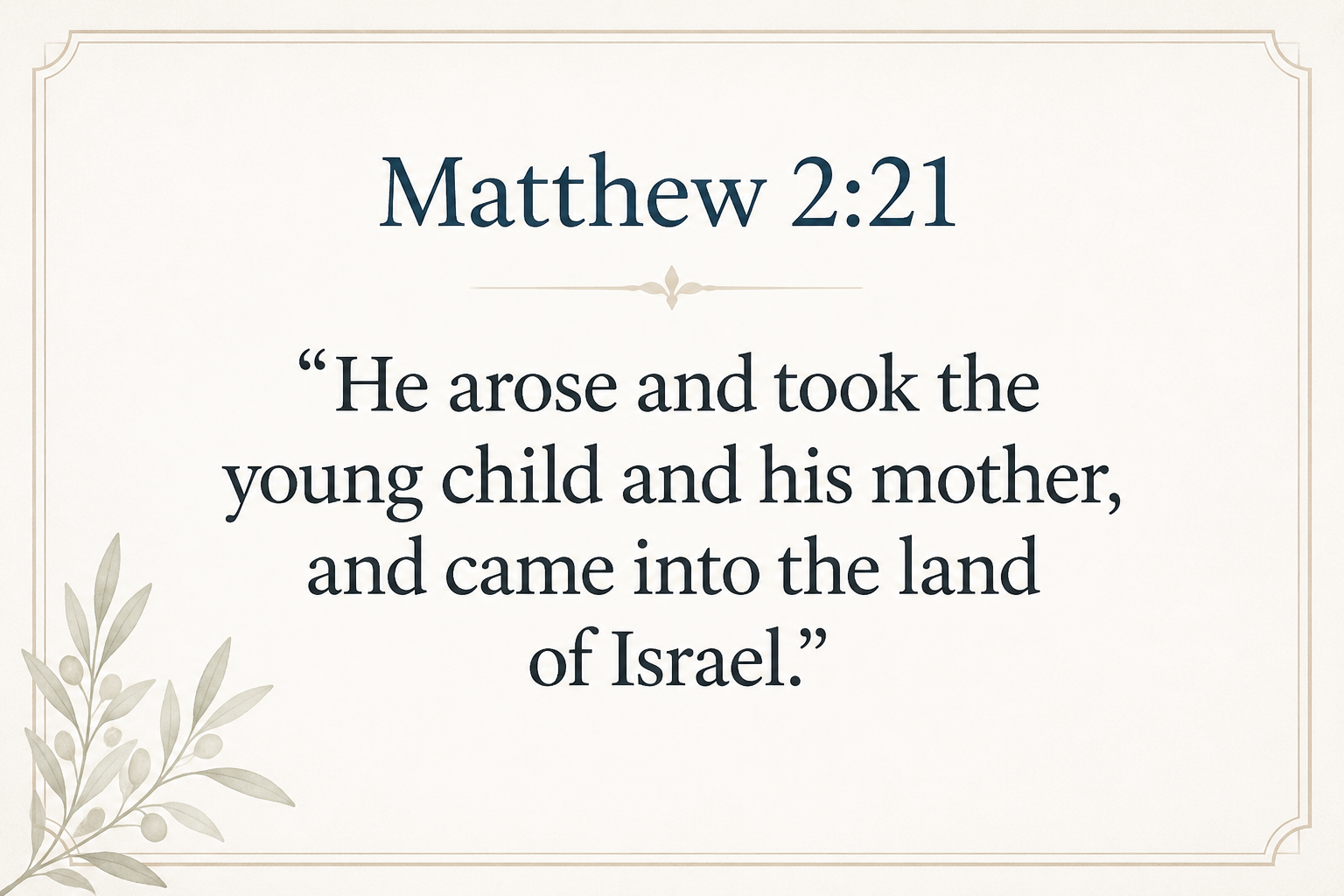
Matthew 2:21 — “He arose and took the young child and his mother, and came into the land of Israel.”
Here εἰσέρχομαι marks a decisive arrival: Joseph’s action is not simply departure or travel, but crossing into a defined territory, “the land of Israel.” The verb frames the return as an entry into a new (or restored) geographic setting that will shape what follows.
Matthew 5:20 — “For I tell you that unless your righteousness exceeds that of the scribes and Pharisees, there is no way you will enter into the Kingdom of Heaven.”
In this saying, εἰσέρχομαι carries entry as admission into a realm, “the Kingdom of Heaven.” The line “there is no way you will enter” makes the verb a boundary-marker: it speaks of crossing from outside to inside, with “righteousness” functioning as the stated condition for that crossing.
Matthew 6:6 — “But you, when you pray, enter into your inner room, and having shut your door, pray to your Father who is in secret, and your Father who sees in secret will reward you openly.”
εἰσέρχομαι is used for deliberate, private movement into “your inner room.” The command to “enter” is paired with “having shut your door,” so the entry is not incidental; it initiates a setting of seclusion. The verb thus introduces a physical relocation that supports the kind of prayer described—addressed to “your Father who is in secret.”
Matthew 7:13 — ““Enter in by the narrow gate; for wide is the gate and broad is the way that leads to destruction, and many are those who enter in by it.”
Jesus places εἰσέρχομαι in a vivid spatial metaphor: a gate that one enters. The first clause urges entering “by the narrow gate,” while the second observes that “many” enter by the wide one. In both halves the verb depicts the act of passing through an opening that commits a traveler to a particular “way,” with contrasting outcomes named in the verse (“leads to destruction”).
Matthew 7:21 — “Not everyone who says to me, ‘Lord, Lord,’ will enter into the Kingdom of Heaven; but he who does the will of my Father who is in heaven.”
Again εἰσέρχομαι describes entry into “the Kingdom of Heaven,” but now the contrast is between speech (“says to me, ‘Lord, Lord,’”) and obedience (“he who does the will of my Father”). The verb highlights that access is not assumed; it is depicted as a transition granted to some and not to others.
Matthew 8:5 — “When he came into Capernaum, a centurion came to him, asking him,”
εἰσέρχομαι is used for Jesus’ arrival “into Capernaum,” setting the scene for the centurion’s approach. The entry functions as the narrative trigger: once Jesus has entered the town, the encounter becomes possible and immediately begins (“a centurion came to him”).
Matthew 8:8 — “The centurion answered, “Lord, I’m not worthy for you to come under my roof. Just say the word, and my servant will be healed.”
The centurion’s statement uses εἰσέρχομαι for entering a house: “come under my roof.” The verb sharpens the social and personal boundary of the household. His claim of unworthiness focuses not on distance or travel but on the significance of Jesus crossing the threshold into his domestic space.
Matthew 9:25 — “But when the crowd was put out, he entered in, took her by the hand, and the girl arose.”
In this miracle account, εἰσέρχομαι marks Jesus’ movement into the room after “the crowd was put out.” The entry is the pivot between public commotion and the intimate act that follows (“took her by the hand”). The verb therefore signals access to the space where the girl lies and the immediate sequence of restoration (“the girl arose”).
Matthew 10:5 — “Jesus sent these twelve out, and commanded them, saying, “Don’t go among the Gentiles, and don’t enter into any city of the Samaritans.”
εἰσέρχομαι appears in a directive limiting the disciples’ movements: “don’t enter into any city of the Samaritans.” Entry here is more than stepping inside city limits; it represents engagement with a locale as a field of mission. The verb makes the boundary practical and concrete by describing the forbidden action in terms of entering.
Matthew 10:11 — “Into whatever city or village you enter, find out who in it is worthy; and stay there until you go on.”
This instruction assumes repeated instances of εἰσέρχομαι (“whatever city or village you enter”) and ties entry to discernment and hospitality. Entering a place initiates responsibilities: they must “find out who in it is worthy” and “stay there,” so the verb frames entry as the start of sustained presence, not a brief visit.
Matthew 10:12 — “As you enter into the household, greet it.”
εἰσέρχομαι is narrowed from towns to a single “household,” describing the moment of crossing into a family’s space. The command to “greet it” is timed to the entry itself: the verb sets the threshold moment when the disciples’ words and demeanor are to match the act of coming in.
Matthew 12:4 — “how he entered into God’s house, and ate the show bread, which was not lawful for him to eat, neither for those who were with him, but only for the priests?”
Here εἰσέρχομαι denotes entry “into God’s house,” introducing a scenario where the location matters for what follows. The act of entering leads directly to eating “the show bread,” and the verse stresses the restricted nature of that act (“not lawful… but only for the priests”). The verb thus underlines the significance of being inside a sacred space where particular permissions apply.

Sense and Usage
Across these occurrences, εἰσέρχομαι regularly marks a boundary crossed: into a land (Matthew 2:21), a city (Matthew 8:5), a room (Matthew 6:6; 9:25), a household (Matthew 8:8; 10:12), and a sacred house (Matthew 12:4). The verb’s basic force is directional and inward, but the contexts show that “entering” can carry different kinds of weight depending on what the destination represents. Entering a geographical area frames the next stage of a narrative; entering a town opens an encounter; entering a room changes the social environment from public to private.
Several passages use the verb for entry into the Kingdom of Heaven (Matthew 5:20; 7:21). In these sayings, the destination is not a building or district but a divine realm, and the verb expresses admission rather than mere arrival. The statements are shaped as exclusions (“there is no way you will enter”; “Not everyone… will enter”), which makes the act of entering a decisive dividing line. The verses themselves supply the terms attached to this boundary: exceeding righteousness (Matthew 5:20) and doing the Father’s will rather than relying on address alone (Matthew 7:21).
Matthew 7:13 places εἰσέρχομαι in a travel image with two gates. The verb is the hinge between the gate and the way: one enters through a gate and so begins along a path. The observation that “many are those who enter in by it” adds a social dimension—entry is an act that can be common and easy, not only rare and deliberate—while still presenting entrance as the moment that commits a person to the road that follows.
In the mission instructions (Matthew 10:5, 10:11, 10:12), εἰσέρχομαι is the practical verb for where the disciples may and may not go and how they must behave once inside. The progression from “city” to “city or village” to “household” shows entry at multiple scales: the same idea governs movement into regions of activity and into the intimate space of a home. In this cluster, entering is not an end in itself; it initiates interaction—finding the worthy, staying, greeting—which treats entry as the start of relationship and responsibility.
Imagery
The passages gather a set of threshold scenes around εἰσέρχομαι: gates, doors, roofs, and defined spaces (“inner room,” “God’s house,” “the land of Israel”). Whether the text speaks of quiet prayer behind a shut door (Matthew 6:6), a teacher arriving in a city (Matthew 8:5), or the hoped-for entry into the Kingdom of Heaven (Matthew 5:20; 7:21), the verb consistently presents “entering” as the moment of transition from outside to inside—the point where setting, access, and consequence become concrete.
Sources: Lexical data from Strong’s Exhaustive Concordance and the Translators Brief Lexicon of Extended Strongs for Greek (STEPBible, CC BY). Occurrence data from the Translators Amalgamated Greek New Testament (STEPBible, CC BY). Scripture quotations from the World English Bible (public domain).