Exploring the Meaning of Eiko in Greek
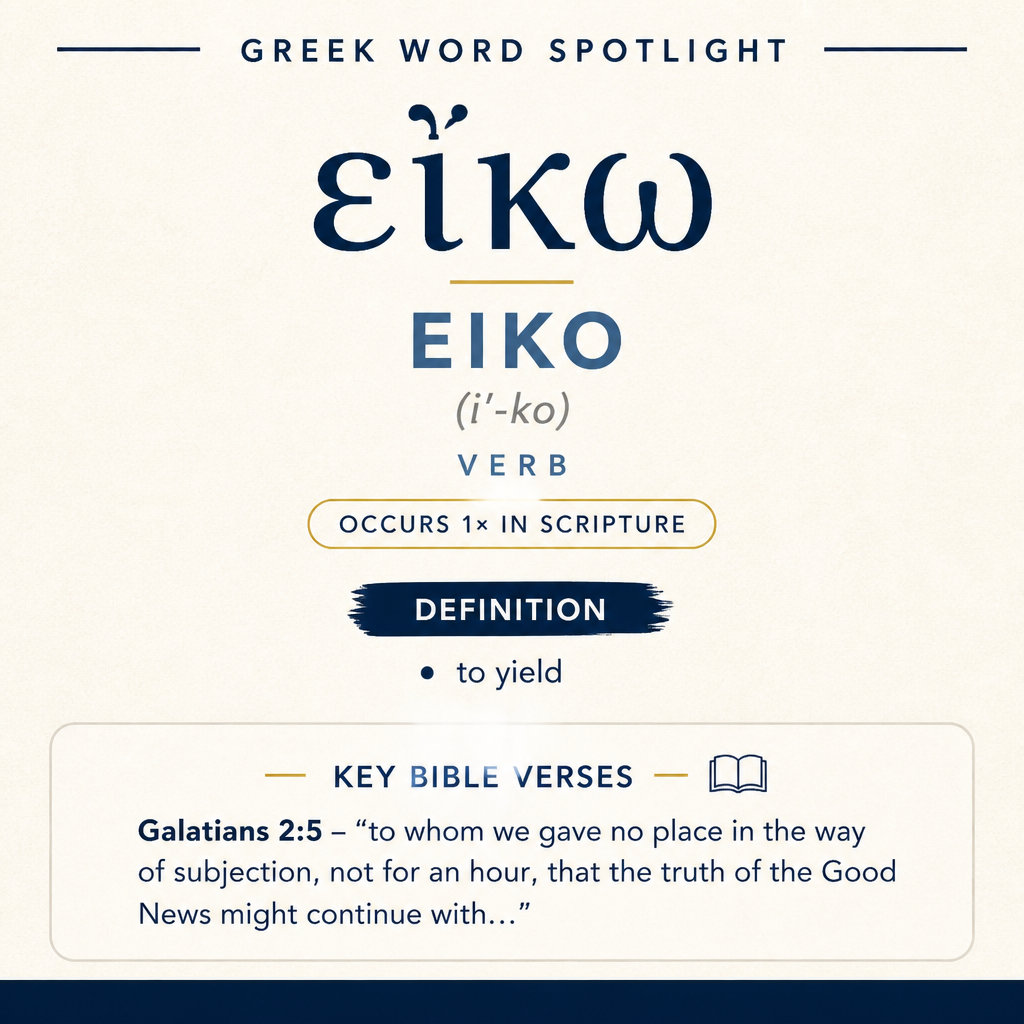
εἴκω means “to yield” and occurs once in Scripture, in Galatians 2:5.
Scripture Occurrence
This word occurs 1 time in Scripture. Its single occurrence is in Galatians 2:5.
Learn More →Context in Galatians
In Galatians 2:5, the verse states “to whom we gave no place in the way of subjection, not for an hour.”
Learn More →Eiko means “to yield,” and it appears in a single New Testament setting where Paul describes a deliberate refusal to make room for compelled submission. In that context, the act of not yielding is tied directly to the ongoing presence of “the truth of the Good News” among his readers.
Occurrences
“to whom we gave no place in the way of subjection, not for an hour, that the truth of the Good News might continue with you.” (Galatians 2:5)
In this line Paul speaks of an encounter with people to whom he and his companions “gave no place in the way of subjection.” Within that phrasing, eiko (“to yield”) is the conceptual hinge: Paul portrays “yielding” as the act that would have created “place” for “subjection.” He does not describe a mere internal attitude, but a practical concession—an opening made by giving way—that would have allowed the pressure toward subjection to stand as accepted.

The time marker “not for an hour” sharpens the statement. Yielding is presented as something that can happen quickly and can be measured in duration: even a brief concession would have been a meaningful act of giving way. Paul’s emphasis is not on how long the confrontation lasted, but on the absolute decision to refuse even the smallest, shortest act of yielding that would amount to submission.
The purpose clause then frames the stakes: “that the truth of the Good News might continue with you.” In this sentence yielding is not treated as neutral or polite flexibility; it is a concession that would have threatened continuity. Paul links the refusal to yield with the safeguarding of “truth,” and he expresses that safeguarding in terms of something remaining present—“continue with you.” Thus, within the scene, eiko is the kind of action that would have altered the situation for the Galatians: yielding would have changed the relationship between the audience and the “truth of the Good News,” whereas not yielding preserves it.

Sense and Usage
The sense “to yield” is concrete and situational: it describes giving way under pressure, allowing another party’s demand to prevail. Galatians 2:5 places yielding on a spectrum with “place” and “subjection.” The wording does not present yielding as a free exchange between equals, but as the step by which subjection gains ground. Yielding, in other words, is the act that turns an attempted imposition into an actual arrangement.
Because the verse pairs “gave no place” with “in the way of subjection,” yielding here is closely associated with making room. It is pictured not as a private surrender of conviction alone, but as granting space in practice—space for the other party to occupy the relationship with a posture of superiority and control. The sentence structure makes yielding the opposite of resistance: where resistance refuses space, yielding grants it.
The phrase “not for an hour” supplies an important nuance. Yielding can be momentary, but it is still significant. The verse implies that even a small concession can carry the character of “subjection.” Yielding is therefore not defined by size or duration but by direction: it is movement toward someone else’s claim. In Paul’s framing, yielding would have been the beginning (or confirmation) of a pattern of subjection, regardless of how briefly it was enacted.
The stated aim—“that the truth of the Good News might continue with you”—shows that yielding would have had consequences beyond the immediate interaction. The verb’s force is relational and communal: Paul sees the choice to yield (or not) as affecting what “continues with” the community. Yielding is not merely personal deference; it is a concession with implications for what the church lives under and with. The line thus portrays yielding as an action that can either protect or jeopardize continuity with “truth,” depending on whether it is refused or granted.
In this single attestation, eiko stands in a tightly argued contrast: yielding would have led to a state described as “subjection,” while refusing to yield serves the goal of preserving the ongoing presence of “the truth of the Good News.” The definition “to yield” is therefore expressed as a tangible, pressure-point decision—whether to give way and allow subjection to take hold, or to deny it any foothold.
Imagery
The verse’s imagery is spatial and temporal: yielding is like giving “place,” and the refusal is marked down to “an hour.” Paul’s wording evokes a contested space in which one side seeks entry “in the way of subjection.” To yield would be to open that space; to refuse is to keep it closed so that what remains present is not subjection but “the truth of the Good News,” continuing with the community.
Sources: Lexical data from Strong’s Exhaustive Concordance and the Translators Brief Lexicon of Extended Strongs for Greek (STEPBible, CC BY). Occurrence data from the Translators Amalgamated Greek New Testament (STEPBible, CC BY). Scripture quotations from the World English Bible (public domain).