Discovering What Does ‘Eber Mean in Hebrew
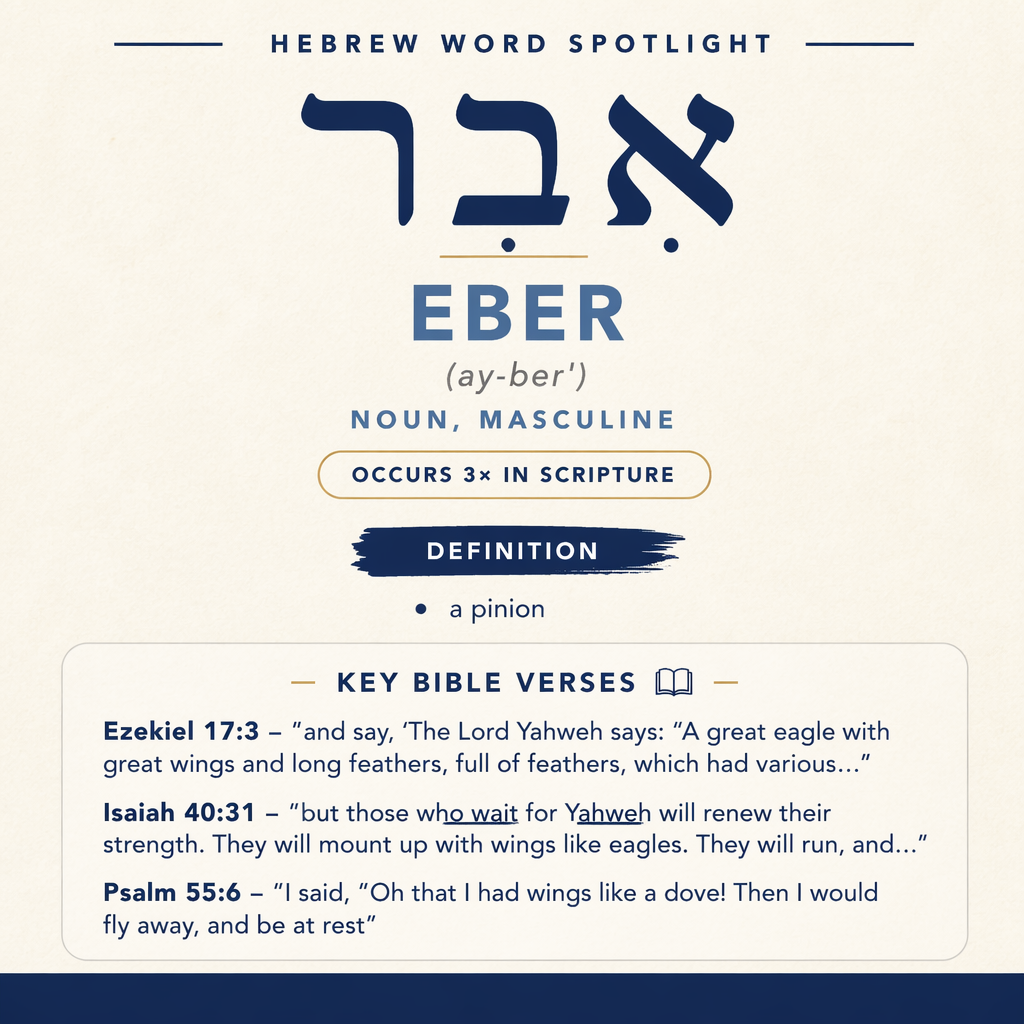
אֵבֶר (eber) means “a pinion” and appears three times in Scripture: Ezekiel 17:3, Isaiah 40:31, and Psalm 55:6.
Where It Appears
This word occurs 3 times in Scripture: Ezekiel 17:3; Isaiah 40:31; Psalm 55:6.
Learn More →Context Glimpses
In these verses it appears in imagery of wings: an eagle’s wings (Ezekiel 17:3; Isaiah 40:31) and a dove’s wings (Psalm 55:6).
Learn More →אֵבֶר (eber) means “a pinion,” a term of wing imagery that appears in three poetic and prophetic scenes. In these passages it belongs to pictures of flight, strength, and the desire to escape danger or weariness.
Occurrences
“and say, ‘The Lord Yahweh says: “A great eagle with great wings and long feathers, full of feathers, which had various colors, came to Lebanon, and took the top of the cedar.” (Ezekiel 17:3)
Here אֵבֶר serves the description of an eagle’s wing in a vivid, layered portrait: “great eagle,” “great wings,” and “long feathers,” with plumage “full of feathers” and “various colors.” Within this tightly packed imagery, the pinion belongs to the eagle’s capacity for action—its wing as the instrument of movement and reach. The verse’s focus is not on a detached wing but on an eagle presented in motion and power, arriving at Lebanon and taking “the top of the cedar.” The pinion imagery, embedded in the winged description, supplies the physical means by which the eagle can come, seize, and carry off what is high and prominent.
“but those who wait for Yahweh will renew their strength. They will mount up with wings like eagles. They will run, and not be weary. They will walk, and not faint.” (Isaiah 40:31)
In this promise of renewed strength, אֵבֶר belongs to a comparison: “wings like eagles.” The pinion is the concrete feature that makes the comparison work; it evokes the lift and upward surge implied by “mount up.” The verse then pairs that upward image with endurance on the ground—“run, and not be weary… walk, and not faint.” Against that sequence, the pinion imagery functions as a concentrated emblem of strength that is not merely momentary burst but sustained capacity. The “wings like eagles” line places the wing/pinion at the head of a chain of metaphors for vigor: ascent, running, and walking, all tied to the renewal that comes to “those who wait for Yahweh.”
“I said, “Oh that I had wings like a dove! Then I would fly away, and be at rest.” (Psalm 55:6)
In this personal cry, אֵבֶר appears as a wished-for possession: “Oh that I had wings like a dove!” The pinion is imagined not as the strength of an eagle but as the means of escape and quiet: “Then I would fly away, and be at rest.” The verse’s logic depends on the wing as enabling flight; the pinion is the bodily equipment that would turn longing into movement. The dove comparison adds a gentler cast to the image—still a real wing, but one suited to the speaker’s aim of departure and rest rather than dominance or seizure. Here the pinion is not described in color or size; it is desired as a simple, practical capability: the ability to leave and to find relief.

Sense and Usage
Across these three passages, אֵבֶר operates within winged imagery that is always purposeful. The pinion is not introduced as an anatomical detail for its own sake; it functions as the decisive feature that makes flight possible and therefore carries the weight of what flight represents in each context.
In Ezekiel 17:3 the pinion belongs to an eagle portrayed with layered physical traits—“great wings,” “long feathers,” and abundant, varied plumage. The pinion fits a scene of decisive motion and reach: the eagle “came to Lebanon” and “took the top of the cedar.” The wing is thus bound to mobility, elevation, and the ability to act upon what is lofty. The picture is concrete and external, focused on what the eagle does in the world.
In Isaiah 40:31 the pinion shifts from a descriptive feature of an eagle to a comparative image for human experience. The passage speaks of strength that is renewed, then casts that renewal as ascent—“mount up with wings like eagles.” The pinion here belongs to a metaphor of lifting and sustaining. The verse then grounds that metaphor in continued activity—running and walking without collapse. Within the verse’s own movement from soaring to running to walking, the pinion image concentrates the idea of strength that carries a person through multiple modes of exertion. The wing is the picture-language for a power that elevates and endures.
In Psalm 55:6 the pinion is again expressed through comparison (“like a dove”), but now the emphasis falls on personal longing and rest. The wing is the imagined means by which the speaker might reach a different condition: “fly away, and be at rest.” The pinion’s semantic force in this line comes from its practicality: wings are what make departure possible. The dove image makes the desired flight feel like retreat rather than conquest—an inwardly driven movement away from distress toward quiet.
Taken together, these uses show that אֵבֶר readily supports both literal depiction and figurative application. Whether it is the eagle’s wing in a prophetic tableau, a metaphor for renewed strength, or a wish for escape, the pinion consistently functions as the enabling element of flight: the feature that makes ascent, travel, and leaving possible. Each passage chooses a bird image aligned to its own tone—majestic and forceful in Ezekiel, empowering in Isaiah, and restful in the psalm—while retaining the pinion as the concrete hinge of the picture.
Wing Imagery
The three scenes place pinion language into a spectrum of emotion and effect. Ezekiel 17:3 uses winged description to paint a powerful creature whose arrival and action are abrupt and consequential: it comes, it takes. Isaiah 40:31 uses winged comparison to express renewed strength as something that lifts and carries through sustained exertion. Psalm 55:6 uses winged longing to voice a desire for distance and repose: to fly away and to be at rest. In each, the pinion gathers the felt meaning of flight—reach, resilience, or release—into a single, tangible image.
Sources: Lexical data from Strong’s Exhaustive Concordance and the Open Scriptures Hebrew Lexicon. Occurrence data from the Westminster Leningrad Codex with STEPBible reference data (CC BY). Scripture quotations from the World English Bible (public domain).