
Discovering the Meaning of ‘eb in Hebrew
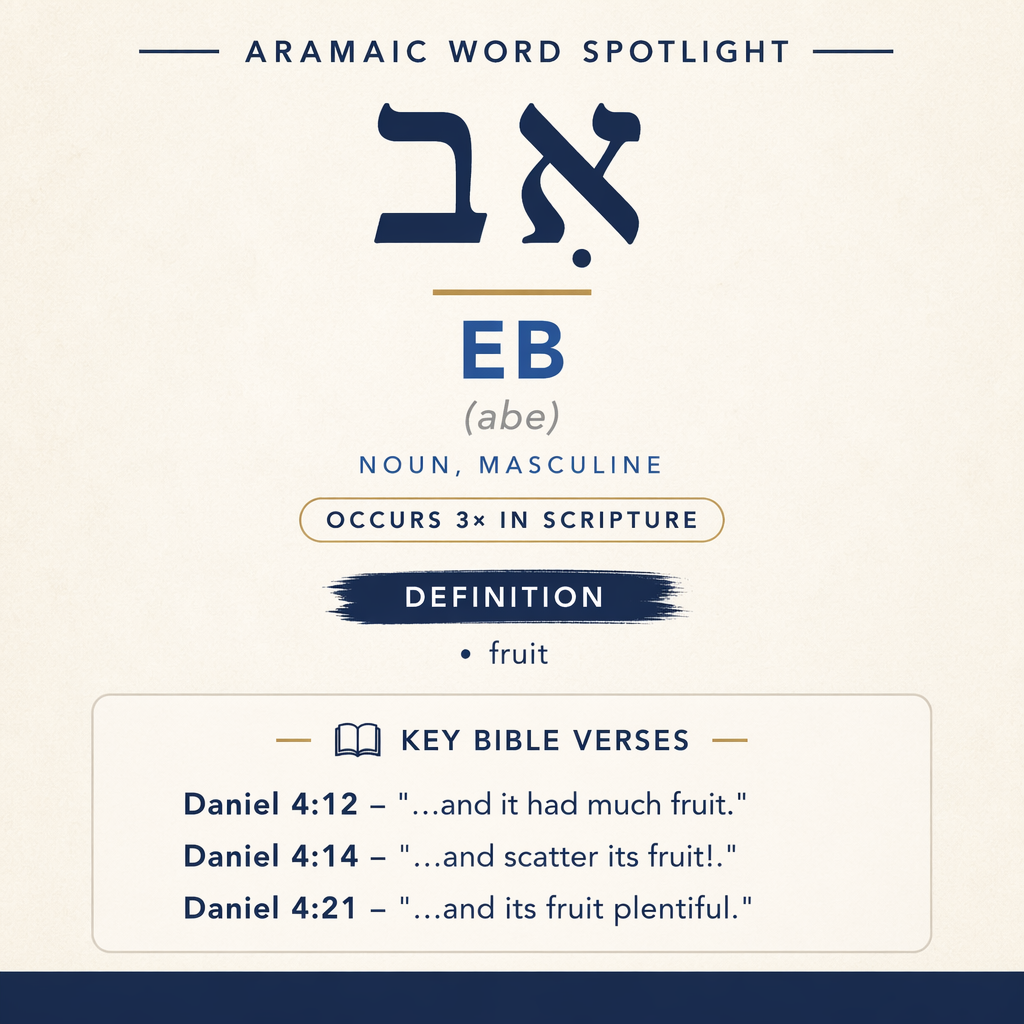
אֵב (eb) means “fruit” and appears three times in Scripture, all in Daniel 4:12, 4:14, and 4:21.
Daniel Context
In Daniel 4, it describes the fruit of a tree whose leaves are beautiful and whose fruit provides food for all.
Learn More →Textual Occurrences
The word occurs in Daniel 4:12, 4:14, and 4:21, each time referring to a tree’s fruit.
Learn More →אֵב (eb) means “fruit” and appears in Daniel 4 within the dream-vision and its interpretation, where a great tree’s produce is described, scattered, and remembered as abundant. In these scenes, “fruit” belongs to the tree’s visible fullness and to its role as a source of provision for living creatures.
Occurrences
Daniel 4:12: “The leaves of it were beautiful, and it had much fruit, and in it was food for all. The animals of the field had shade under it, and the birds of the sky lived in its branches, and all flesh was fed from it.”
Here אֵב (eb) marks the tree’s output as part of a larger picture of flourishing. The verse coordinates several features: beauty (“The leaves of it were beautiful”), abundance (“it had much fruit”), and usefulness (“in it was food for all”). “Fruit” is not an isolated detail; it sits between the tree’s appearance and its capacity to sustain others. The sentence then expands outward from the tree to the creatures that benefit from it: animals find “shade under it,” birds “lived in its branches,” and finally the scope widens to “all flesh,” which “was fed from it.” Within this chain, “fruit” functions as a concrete expression of the tree’s life and productivity, a reason the tree is more than scenery. The mention of “much fruit” supports the claim that the tree contains “food for all,” tying visible abundance to the feeding of many.
Daniel 4:14: “He cried aloud, and said this, ‘Cut down the tree, and cut off its branches! Shake off its leaves, and scatter its fruit! Let the animals get away from under it, and the fowls from its branches.”
In this command, “fruit” is singled out as something that can be “scatter[ed],” and its scattering forms part of a total dismantling of the tree’s presence. The imperatives move from the structure (“Cut down the tree”) to its extensions (“cut off its branches”), then to what covers it (“Shake off its leaves”), and then to what it bears (“scatter its fruit”). By placing “fruit” alongside leaves, branches, and the tree itself, the verse treats it as part of the tree’s completeness—its produce belongs to the tree’s integrity and is disrupted when that integrity is judged. The final lines address the creatures who had benefited earlier: “Let the animals get away from under it, and the fowls from its branches.” In that context, the scattering of “fruit” reads as the removal of a stable source of provision; the productive yield is no longer gathered and enjoyed but dispersed as the sheltering, feeding environment collapses.
Daniel 4:21: “whose leaves were beautiful, and its fruit plentiful, and in it was food for all; under which the animals of the field lived, and on whose branches the birds of the sky had their habitation:”
This occurrence returns to the earlier description but with the feel of a recalled or interpreted summary. “Fruit” is again paired with the tree’s attractive foliage (“leaves were beautiful”) and its capacity to sustain life (“in it was food for all”). The adjective “plentiful” reinforces the impression of abundance, while the repeated link between “fruit” and “food for all” keeps the focus on the tree’s role as a provider. The verse also repeats the ecological picture: animals “lived” under it, and birds had “their habitation” in its branches. In this setting, “fruit” signals not only that the tree is alive but that it is beneficial—its produce belongs to a habitat where creatures do not merely pass through but settle and live.

Sense and Usage
Across these three uses, “fruit” is consistently the tree’s yield, described in relation to abundance and to the feeding of living beings. In Daniel 4:12 the phrase “much fruit” supports a broad claim: “all flesh was fed from it.” The word thus stands close to the idea of provision without being reduced to a metaphor; it remains the tangible produce that makes the statement about feeding credible within the picture. The narrative logic is simple and concrete: the tree has fruit, therefore it contains “food,” therefore many creatures benefit.
Daniel 4:14 shows how “fruit” behaves when the tree’s order is overturned: it can be “scatter[ed].” This is a distinctive action associated with the word in these passages. Leaves can be shaken off, branches can be cut, and fruit can be scattered—each item is treated according to what it is. The choice of verb suggests that fruit, once borne in an ordered way by the tree, becomes dispersed and no longer functions as gathered provision. The command sequence portrays a reversal: what was concentrated enough to feed “all” becomes spread out in the disruption of the tree. In the immediate context of animals and birds being forced away, scattering fruit participates in the undoing of a stable environment.
Daniel 4:21 reiterates the earlier portrait using “plentiful” rather than “much,” keeping the emphasis on quantity and sufficiency. The pairing of “fruit plentiful” with “food for all” indicates that the tree’s produce is not presented as merely decorative; it is the sustaining output of the tree’s life. When animals “lived” under it and birds had “habitation” in it, the picture presupposes continuity and reliability. “Fruit” fits that continuity: it is the repeated, expected yield of a thriving tree, enabling the scene’s claim that the tree supports a wide community of life.
Together, these uses show “fruit” as an index of fullness: the tree’s flourishing is measured not only by beauty (“leaves … beautiful”) or size implied by shelter and branches, but also by what it bears in quantity. The word is also bound to the theme of distribution: in abundance it feeds many; in judgment it is scattered. The movement from “much” and “plentiful” to “scatter” traces a shift from ordered provision to disordered dispersal, while still keeping “fruit” anchored in its plain, concrete sense as produce borne by the tree.
Imagery
The passages place “fruit” within a vivid ecosystem: leaves above, fruit borne, animals beneath, birds among branches, and “food for all” flowing outward from a single source. When the command comes to cut down the tree, the scattering of fruit contributes to the image of loss—abundance is not simply removed but thrown into disarray as the creatures are driven away. In the later description of “fruit plentiful,” the word carries the weight of remembered plenty, reinforcing how the tree’s yield had once made it a center of feeding and habitation.
Sources: Lexical data from Strong’s Exhaustive Concordance and the Open Scriptures Hebrew Lexicon. Occurrence data from the Westminster Leningrad Codex with STEPBible reference data (CC BY). Scripture quotations from the World English Bible (public domain).




