Understanding the Significance of Dosis in Greek
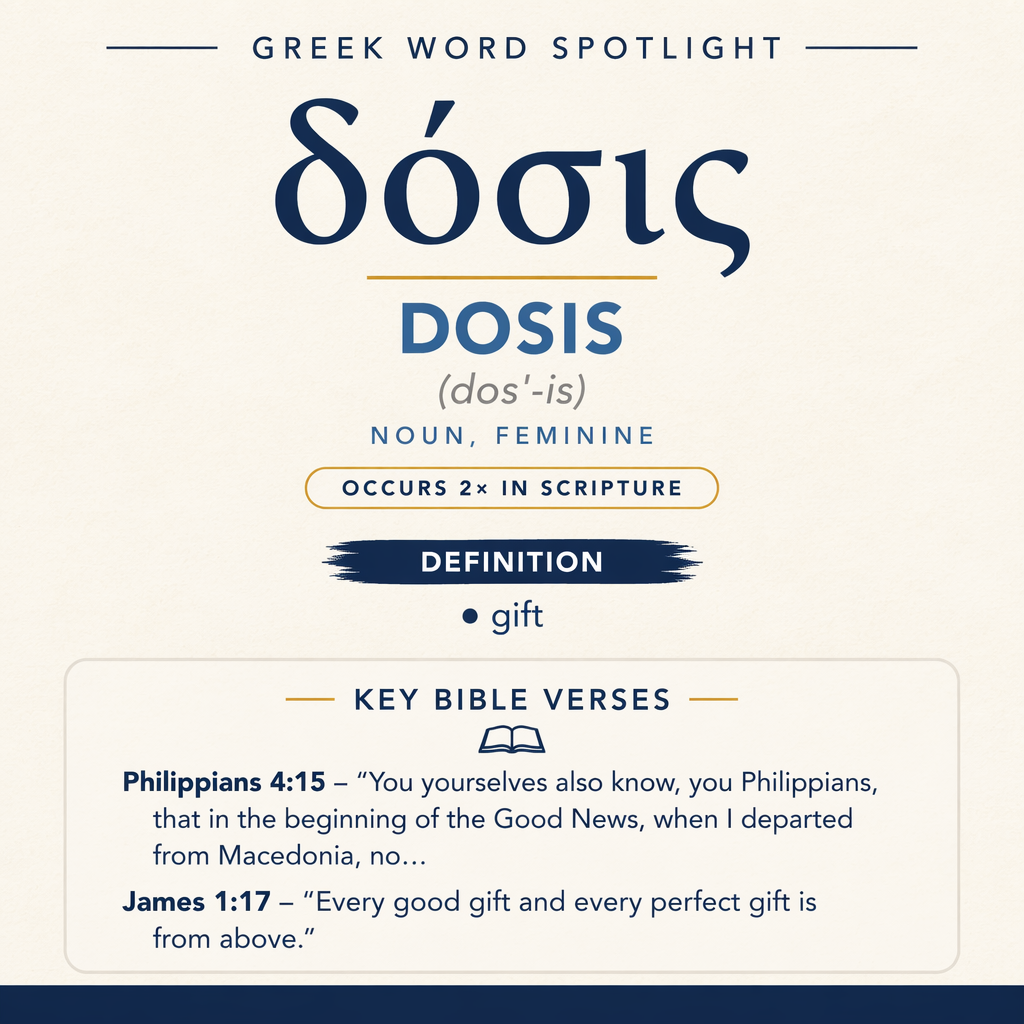
δόσις (Dosis) means “gift” and occurs twice in Scripture: Philippians 4:15 and James 1:17.
Scripture Occurrences
This word appears 2 times in Scripture. Its references are Philippians 4:15 and James 1:17.
Learn More →Verse Context
In Philippians 4:15, it appears in a passage addressing the Philippians. In James 1:17, it appears in the phrase “Every good gift and every perfect gift is from above.”
Learn More →δόσις refers to a “gift,” and it appears in two New Testament passages: one set in the practical partnership of a congregation with Paul, and one set in a theological statement about what comes down from God. In both places, the term frames giving as something bestowed, whether in human sharing or divine generosity.
Root and Related Words
δόσις is related to the verb didomi (δίδωμι), “to give” (Strong’s G1325). The connection highlights the action of giving as the source-domain for the noun’s use: δόσις names what is given.

Occurrences
Philippians 4:15: “You yourselves also know, you Philippians, that in the beginning of the Good News, when I departed from Macedonia, no assembly shared with me in the matter of giving and receiving but you only.”
In Philippians, δόσις appears within a commercial-sounding pairing: “giving and receiving.” The sentence is not an abstract meditation on generosity; it is a concrete recollection of a relationship between Paul and a particular assembly. The Philippians are singled out because, at a key moment (“in the beginning of the Good News,” and “when I departed from Macedonia”), they alone “shared with” Paul “in the matter” that involved δόσις. Here the word contributes to the idea of mutual participation: the community’s gift is part of an ongoing exchange that links sender and receiver. The emphasis falls on the Philippians’ distinctive role (“but you only”), so δόσις functions as evidence of their partnership when others did not enter that same pattern of sharing.
The phrasing “the matter of giving and receiving” also places δόσις within a broader framework than a single isolated act. Paul’s wording suggests an established concern or account—something that can be spoken of as a “matter” in which an assembly may or may not “share.” In this context, δόσις is not merely the object transferred; it is one pole of a relationship that includes the receiving side as well. As used here, the term helps portray the Philippians’ support as an identifiable practice, tied to real movements (“departed”) and real locations (“Macedonia”), rather than a vague sentiment.
James 1:17: “Every good gift and every perfect gift is from above, coming down from the Father of lights, with whom can be no variation, nor turning shadow.”
In James, δόσις stands in a sweeping statement: “Every good gift and every perfect gift is from above.” The word is framed not by a specific human recipient but by origin and descent: the gift is “from above,” “coming down,” and sourced in “the Father of lights.” Here δόσις contributes to a vertical picture of giving. The verse is shaped by movement language—what is given is not merely possessed but “coming down,” locating the gift’s beginning in God rather than in human initiative.
The line also pairs δόσις with evaluative descriptors: “good” and “perfect.” Without changing the basic sense of “gift,” these adjectives press attention onto the quality of what is bestowed. The verse then grounds the reliability of such giving in the giver’s character: “with whom can be no variation, nor turning shadow.” In this scene, δόσις is not treated as unpredictable or capricious; instead, the gifts’ goodness is coherent with a giver who does not shift. The noun thus participates in James’s emphasis on steadfast beneficence, presenting gifts as consistent with the unchanging source from which they come.
Sense and Usage
Across these two uses, δόσις keeps the simple sense of a “gift,” yet each context shapes how the reader feels its weight. In Philippians 4:15, the term is embedded in communal memory and practical support. The gift belongs to an exchange that marks an assembly’s commitment during a transitional period in Paul’s work. The focus is not on the internal attitude of the giver but on the fact of shared participation: δόσις is part of what makes their relationship measurable and distinctive (“no assembly… but you only”). The noun therefore sits close to concrete fellowship—giving is something an assembly can enter into as a recognizable practice.
In James 1:17, δόσις expands outward to include “every” instance of such benefaction that can be called “good” and “perfect.” The gift is traced upward in origin and downward in arrival, so the word functions as a bridge between heaven and earth: what people experience as benefaction is described as something bestowed from above. The emphasis on “coming down” keeps the term from remaining merely conceptual; it suggests that gifts arrive, reaching recipients as an act of gracious bestowal. The accompanying affirmation that there is “no variation, nor turning shadow” anchors the notion of gift in the stability of the giver, so that δόσις carries an implication of dependable generosity within this verse’s own logic.
Taken together, these two occurrences present δόσις in both human and divine giving without requiring the sense to change. Philippians shows the word at home in interpersonal and ecclesial support—one group shares in giving where others do not. James sets the word within a cosmic frame, describing gifts as descending from God in a way consistent with his unchanging character. The same noun can therefore name what is transferred between people and what is bestowed from God, and the contexts supply the different horizons: partnership and remembrance on the one hand, origin and constancy on the other.
The collocation “giving and receiving” in Philippians also helps clarify δόσις by contrast: it is the giving side of a two-part relation. That pairing highlights that a gift, in this setting, is not only an item but an act that creates a recipient and thus a relationship. James, by contrast, does not balance δόσις with “receiving” terminology in the same explicit way; instead, it balances the gift with its source (“from above”) and with the giver’s unvarying nature. In both cases, δόσις is intelligible through its connections: in Philippians, through reciprocity and shared practice; in James, through descent and divine steadiness.
Imagery
In Philippians 4:15, δόσις evokes the picture of tangible support moving toward a worker who has “departed,” linking distant places through a community’s active sharing. In James 1:17, the word carries a downward motion—gifts “coming down” from “above”—and the image is lit by the title “Father of lights,” reinforced by the denial of “variation” and “turning shadow,” so that giving is pictured as steady and unmarred by change.
Sources: Lexical data from Strong’s Exhaustive Concordance and the Translators Brief Lexicon of Extended Strongs for Greek (STEPBible, CC BY). Occurrence data from the Translators Amalgamated Greek New Testament (STEPBible, CC BY). Scripture quotations from the World English Bible (public domain).