
Understanding the Meaning of Dipsuchos in Greek
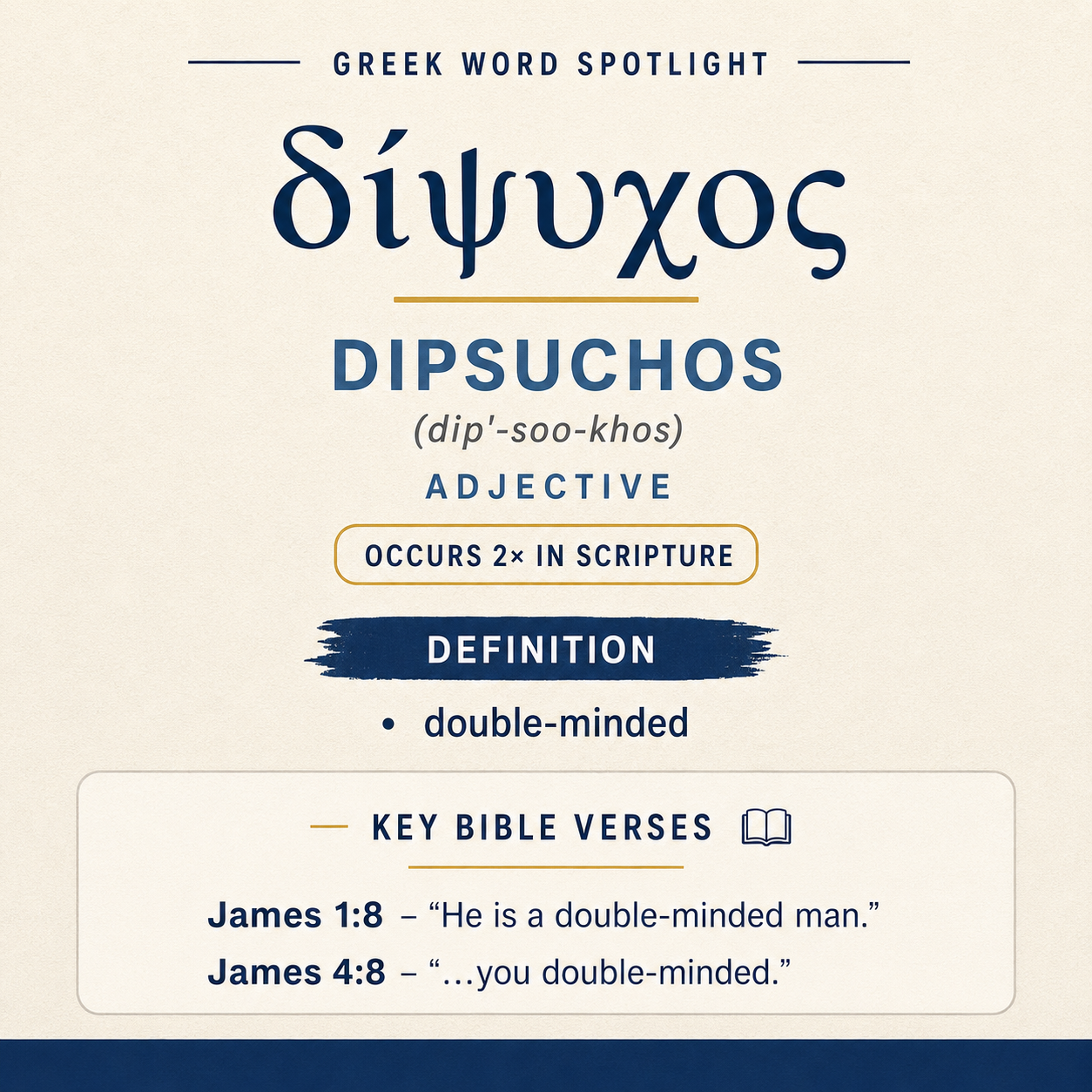
δίψυχος means “double-minded” and appears twice in Scripture, both in James (1:8; 4:8).
James Occurrences
It occurs in James 1:8 and James 4:8. In James 1:8, it describes a man unstable in all his ways.
Learn More →Call to Purity
In James 4:8, “you double-minded” is addressed alongside commands to cleanse hands and purify hearts.
Learn More →δίψυχος means “double-minded” and appears in the Letter of James in two pointed admonitions. In both places it marks an inner dividedness that shows itself in an inconsistent life and a need for cleansing and purification.
Root and Related Words
δίψυχος (Dipsuchos) is formed from δίς (dis), meaning “twice” (Strong’s G1364), and ψυχή (psyche), meaning “soul” (Strong’s G5590). The compound shape of the word presses the idea of a person whose inner life is split into two, expressing a kind of inward duplicity rather than a merely external fluctuation.

Occurrences
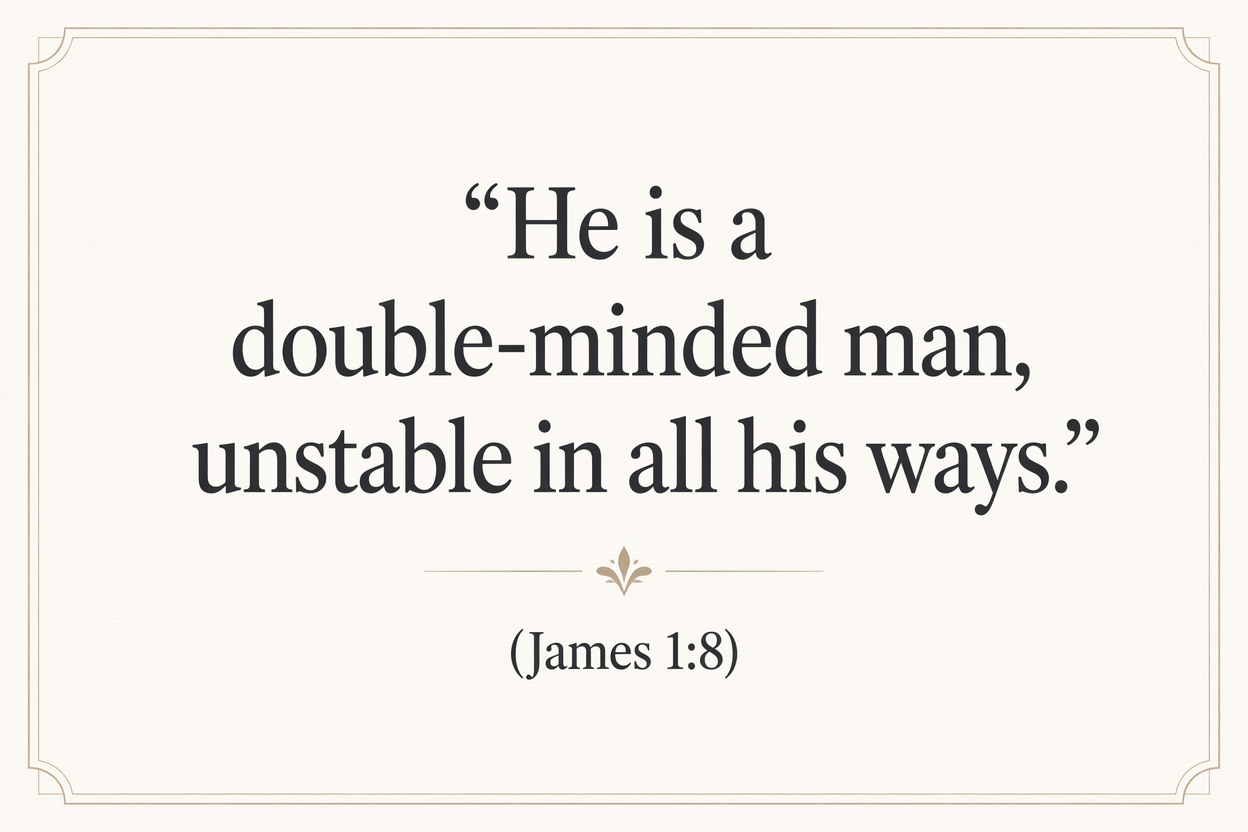
“He is a double-minded man, unstable in all his ways.” (James 1:8)
Here δίψυχος stands in apposition to “man” and is immediately interpreted in practical terms: “unstable in all his ways.” The adjective does not function as a passing label but as an explanation for the person’s lived pattern—his “ways” are affected broadly (“in all”). James uses the word to name an inner condition that produces an outward result: instability. The line’s compression is part of its force: the word identifies the person, and the remainder of the sentence shows the reach of that inner division into the whole course of life.
“Draw near to God, and he will draw near to you. Cleanse your hands, you sinners. Purify your hearts, you double-minded.” (James 4:8)
In this call to respond to God, δίψυχος appears as a direct address: “you double-minded.” The setting is explicitly relational and moral: “Draw near to God,” followed by a promise of reciprocal nearness, and then two imperatives of cleansing—“Cleanse your hands” and “Purify your hearts.” Within that sequence, δίψυχος belongs with a divided interior (“hearts”) that requires purification. The word’s placement at the end of the verse gives it a climactic role: after the summons to approach and the commands to cleanse, “you double-minded” names the inner stance that must be dealt with if nearness to God is to be real. The verse also pairs outward and inward language (“hands” and “hearts”), and δίψυχος aligns naturally with the inward side of that pairing.
Sense and Usage
Across these two uses, “double-minded” is presented as a condition of the person rather than a momentary hesitation. In James 1:8 it is tied to a comprehensive instability: the double-minded person is “unstable in all his ways.” The adjective therefore carries an evaluative weight; it is not simply describing complexity or mixed feelings, but a dividedness that makes the person unreliable in practice. The scope language (“all his ways”) shows that James treats this as pervasive rather than compartmentalized.
In James 4:8 the term is joined to repentance language that reaches both exterior conduct and interior disposition. The commands “Cleanse your hands” and “Purify your hearts” imply that the double-minded person needs more than a change of posture; the inner division has to be addressed at its source in the “heart.” Within the verse, δίψυχος stands as a name for those whose approach to God is compromised by competing inner allegiances. The call “Draw near to God” frames the issue: double-mindedness is the opposite of an undivided approach, and purification is the appropriate remedy in James’s rhetoric.
The two occurrences also show how δίψυχος works as a bridge between inner life and outward behavior. James 1:8 explicitly connects the adjective to a visible pattern (“ways”), while James 4:8 locates the problem at the level of the “heart” even as it also demands clean “hands.” Together these passages portray double-mindedness as something that affects direction, consistency, and moral posture. The word is thus well suited to James’s concern for integrity—a person’s inward stance and outward path belonging together—because δίψυχος names the fracture between the two that must be healed through purification and stable practice.
Finally, James’s choice to use δίψυχος as a direct form of address in 4:8 (“you double-minded”) shows that the term can function not only as analysis but as confrontation. It identifies a group in need of decisive action, and the verse’s imperative structure places the responsibility for change on those so named. The promised response—“and he will draw near to you”—sets nearness to God as the relational goal that double-mindedness obstructs.
Imagery and Emphasis
Although δίψυχος is an inner descriptor, James attaches it to vivid, concrete language. In James 1:8 the picture is a life-path marked by instability, with “ways” that cannot keep a steady course. In James 4:8 the imagery moves to cleansing: hands washed and hearts purified. These paired images press the reader to see double-mindedness as something that does not remain hidden; it shows itself in one’s “ways,” and it calls for a cleansing that reaches both what a person does (“hands”) and what a person is inside (“hearts”).
Sources: Lexical data from Strong’s Exhaustive Concordance and the Translators Brief Lexicon of Extended Strongs for Greek (STEPBible, CC BY). Occurrence data from the Translators Amalgamated Greek New Testament (STEPBible, CC BY). Scripture quotations from the World English Bible (public domain).




