Exploring the Meaning of Didaktikos in Greek
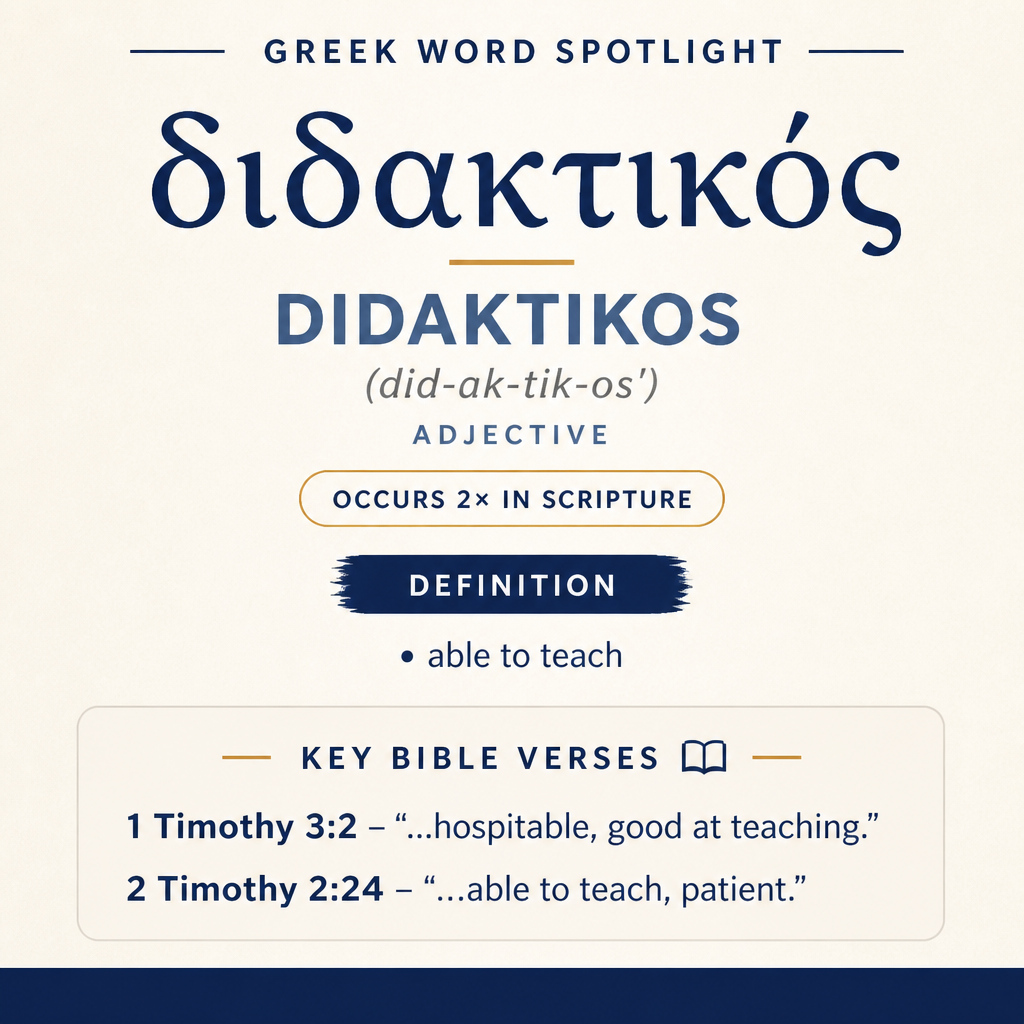
διδακτικός means “able to teach” and appears in 1 Timothy 3:2 and 2 Timothy 2:24.
Scripture Occurrences
This word occurs 2 times in Scripture: 1 Timothy 3:2 and 2 Timothy 2:24.
Learn More →Verse Context
In 2 Timothy 2:24 it is rendered “able to teach,” describing the Lord’s servant.
Learn More →διδακτικός describes a person as “able to teach.” In the New Testament it appears in two Pastoral Epistles, each time within a concise set of character qualities expected of a recognized minister.
Root and Related Words
διδακτός (didaktos), “taught” (Strong’s G1318), stands as the related form from which διδακτικός derives. The relationship links the adjective to the sphere of learning and instruction: what is “taught” on the one side, and the capacity to teach on the other.

Occurrences
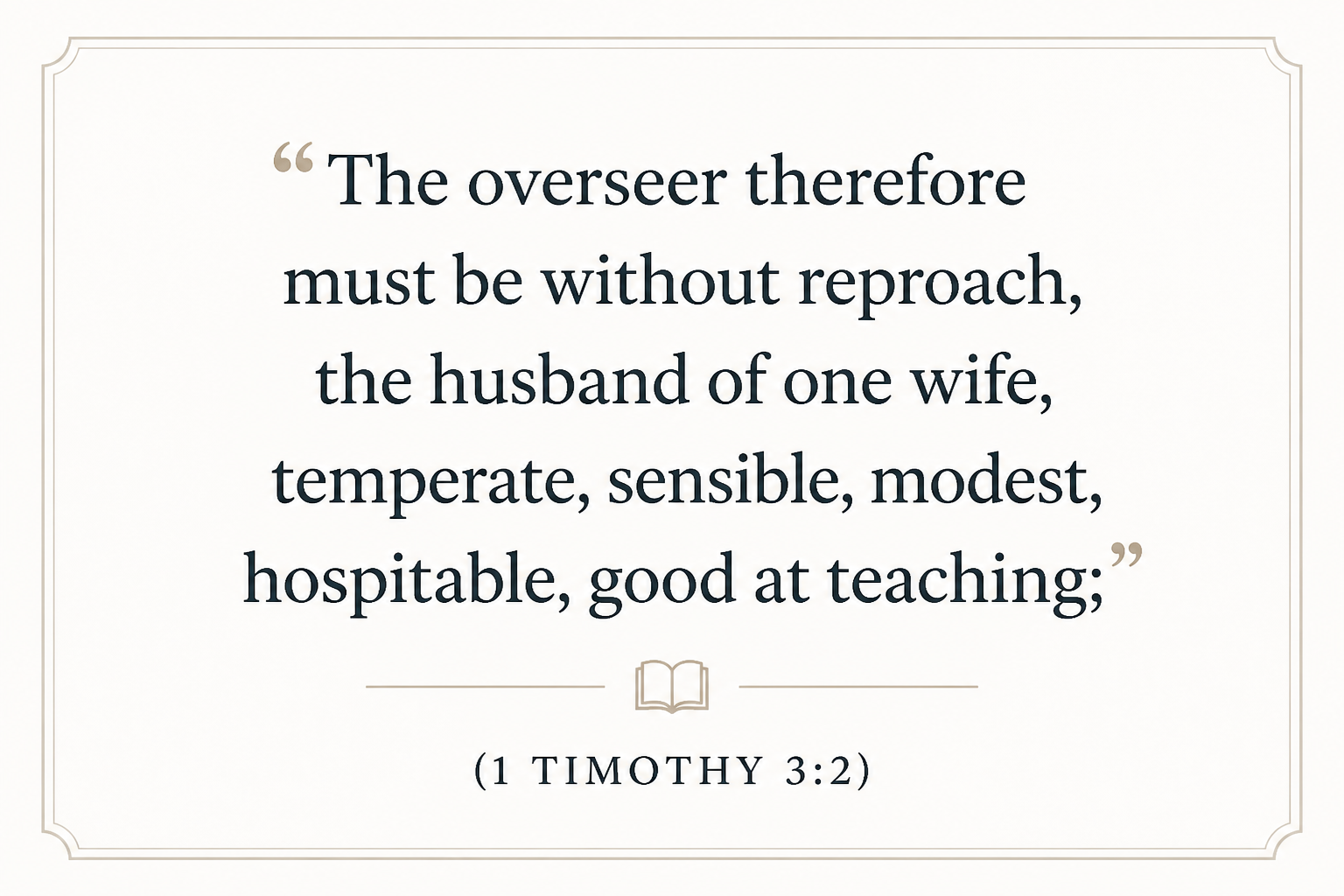
“The overseer therefore must be without reproach, the husband of one wife, temperate, sensible, modest, hospitable, good at teaching;” (1 Timothy 3:2)
Here the term is embedded in a list of qualifications for “the overseer.” The verse strings together observable traits—self-control (“temperate”), judgment (“sensible”), outward restraint (“modest”), and openness of home (“hospitable”)—and then places “good at teaching” alongside them. Within this catalog, “able to teach” functions as a practical competency rather than a private preference: it sits with public-facing virtues that make the overseer fit for a role that necessarily involves other people.
The immediate wording also frames teaching as something an overseer must be ready to do in the normal course of ministry. The verse does not isolate teaching as the sole gift required, nor does it treat it as an optional strength; it is one item in a set that defines what “must” characterize the office. In this setting, “able to teach” reads as a steady aptitude that belongs to the overseer’s profile in the same way that being “hospitable” belongs to it: a capacity expressed through ongoing interaction, not a single moment.
“The Lord’s servant must not quarrel, but be gentle toward all, able to teach, patient,” (2 Timothy 2:24)
In this verse the adjective appears in a different cluster, but it is again framed by “must.” The “Lord’s servant” is defined first by what he avoids (“must not quarrel”) and then by the manner he brings to relationships (“gentle toward all”). “Able to teach” is positioned between gentleness and patience, so the capacity to teach is pictured as operating within a particular temperament. Teaching, in this portrayal, is not paired with forcefulness or domination; it belongs with gentleness that extends “toward all” and with the endurance suggested by “patient.”
The sequence also implies that teaching is one way the Lord’s servant engages situations that might otherwise turn into disputes. Where quarrels would fracture, the servant’s combination of gentleness, teachability in practice, and patience keeps the interaction oriented toward instruction rather than contention. The verse does not redefine “teaching” as something other than teaching; it instead situates the act of teaching inside a relational posture that refuses to escalate conflict.
Sense and Usage
Across its two uses, διδακτικός names a capability expected of recognized Christian ministers: the “overseer” (1 Timothy 3:2) and the “Lord’s servant” (2 Timothy 2:24). The shared feature is that the word is not presented as an occasional talent but as a stable fitness for service. In both verses it is included among traits that shape how a leader is perceived and how he behaves among others. The two lists differ—one leans toward household- and reputation-related qualities, the other toward conflict-avoidance and interpersonal conduct—but “able to teach” belongs naturally in each, connecting leadership with the ability to convey instruction.
The surrounding qualifiers help show what kind of “ability” is in view. In 1 Timothy 3:2, the term stands among qualities that can be tested in everyday life: an overseer’s self-restraint, judgment, and hospitality are not merely internal; they become evident through repeated choices. Placed there, “able to teach” likewise suggests a competency that can be recognized over time. It is the sort of ability that would become apparent to a community that listens, learns, and observes whether instruction is given with clarity and appropriateness. The verse’s structure makes “good at teaching” part of the public trustworthiness required for oversight.
In 2 Timothy 2:24, the capacity is framed by moral and emotional restraint. The “Lord’s servant” must not be drawn into quarrels; instead he is “gentle toward all” and “patient.” In that environment, teaching is not merely the transfer of information; it is a form of service carried out in a way that matches gentleness and patience. The word therefore carries a sense of readiness to instruct without resorting to contentiousness. The ability is compatible with, and in practice expressed through, a manner that does not break fellowship through argumentative force.
Taken together, the occurrences show that διδακτικός belongs to the vocabulary of pastoral qualification. It is not attached to a setting like a classroom in these texts; it is attached to persons who bear responsibility in the church. That placement gives the adjective a vocational feel: it marks those who will inevitably face moments requiring explanation, correction, and guidance, and it identifies a basic suitability for that task. The word’s two contexts also guard against narrowing the idea to mere platform ability. The overseer’s teaching aptitude sits beside hospitality and modesty; the Lord’s servant’s teaching aptitude sits beside gentleness and patience. In both cases, ability is integrated with character.
Imagery and Texture
Although διδακτικός is an attribute rather than a concrete object, the two verses give it a lived setting. In 1 Timothy 3:2 the word evokes the ordinary scene of an overseer among people—known well enough for his steadiness to be assessed, opening his life to others, and instructing as part of his charge. In 2 Timothy 2:24 it evokes the quieter strength of a servant who refuses quarrels and instead teaches with a gentleness “toward all,” holding patience in reserve when tensions rise.
Sources: Lexical data from Strong’s Exhaustive Concordance and the Translators Brief Lexicon of Extended Strongs for Greek (STEPBible, CC BY). Occurrence data from the Translators Amalgamated Greek New Testament (STEPBible, CC BY). Scripture quotations from the World English Bible (public domain).