
Exploring the Meaning of Diaireo in Greek
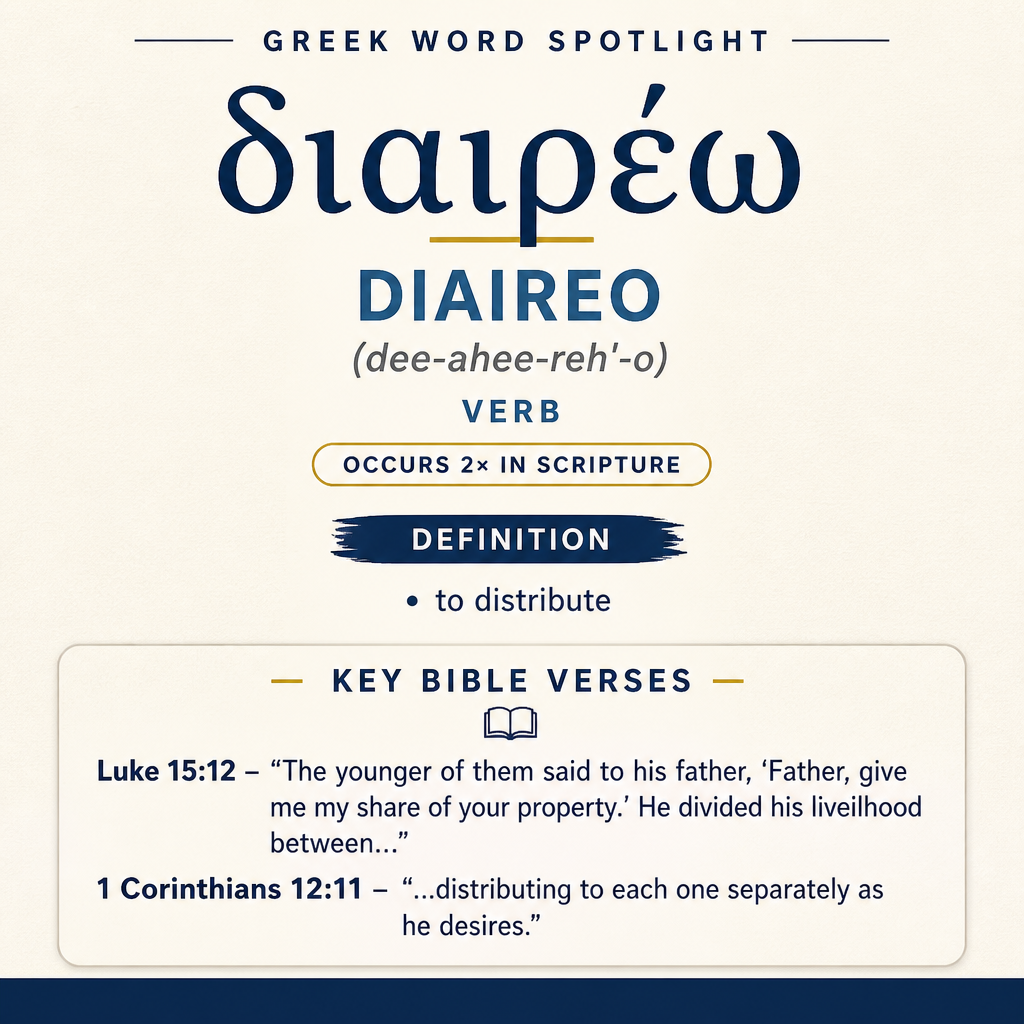
διαιρέω (Diaireo) means “to distribute” and appears twice in Scripture: Luke 15:12 and 1 Corinthians 12:11.
Core Meaning
διαιρέω means “to distribute.” In Luke 15:12 it describes dividing a livelihood between sons.
Learn More →Scripture Occurrences
This verb occurs 2 times in Scripture. The references are Luke 15:12 and 1 Corinthians 12:11.
Learn More →Contextual Usage
In 1 Corinthians 12:11, the Spirit distributes to each one separately as he desires. In Luke 15:12, a father divides his property between his sons.
Learn More →διαιρέω expresses the act of distributing, and it appears in two scenes: a father dividing his livelihood between his sons and the Spirit distributing gifts among individuals. In both settings the word describes an active apportioning that results in distinct portions being assigned.
Root and Related Words
διαιρέω is connected with διά (dia), “through/because of” (Strong’s G1223), and αἱρέω (haireomai), “to choose” (Strong’s G138). Read together as related elements, they point to an action that moves “through” a set of recipients with a selecting or assigning movement, fitting the idea of portions being allotted out across more than one person.
Occurrences
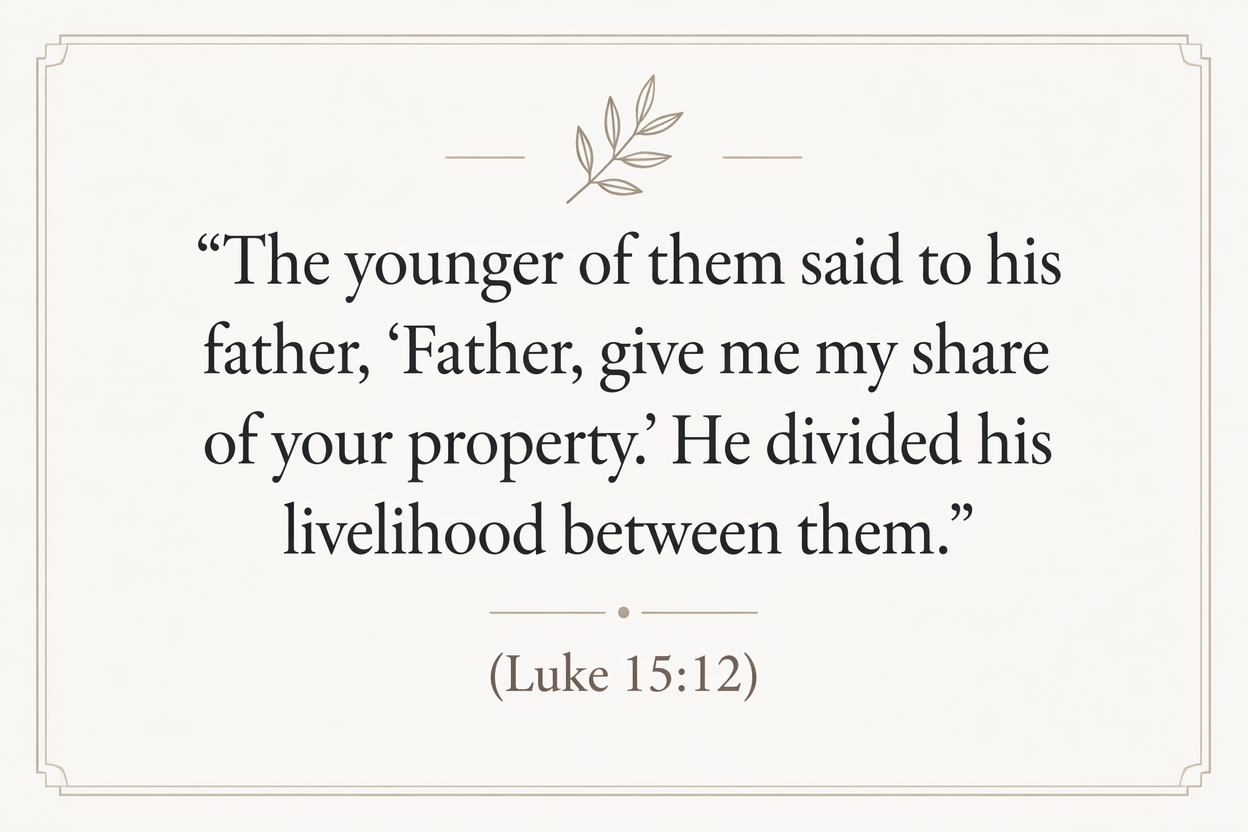
“The younger of them said to his father, ‘Father, give me my share of your property.’ He divided his livelihood between them.” (Luke 15:12)
Here διαιρέω names the father’s concrete response to a request for a “share.” The son asks for “my share of your property,” and the father’s act of distributing is described as dividing “his livelihood between them.” The word thus carries a household-and-estate setting: something that belongs to one person (“his livelihood”) is apportioned so that multiple parties hold portions. The narrative emphasis falls on the father’s decisive action—he does not merely acknowledge the request but performs an actual distribution that changes how the family’s resources are held. The phrase “between them” is important for the scene: the distribution is relational and comparative, mapping a single pool of livelihood onto at least two recipients in a way that creates distinguishable shares.
Because the object is “his livelihood,” the distribution is not presented as a trivial handout. The word is placed at the moment a father’s means of life are parceled out, so the verb highlights the weight of what is being distributed: a resource tied to ongoing life, not simply a one-time item. Luke’s sentence is short and direct, and διαιρέω does much of the narrative work—this is the pivot where an internal family request becomes an external reallocation of goods.
“But the one and the same Spirit produces all of these, distributing to each one separately as he desires.” (1 Corinthians 12:11)
In this context διαιρέω describes distribution carried out by “the one and the same Spirit.” The verse frames the action with two balancing claims: unity of source (“one and the same Spirit”) and variety at the point of reception (“to each one separately”). The distributing is part of the Spirit’s production of “all of these,” and the verb explains how that single producing agency reaches individuals: it assigns out what is produced so that each person receives something in a distinct way.
The words “to each one separately” sharpen the picture of distribution. The Spirit’s act is not a general, undifferentiated giving; it is a distribution that results in individualized allotments. The clause “as he desires” locates initiative and discretion with the distributor rather than the recipients. In this sentence, διαιρέω therefore communicates an ordered apportioning that is personal in its endpoints and intentional in its pattern—gifts are not randomly scattered but distributed in line with the Spirit’s will.
Sense and Usage
Across its two uses, διαιρέω consistently portrays distribution as an act that moves from a single source toward multiple recipients, producing separate portions. In Luke 15:12, the distribution is of “livelihood” within a family, prompted by a son’s demand for “my share.” The verb captures the concrete dividing that makes “share” a reality: the father’s resources are reallocated so that what had been held together under his stewardship now exists in distinct portions “between them.” In 1 Corinthians 12:11, the distribution is not of property but of what the Spirit “produces,” yet the mechanics are comparable: one agent distributes, and the result is that “each one” has something “separately.”
The two scenes also show how distribution can be understood without changing the basic idea. In Luke, the action takes place within ordinary economic life—property and livelihood, shares, and family members. In Corinthians, the setting is communal life shaped by the Spirit’s activity, where the distributor is not a human householder but “the one and the same Spirit.” Yet διαιρέω functions similarly in both: it marks the moment when an undivided source is intentionally apportioned out so that multiple recipients are each addressed by the distribution.
The immediate phrasing in each verse adds nuance to how distribution is conceived. Luke’s “between them” underscores distribution as a dividing that establishes comparative portions among people who stand in relation to one another. Corinthians’ “to each one separately” underscores distribution as individually targeted assignment, and “as he desires” stresses purposeful discretion. Taken together, these uses show distribution as more than mere transfer: it is structured allotment, making distinct shares visible and effective in a relational group (a family in Luke; a community addressed by “each one” in Corinthians).
Imagery in Context
In Luke 15:12, διαιρέω carries the imagery of a household estate being portioned out—resources that sustain life being divided so that different family members hold their own shares. In 1 Corinthians 12:11, the imagery shifts to a unified source distributing varied allotments throughout a group: one Spirit, many recipients, and distribution that reaches “each one separately” according to the distributor’s desire. In both passages, the word evokes the moment when what is held by one is intentionally apportioned among many, creating distinct portions where there had been a single store.
Sources: Lexical data from Strong’s Exhaustive Concordance and the Translators Brief Lexicon of Extended Strongs for Greek (STEPBible, CC BY). Occurrence data from the Translators Amalgamated Greek New Testament (STEPBible, CC BY). Scripture quotations from the World English Bible (public domain).





