
Understanding the Significance of Diagregoreo in Greek
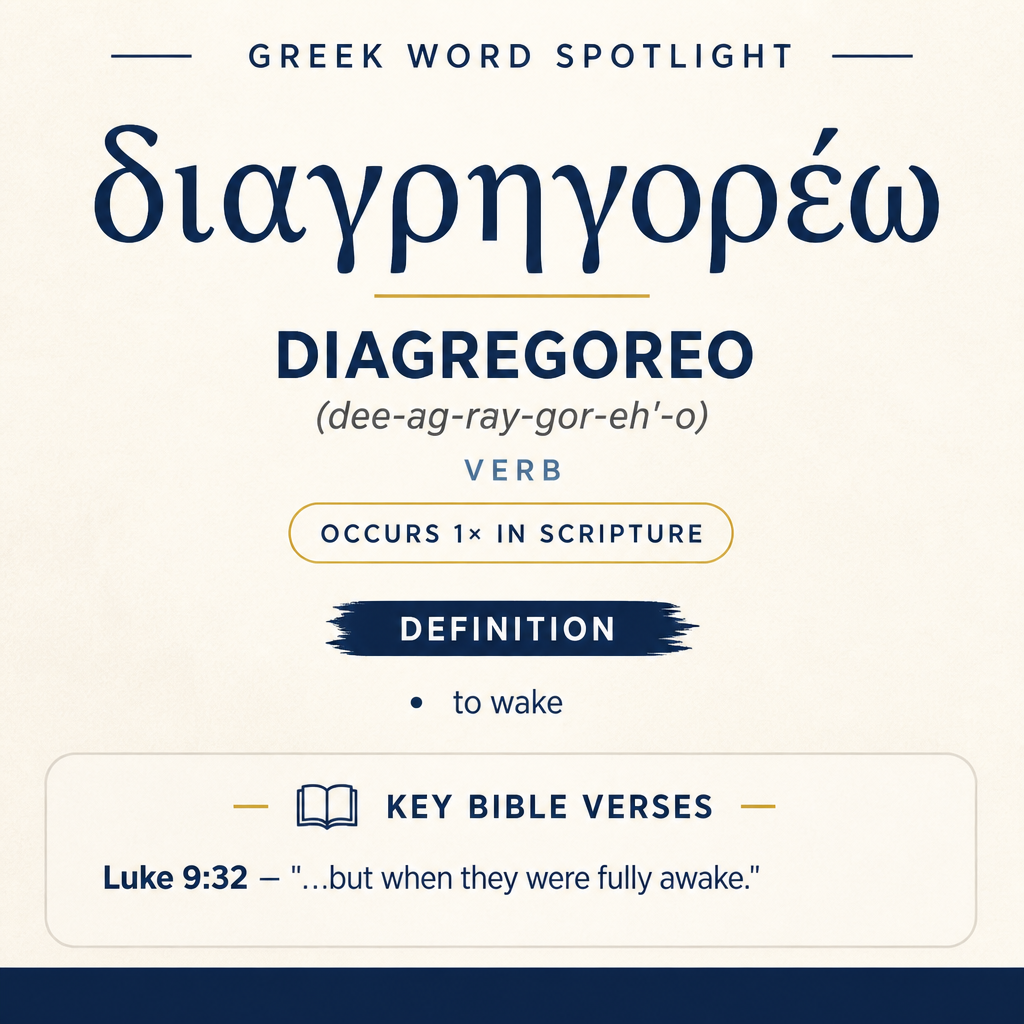
διαγρηγορέω means “to wake” and appears once in Scripture, in Luke 9:32.
Scripture Occurrence
διαγρηγορέω occurs 1 time in Scripture. Its single occurrence is in Luke 9:32.
Learn More →Luke 9:32 Context
In Luke 9:32, Peter and those with him were heavy with sleep. When they were fully awake, they saw Jesus’ glory.
Learn More →διαγρηγορέω means “to wake,” and it appears in the account of Peter and his companions during the vision of Jesus’ glory in Luke 9:32. In that scene it marks the moment sleep gives way to clear awareness, opening the way for sight and recognition.
Root and Related Words
διαγρηγορέω is connected with the verb gregoreuo (γρηγορέω), “to keep watch,” and with the preposition dia (διά), “through/because of.” Together these related words frame waking as more than a passing sensation: an alert state that comes through an overcoming of sleep and results in watchful awareness.

Occurrences
“Now Peter and those who were with him were heavy with sleep, but when they were fully awake, they saw his glory, and the two men who stood with him.” (Luke 9:32)
In Luke’s wording, the movement of the sentence is from physical weariness to full wakefulness, and the verb stands at the hinge. Peter and his companions begin “heavy with sleep,” a condition that suggests dulled perception and limited engagement with what is happening around them. The turning point comes “when they were fully awake,” and only then does the narrative state the resulting perception: “they saw his glory, and the two men who stood with him.” διαγρηγορέω therefore functions as the narrative prerequisite for seeing; it signals that the disciples’ awareness is restored and intensified to the point that they can observe and register what is before them.
The verse links waking with visual recognition in a tightly connected sequence: heavy sleep → full wakefulness → sight. The seeing is not described as a vague impression but as specific observation: “his glory,” and “the two men who stood with him.” In this setting, the verb marks not merely that they are no longer asleep, but that their wakefulness is complete enough to support attentive perception of persons and of what accompanies Jesus. The emphasis on the result (“they saw”) shows waking as an enabling condition for witness within the narrative frame of the passage.
Sense and Usage
The defined sense “to wake” is expressed here with an added note of completeness: “fully awake.” Luke places the verb in contrast with being “heavy with sleep,” so waking is presented as the overcoming of a weight that presses a person toward unconsciousness. The usage highlights the transition from impaired awareness to active perception. In other words, διαγρηγορέω is not employed in an isolated statement about sleep, but in a scene where waking has immediate interpretive consequences: once wakefulness occurs, the disciples can see and identify what they are encountering.
Because the verse immediately attaches seeing to the state of being “fully awake,” the verb carries the practical idea that wakefulness is the condition for receiving and processing what is present. Luke’s phrasing does not describe the content of the awakening as speech or action on the disciples’ part; instead, it frames waking as readiness—an opened capacity—to behold. The scene therefore uses the verb to mark a decisive change in the disciples’ ability to attend to reality: their eyes and minds are no longer suppressed by sleep, and the narrative can proceed to what they perceive.
The related verb gregoreuo (γρηγορέω), “to keep watch,” sits naturally beside this usage, since Luke’s portrayal of full wakefulness aligns with alertness that can observe. Likewise dia (διά), “through/because of,” fits the verse’s logic of transition: the disciples pass through heaviness of sleep into a fully waking state, and because they are awake they are able to see. Within the single attested context, then, “to wake” carries the sense of entering a state of alert awareness that makes perception possible and meaningful.
Imagery
Luke 9:32 paints waking as a threshold moment: drowsy disciples become “fully awake,” and the world before them becomes visible in a new way—“his glory” and “the two men who stood with him.” The word’s imagery is simple and concrete: the lifting of sleep’s weight so that sight can occur, turning a scene that might have passed unnoticed into one that is witnessed.
Sources: Lexical data from Strong’s Exhaustive Concordance and the Translators Brief Lexicon of Extended Strongs for Greek (STEPBible, CC BY). Occurrence data from the Translators Amalgamated Greek New Testament (STEPBible, CC BY). Scripture quotations from the World English Bible (public domain).





