
Understanding the Significance of Derma in Greek
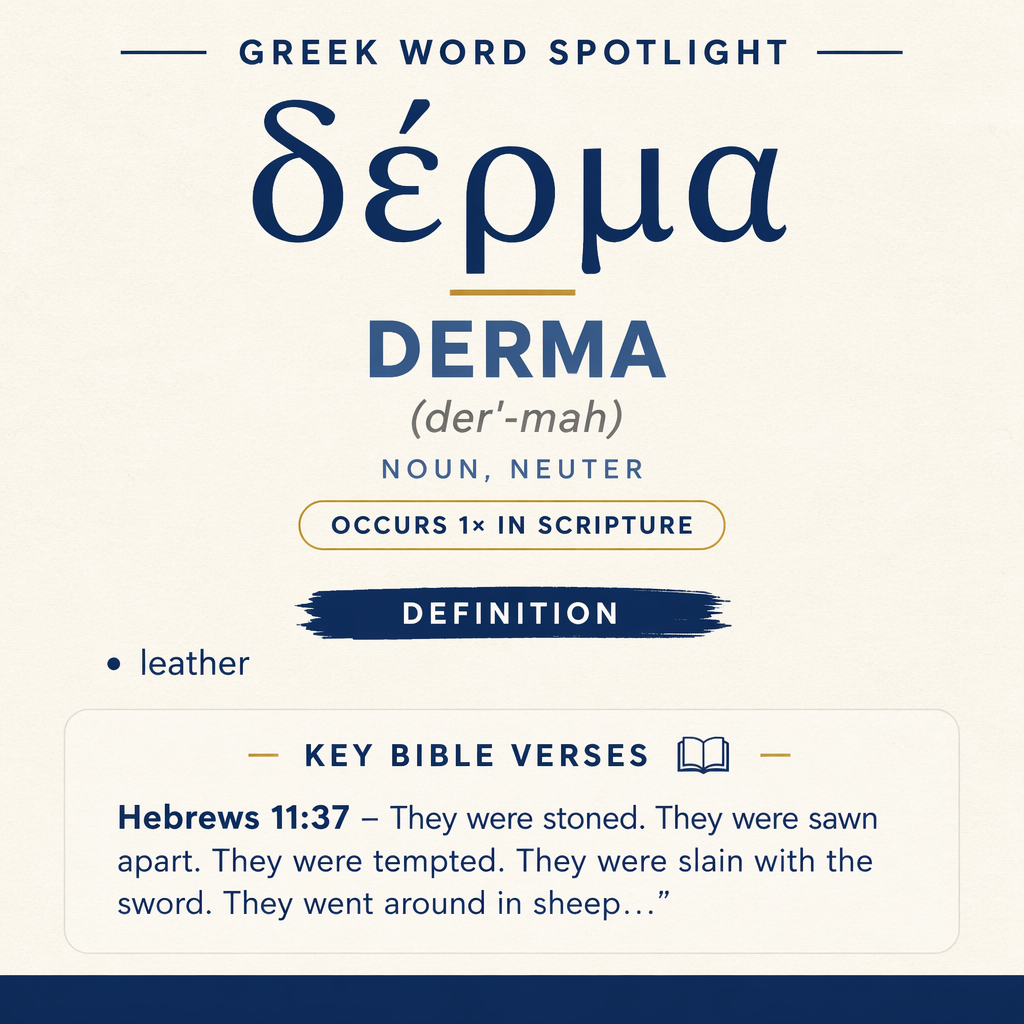
δέρμα means “leather” and appears in Hebrews 11:37.
Scripture Occurrence
It occurs 1 time in Scripture. The occurrence is in Hebrews 11:37.
Learn More →Context in Hebrews
Hebrews 11:37 includes the phrase “They went around in sheep ski…” where δέρμα appears.
Learn More →δέρμα refers to “leather” and appears in a single New Testament passage describing the conditions endured by faithful sufferers. In its lone context it belongs to a catalog of hardships and portrays a life marked by exposure and deprivation.
Root and Related Words
δέρμα is related to the verb derō (δέρω), “to beat up” (Strong’s G1194).

Occurrences
“They were stoned. They were sawn apart. They were tempted. They were slain with the sword. They went around in sheep skins and in goat skins; being destitute, afflicted, ill-treated—” (Hebrews 11:37)
Here δέρμα stands within the phrase “sheep skins” and “goat skins,” specifying the material of what these people “went around in.” The verse is structured as a rapid sequence of short statements—stoned, sawn apart, tempted, slain—followed by a depiction of ongoing life on the move. Within that movement, “skins” functions as a visible marker of their condition: not simply that they traveled, but that they did so clothed in the leather of animals rather than in ordinary, comfortable garments. The clause that follows (“being destitute, afflicted, ill-treated—”) interprets this outward circumstance as part of a broader pattern of suffering and social rejection. δέρμα therefore contributes concrete texture to the portrait, placing “destitute” and “afflicted” into a tangible scene of harsh living.
The pairing of two kinds of skins (“sheep” and “goat”) makes the image specific and grounded. The emphasis is not on fashion or craft but on necessity: the verse presents these skins as what the sufferers had, worn while they were actively “going around.” In the flow of the sentence, δέρμα helps the reader feel the difference between violent episodes (stoned; slain) and the long endurance between those episodes (moving about under hardship). Leather, as the substance named, is the physical medium through which the verse communicates that endurance.
Sense and Usage
The sense “leather” is expressed indirectly through the compound expressions “sheep skins” and “goat skins,” where δέρμα denotes the material aspect of those skins—animal hide used as covering. The word’s contribution is materially descriptive: it highlights what the covering is made of, not merely that some covering exists. Within Hebrews 11:37 the mention of leather coverings aligns with the surrounding terms “destitute, afflicted, ill-treated,” showing deprivation in a way that is immediately imaginable.
Because the verse frames these figures as people who “went around” in such skins, δέρμα also serves the rhetoric of endurance. The hardships are not only momentary acts done to them; there is also a sustained mode of life characterized by want. In this one occurrence, δέρμα communicates that sustained hardship by pointing to a minimal, utilitarian covering—an article of clothing defined by its raw material. The word thus functions as an economical detail that anchors a long list of sufferings in an everyday reality.
In the same sentence, the word sits beside a series of passive experiences (“were stoned … were slain”) and an active, habitual action (“went around”). The leather clothing bridges these: it suggests a continuing state resulting from persecution and exclusion. It is not presented as a symbol in itself but as a plain object within a portrait of deprivation. The lexical value of δέρμα in this context is to make that portrait concrete.
Imagery
Hebrews 11:37 compresses extreme violence and prolonged hardship into a few lines, and δέρμα contributes a stark, physical image within that compression. “Sheep skins” and “goat skins” place the reader in a world where survival and movement are carried out with the simplest of materials. The mention of leather coverings, set right before “destitute, afflicted, ill-treated—,” leaves the impression of exposure and poverty that can be seen as well as felt.
Sources: Lexical data from Strong’s Exhaustive Concordance and the Translators Brief Lexicon of Extended Strongs for Greek (STEPBible, CC BY). Occurrence data from the Translators Amalgamated Greek New Testament (STEPBible, CC BY). Scripture quotations from the World English Bible (public domain).





