Exploring the Meaning of Dekatoo in Greek
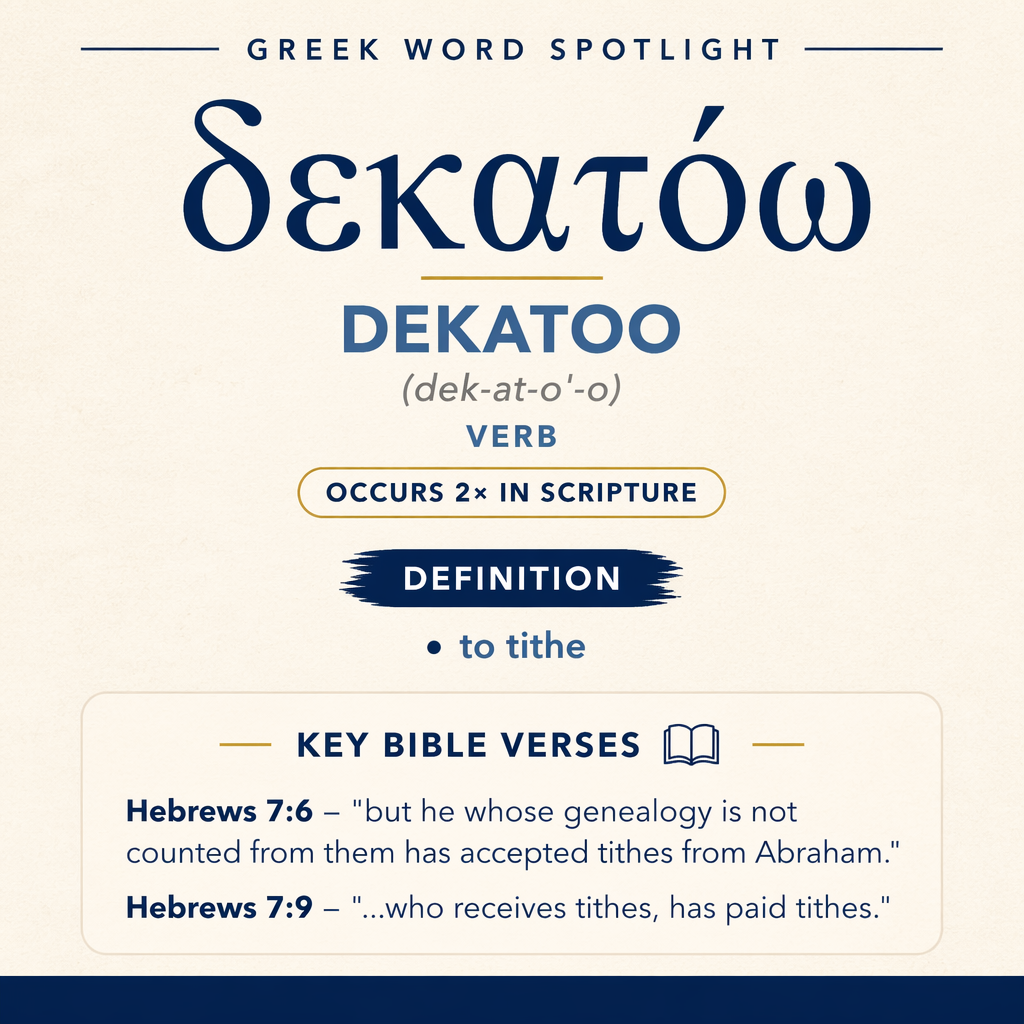
δεκατόω means “to tithe” and appears twice in Scripture, in Hebrews 7:6 and 7:9.
Hebrews Context
In Hebrews 7:6 it refers to accepting tithes from Abraham. In Hebrews 7:9 it refers to paying tithes through Abraham.
Learn More →δεκατόω expresses the act of tithing. It appears in Hebrews 7 within an argument about Abraham, Levi, and the receiving and paying of tithes.
Root and Related Words
δεκατόω is related to δεκάτη (dekate), “tenth” (Strong’s G1181).

Occurrences
“but he whose genealogy is not counted from them has accepted tithes from Abraham, and has blessed him who has the promises.” (Hebrews 7:6)
In this line, δεκατόω frames a concrete transaction: someone “has accepted tithes from Abraham.” The act is presented as deliberate and completed (“has accepted”), making the tithe a definite act of giving and receiving rather than a vague attitude of generosity. Hebrews links this reception of tithes with another stated action in the same verse—“has blessed him who has the promises”—so the verb participates in a paired description: the one who receives tithes from Abraham is also the one who blesses Abraham. The structure of the sentence positions tithing as a relational act between persons, not merely an arithmetic portion, and it functions as evidence within the author’s reasoning about status and recognition (“he whose genealogy is not counted from them”).

“We can say that through Abraham even Levi, who receives tithes, has paid tithes,” (Hebrews 7:9)
Here δεκατόω is used for “has paid tithes,” and the verse sets the action within a layered representation: “through Abraham even Levi… has paid tithes.” The clause “who receives tithes” identifies Levi by a characteristic role, and against that backdrop the statement that he “has paid tithes” creates a reversal: the one known for receiving is portrayed as giving. The verb therefore serves the author’s argumentative move from literal action (“paid”) to mediated participation (“through Abraham”), showing how a tithe can be spoken of as paid by someone not directly named as the immediate giver in the earlier scene. The tense again presents the action as a settled event, supporting the claim as a finished reality that the author can “say” on that basis.
Sense and Usage
Across these two occurrences, δεκατόω covers both sides of the tithe relationship: receiving tithes (Hebrews 7:6) and paying tithes (Hebrews 7:9). The passages treat tithing as a defined act that can be attributed to specific parties and used to describe their standing in relation to one another. In Hebrews 7:6, the verb belongs to a named exchange between two individuals, emphasizing that tithing can be narrated as an event (“has accepted tithes from Abraham”) that helps characterize the receiver in contrast to a genealogical category (“he whose genealogy is not counted from them”). In Hebrews 7:9, the same action is applied in a more mediated way: Levi is said to have paid tithes “through Abraham,” even while Levi is simultaneously described as one who “receives tithes.”
This pairing shows that the act of tithing in Hebrews is not used merely to describe an obligation in the abstract but to mark lines of relationship and representation. The verb’s force in both verses is transactional and relational: it identifies who gives and who receives, and it can be used to argue how one person’s action can be reckoned as bearing on another (“through Abraham”). The fact that the author can speak of Levi’s paying while defining him as a receiver indicates that δεκατόω can function rhetorically: the act is stable enough to be transferred, in speech, from one party to another by means of an expressed connection, while still retaining its sense as an act of tithing.
Imagery in Hebrews 7
In these lines, δεκατόω carries the imagery of a portioned gift moving from one party to another, and of a recognized receipt that can be appealed to in reasoning. Hebrews 7:6 places the action alongside blessing—“has accepted tithes from Abraham, and has blessed him who has the promises”—so the tithe appears as part of a scene in which giving, receiving, and blessing are all visible markers of relationship. Hebrews 7:9 adds the striking picture of a receiver portrayed as a payer: “even Levi, who receives tithes, has paid tithes,” sharpening the sense that the act of tithing can be used to depict roles and standing within an argument built from concrete acts.
Sources: Lexical data from Strong’s Exhaustive Concordance and the Translators Brief Lexicon of Extended Strongs for Greek (STEPBible, CC BY). Occurrence data from the Translators Amalgamated Greek New Testament (STEPBible, CC BY). Scripture quotations from the World English Bible (public domain).