
Exploring the Meaning of Deigma in Greek
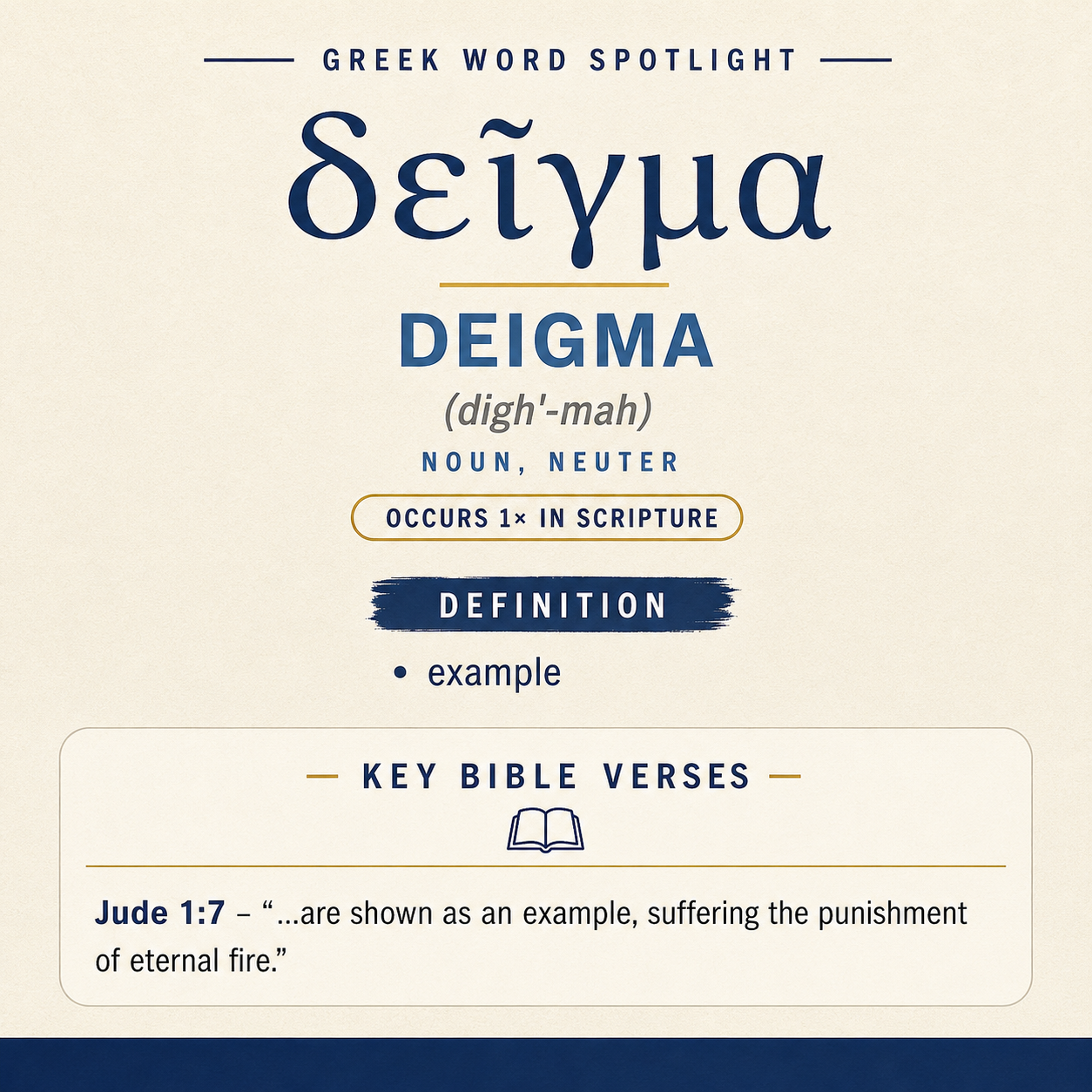
δεῖγμα means “example” and appears once in Scripture, in Jude 1:7.
Verse Context
In Jude 1:7, it appears within a statement about Sodom and Gomorrah and the surrounding cities.
Learn More →δεῖγμα means “example” and appears once in the New Testament, in Jude 1:7. In that verse it functions as a framing term, presenting a past judgment as a publicly displayed case meant to be seen and understood.
Root and Related Words
δεῖγμα is related to the verb deiknyo (δεικνύω), “to show” (Strong’s G1166). This relationship highlights the word’s orientation toward something set forth in view—an “example” as something exhibited rather than merely mentioned.

Occurrences
“Even as Sodom and Gomorrah and the cities around them, having in the same way as these given themselves over to sexual immorality and gone after strange flesh, are shown as an example, suffering the punishment of eternal fire.” (Jude 1:7)
In Jude 1:7, δεῖγμα appears in a clause that turns historical cities into a displayed instance: they “are shown as an example.” The verse presents a sequence: particular communities (“Sodom and Gomorrah and the cities around them”) are characterized by actions (“given themselves over to sexual immorality and gone after strange flesh”), and then their present status is described—they “are shown as an example,” specifically while “suffering the punishment of eternal fire.” Within this structure, δεῖγμα names what their situation communicates. The cities are not treated merely as a past event; they are set forth as a case that carries a visible lesson embedded in their punishment.
The wording “are shown” places emphasis on exposure and visibility. The verse does not present the “example” as a private inference; it is something displayed. In the sentence, the “example” is inseparable from the ongoing description “suffering the punishment of eternal fire.” That suffering is not an incidental detail but the content that makes the case exemplary: the cities’ fate is what is being held out for observation. Jude’s phrasing also ties the “example” to moral description—what they “given themselves over” to and what they “gone after.” δεῖγμα thus marks the connection between conduct and consequence as something meant to be recognized when the example is “shown.”

The opening “Even as” introduces an analogy: these cities are placed alongside “these” who have acted “in the same way.” The “example” therefore functions in comparative reasoning. Jude does not use the cities only to recount what happened to them, but to position them as a precedent-like illustration for understanding the situation he is addressing. δεῖγμα is the hinge that turns the account into a demonstrative case: their punishment is presented as a specimen of what such behavior leads to.
Sense and Usage
The definition “example” in Jude 1:7 is not an abstract category label; it is a concrete use in which real places and real judgment become the displayed “example.” In this verse, an “example” is something shown, and what is shown is bound tightly to the experience described: “suffering the punishment of eternal fire.” The sense is therefore didactic by presentation—the reader is meant to see a case set out in front of them and draw appropriate conclusions from it.
Because δεῖγμα is used with a passive verb (“are shown”), the “example” is not self-generated by the cities; it is something made of them, something they have become in the telling. The verse depicts their status as exemplary in the present tense of the description, not merely as a historical report. That presentational force matches the related verb deiknyo (δεικνύω), “to show”: the “example” is something exhibited for view. Jude’s phrasing makes the “example” a mode of communication—judgment is not only an event but also a displayed case that warns by being set forth.
The verse also clarifies the boundaries of what is being exemplified without requiring any additional gloss. The “example” is not the cities’ actions alone, and not the punishment alone, but the cities as a whole situation: their conduct (“sexual immorality” and pursuing “strange flesh”) together with their outcome (“suffering the punishment of eternal fire”). The “example” is therefore a packaged instance, a complete case in which behavior and consequence are inseparable. Jude uses δεῖγμα to make that whole case stand as something observable for others who act “in the same way.”
Finally, δεῖγμα in this setting works rhetorically by making the argument feel immediate. By saying these cities “are shown as an example,” Jude presents the outcome as publicly set out, not remote. The term “example” compresses a narrative into a single demonstrative point: a case is on display, and its visible features—identified conduct and stated punishment—are sufficient for the intended warning function within the verse’s comparison.
Imagery
The imagery carried by δεῖγμα in Jude 1:7 is the image of something placed in view: cities presented as a case “shown” to others. The verse supplies the picture in its own words—communities held up as an “example” in the very fact that they are “suffering the punishment of eternal fire,” so that the example is not merely remembered but displayed through the stated consequence.
Sources: Lexical data from Strong’s Exhaustive Concordance and the Translators Brief Lexicon of Extended Strongs for Greek (STEPBible, CC BY). Occurrence data from the Translators Amalgamated Greek New Testament (STEPBible, CC BY). Scripture quotations from the World English Bible (public domain).




