Exploring the Meaning of Damazo in Greek
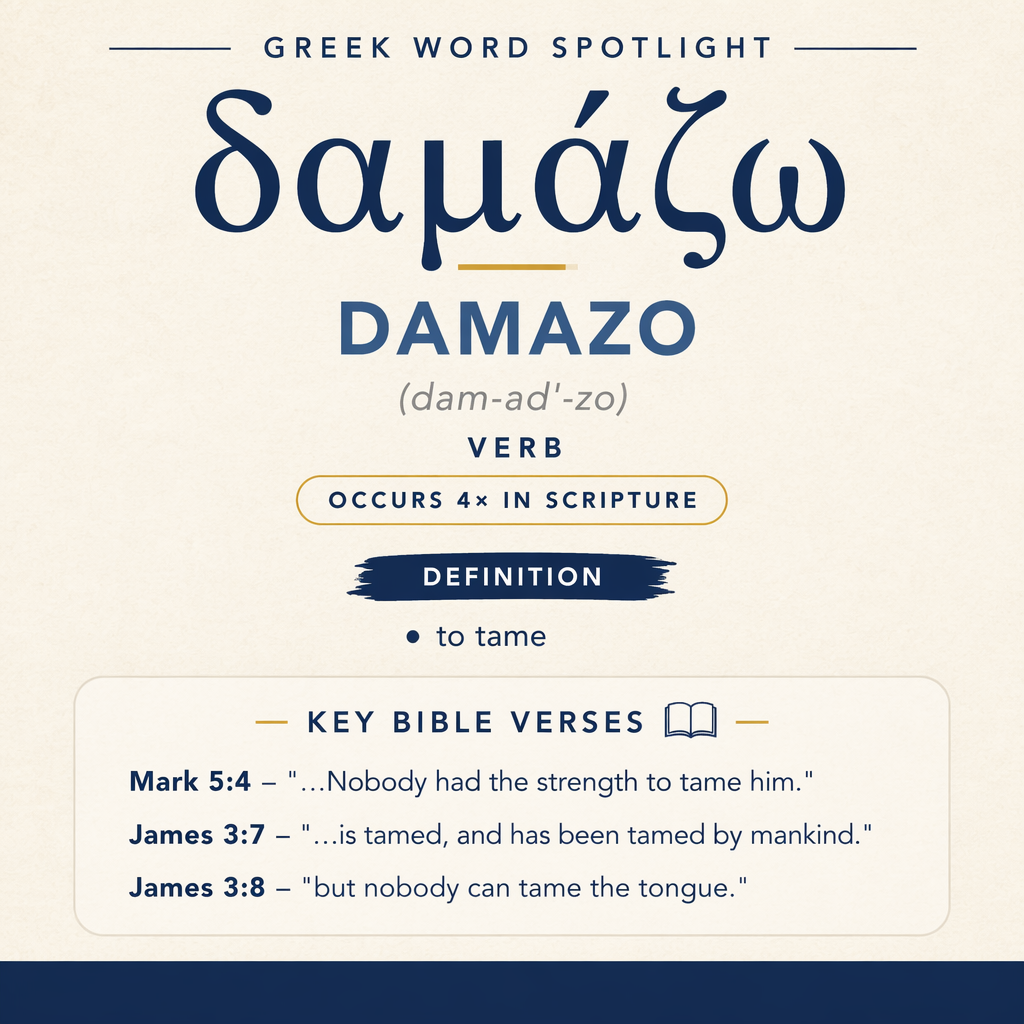
δαμάζω means “to tame” and occurs four times in Scripture, including Mark 5:4 and James 3:7–8.
Scripture Occurrences
The verb occurs four times in Scripture. It appears in Mark 5:4 and in James 3:7–8.
Learn More →Context Snapshots
In Mark 5:4, it describes a situation where restraints were repeatedly broken. In James 3:7–8, creatures are tamed by mankind, but the tongue cannot be tamed.
Learn More →δαμάζω expresses the act of taming. It appears in a narrative description of an unmanageable man in Mark and in James’s discussion of what living creatures humans can tame—and what they cannot.
Occurrences
“because he had been often bound with fetters and chains, and the chains had been torn apart by him, and the fetters broken in pieces. Nobody had the strength to tame him.” (Mark 5:4)
Here δαμάζω is set against repeated attempts at restraint. The verse piles up concrete measures—“fetters and chains”—and then stresses their failure: the chains are “torn apart” and the fetters “broken in pieces.” Against that backdrop, “Nobody had the strength to tame him” frames taming as more than simply fastening someone; it is the sought-after outcome that all those bindings aimed at but could not achieve. The word gathers the whole situation into a single verdict: despite frequent, forceful efforts, the man remained beyond human control.
“For every kind of animal, bird, creeping thing, and sea creature, is tamed, and has been tamed by mankind;” (James 3:7)
James uses δαμάζω in a sweeping claim about human capacity across the animal world. The list is deliberately expansive—“animal, bird, creeping thing, and sea creature”—so the idea of taming is not confined to one familiar class of creatures but ranges over land, air, ground-dwelling life, and the sea. The wording “is tamed, and has been tamed” presents taming both as something done in the present and as something demonstrated over time. In this sentence, δαμάζω functions as a marker of mastery that “mankind” can exercise broadly over living creatures.
“but nobody can tame the tongue. It is a restless evil, full of deadly poison.” (James 3:8)
In immediate contrast to the previous verse, δαμάζω is negated: “nobody can tame the tongue.” The move depends on the expectation created by James 3:7; after hearing that humans tame every kind of creature, the reader meets a sharp limit. The tongue is not presented as a neutral difficulty but as something actively dangerous: “a restless evil, full of deadly poison.” Within this portrayal, taming would mean bringing what is unstable and harmful under control, but the verse insists that such control is beyond human ability. δαμάζω thus carries the weight of the comparison: what seems achievable with animals is impossible with the tongue.

Sense and Usage
Across these passages δαμάζω consistently describes bringing something under control, but the scenes show different arenas and different outcomes. In Mark 5:4 the word is linked to physical domination: restraints are applied and then shattered, and the conclusion is not merely that the man is strong, but that no one has the “strength to tame him.” Taming there is the decisive form of control that repeated binding fails to produce, so the verb stands for effective subduing rather than momentary restraint.
James 3:7–8 shifts the discussion from a single uncontrollable individual to a broad statement about human capability. The catalog of creatures is intentionally comprehensive, and δαμάζω is the verb that ties them together: all these categories “is tamed.” Yet the same verb, placed under negation in the next verse, becomes the pivot for James’s argument. By choosing the same verb in back-to-back lines, James measures the tongue against the widest imaginable range of living creatures and then declares the tongue the exception to humanity’s taming power. The sense of δαμάζω remains stable—taming is still taming—but the contrast exposes a boundary: there are realities that resist the kind of control humans can exert elsewhere.
These uses also show how δαμάζω can be applied both to external and internal spheres of life. Mark’s statement concerns someone other people cannot tame, emphasizing strength and failed containment. James applies the verb to what people do with animals, and then to what people cannot do with “the tongue,” something that belongs to human speech and behavior. In this way the word can describe control over another being and also control over a human faculty, and the difference in results—successful taming of creatures versus inability to tame the tongue—drives the rhetorical force of James’s comparison.
Imagery
The imagery surrounding δαμάζω is vivid and concrete in Mark and deliberately expansive in James. Mark 5:4 pictures torn chains and broken fetters, with taming presented as the unmet goal behind those shattered restraints. James 3:7–8 evokes the breadth of the natural world—creatures of land, air, and sea—only to set beside it the tongue, described as “restless” and poisonous. In these verses, δαμάζω calls up the picture of mastery that humans can exercise widely, while also highlighting situations where such mastery fails.
Sources: Lexical data from Strong’s Exhaustive Concordance and the Translators Brief Lexicon of Extended Strongs for Greek (STEPBible, CC BY). Occurrence data from the Translators Amalgamated Greek New Testament (STEPBible, CC BY). Scripture quotations from the World English Bible (public domain).