
Exploring the Meaning of Bous in Greek
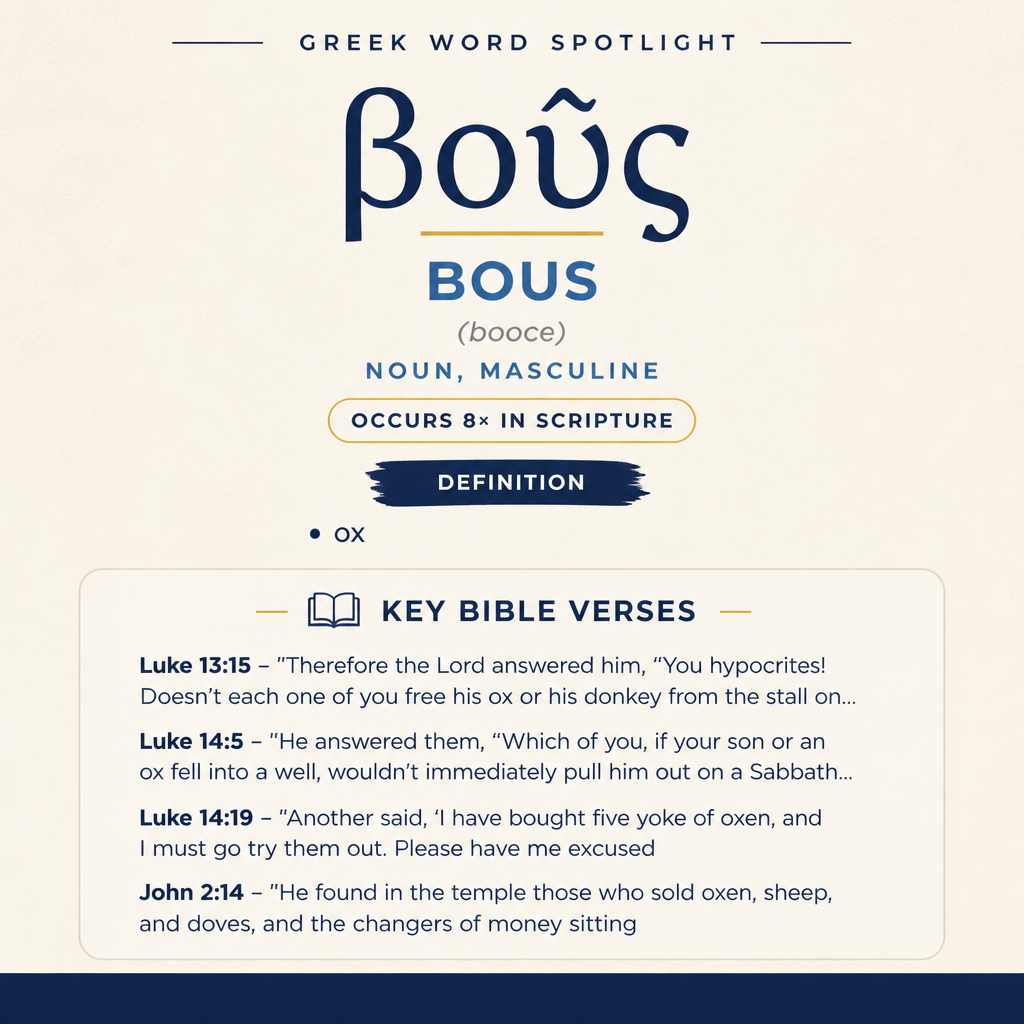
βοῦς means “ox” and occurs 8 times in Scripture, including Luke 13–14, John 2, 1 Corinthians 9, and 1 Timothy 5.
Gospel Scenes
In Luke 13:15 and Luke 14:5 it appears in Sabbath examples, and in Luke 14:19 it appears in buying five yoke of oxen. In John 2:14–15 it appears among animals sold in the temple and driven out.
Learn More →Apostolic Citation
In 1 Corinthians 9:9 and 1 Timothy 5:18 it appears in the quotation, “You shall not muzzle an ox while it treads out the grain.”
Learn More →βοῦς denotes an “ox” in scenes drawn from daily work, household care, marketplace religion, and Scripture-based argument. In the Gospels it appears in Sabbath disputes, a parable of excuses, and the temple courts; in Paul it appears in a quotation about threshing and wages.
Occurrences
Luke 13:15 — “Therefore the Lord answered him, “You hypocrites! Doesn’t each one of you free his ox or his donkey from the stall on the Sabbath, and lead him away to water?”
Here the ox stands as a familiar animal kept in a stall and needing routine care: it is “free[d]” and “lead…away to water.” The word’s force lies in its ordinariness: the speaker appeals to what “each one” does, using the ox as a representative case of a domesticated work animal whose basic needs are met even on a Sabbath. The pairing with “donkey” keeps the focus on common livestock rather than something rare or ceremonial.
Luke 14:5 — “He answered them, “Which of you, if your son or an ox fell into a well, wouldn’t immediately pull him out on a Sabbath day?””
βοῦς is placed alongside “your son” as the object of urgent rescue: one might “fall into a well” and be “immediately pull[ed]…out.” The ox functions as a strong practical example in an argument about what people instinctively do on the Sabbath. The scene also adds physical realism: an ox is large and valuable enough that its fall into a well becomes a crisis requiring prompt action.
Luke 14:19 — ““Another said, ‘I have bought five yoke of oxen, and I must go try them out. Please have me excused.’”
In the parable’s excuse, the oxen appear in quantity and in harness: “five yoke of oxen.” The word contributes economic and vocational texture—this is an acquisition connected to labor—and the speaker’s claimed necessity: “I must go try them out.” The oxen here are not merely animals present in a scene; they are assets that pull attention away from the invitation, illustrating how ordinary responsibilities and investments can become reasons to decline participation.
John 2:14 — “He found in the temple those who sold oxen, sheep, and doves, and the changers of money sitting.”
βοῦς appears as merchandise: “those who sold oxen.” The listing with “sheep, and doves” and the presence of “changers of money” place the ox within a commercial setting embedded in the temple courts. The word’s contribution is concrete and visual: large animals being offered for sale, tied to a system that requires currency exchange and thus creates a marketplace atmosphere in a sacred space.
John 2:15 — “He made a whip of cords, and threw all out of the temple, both the sheep and the oxen; and he poured out the changers’ money and overthrew their tables.”
The oxen are part of what is physically driven out: “threw all out…both the sheep and the oxen.” The word helps convey the scale of the action: it is not limited to small items or a quiet rebuke but includes clearing substantial livestock from the area. By naming the oxen specifically, the text underscores that the disruption reaches into the heart of the selling operation, alongside the money-handling that is dramatized by “poured out” coins and “overthrew” tables.
1 Corinthians 9:9 — “For it is written in the law of Moses, “You shall not muzzle an ox while it treads out the grain.” Is it for the oxen that God cares,”
Here βοῦς occurs in a direct quotation: “You shall not muzzle an ox while it treads out the grain.” The ox is pictured working at threshing (“treads out the grain”), and the instruction assumes the animal’s access to food while laboring (“not muzzle”). The rhetorical question that follows—“Is it for the oxen that God cares,”—shows how the ox serves as a starting point for moral reasoning: the concrete case of an animal at work becomes the basis for a broader argument, without the scene itself ceasing to be about an actual ox engaged in agricultural labor.
1 Timothy 5:18 — “For the Scripture says, “You shall not muzzle the ox when it treads out the grain.” And, “The laborer is worthy of his wages.””
βοῦς again appears within the same quoted line about threshing. In this context it stands beside another scriptural saying about compensation: “The laborer is worthy of his wages.” The ox functions as an illustration embedded in Scripture’s own language: the unmuzzled threshing animal becomes a parallel to the principle that work merits provision. The pairing of the two quotations makes the ox-image do argumentative work—contributing a vivid, agrarian picture that supports a claim about fair support for those who labor.
Sense and Usage
Across these passages βοῦς is consistently a real, tangible ox, not a metaphorical creature. Yet the word carries different practical associations depending on the setting. In Luke, the ox belongs to the sphere of household management and immediate necessity. The animal is kept “from the stall,” needs to be “lead…away to water,” and can face danger by “fell into a well.” The ox thus anchors arguments in what hearers recognize as normal and compelling: daily care and urgent rescue are not theoretical puzzles but familiar responsibilities.
Luke’s parable adds another angle: the ox as a tool of work and a financial commitment—“five yoke of oxen.” The yoking language frames the animal in terms of draft labor, and the purchase-and-testing scenario brings the ox into the realm of transactions, planning, and priorities. Within the excuse, the oxen are not the problem; the point is that attention to such possessions can become a decisive claim on one’s time.
In John, βοῦς appears in an environment where animals and money intersect. The temple scene names “those who sold oxen” and later depicts the clearing out of “the sheep and the oxen” along with the overturned tables and scattered money. The ox contributes to the reader’s sense of physical mass and commotion: livestock presence implies pens, handling, noise, and movement, so their expulsion signals a thorough purging of a commercial setup rather than a symbolic gesture confined to coins.
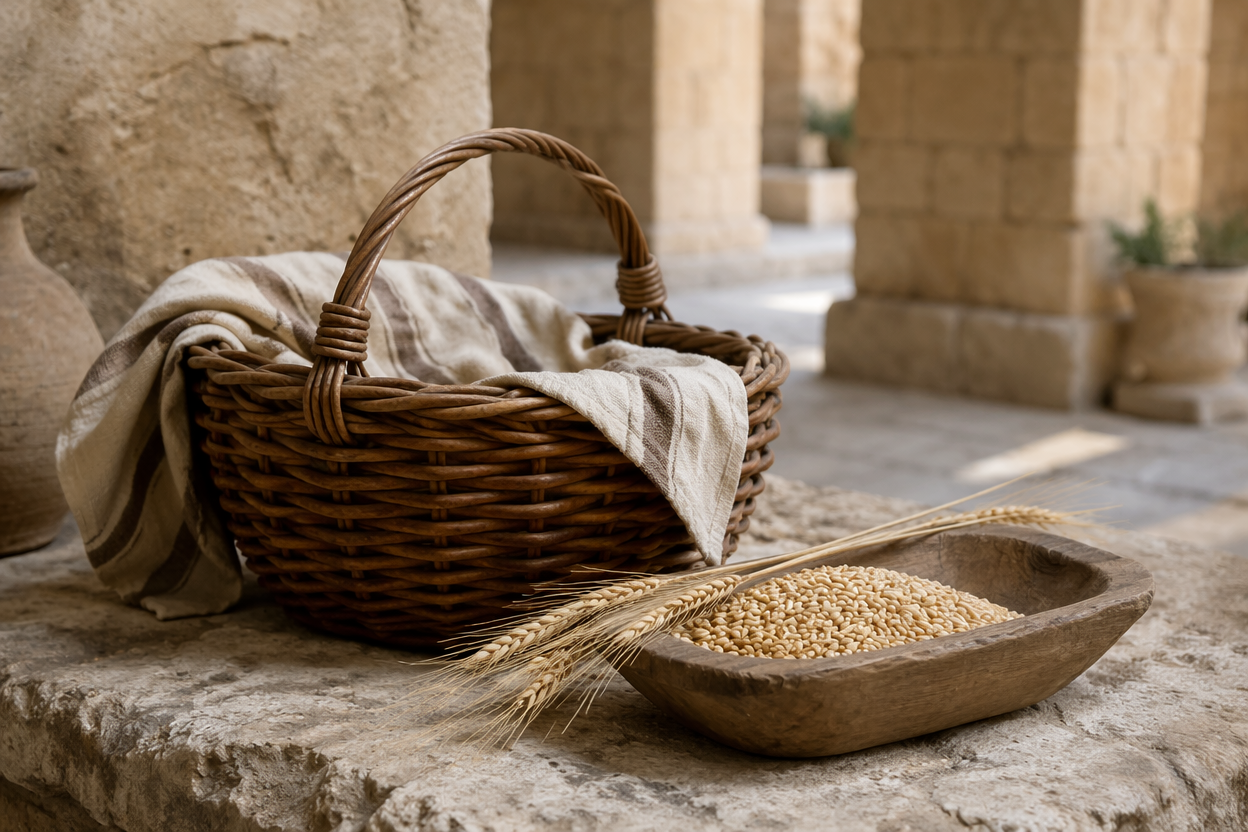
Paul’s citations in 1 Corinthians and 1 Timothy use the ox in a different register: the animal is a worker in agriculture, “treads out the grain,” and is protected from being prevented from eating (“not muzzle”). In both places the ox remains a literal animal, but it also becomes a fixed scriptural image suitable for ethical reasoning about labor and provision. The stability of the picture—an ox working the grain—allows it to serve as a shared reference point, lending weight and clarity to the argument being advanced.
Considering all the occurrences together, βοῦς gathers a coherent profile: an ox is valuable, useful, and involved in routine human life, whether in care, rescue, farming, commerce, or instruction. The word’s power in these texts comes from how readily the hearer can visualize the animal’s needs and the human actions associated with it—leading to water, pulling from a well, buying in yokes, selling in a crowded precinct, driving out of a court, and walking out the grain.
Imagery
The imagery attached to βοῦς is earthy and kinetic. It can be as quiet as leading an animal to water, as urgent as hauling it from a well, as practical as testing a newly bought team, as bustling as animals for sale beside money-changers, or as rhythmic as an ox treading grain. In each setting the ox makes the scene feel concrete: the arguments turn on recognizable actions and situations, and the reader is asked to picture the animal to grasp the point being made.
Sources: Lexical data from Strong’s Exhaustive Concordance and the Translators Brief Lexicon of Extended Strongs for Greek (STEPBible, CC BY). Occurrence data from the Translators Amalgamated Greek New Testament (STEPBible, CC BY). Scripture quotations from the World English Bible (public domain).





