Exploring the Meaning of Boulomai in Greek
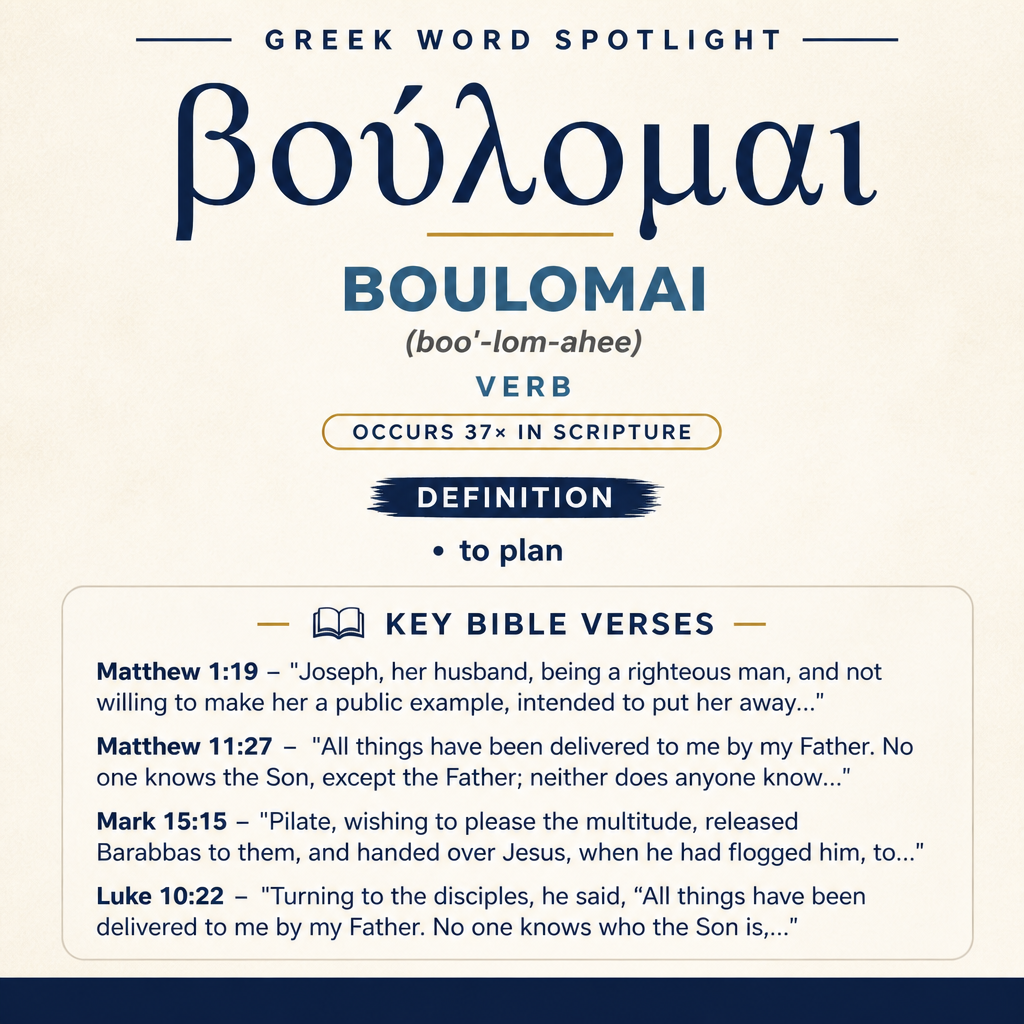
βούλομαι means “to plan” and occurs 37 times in Scripture, including Matthew 1:19; Mark 15:15; Luke 22:42; John 18:39; and Acts 5:28–33.
Core Meaning
βούλομαι is defined as “to plan.” It appears in contexts of intention or willingness in multiple passages.
Learn More →Gospel Examples
In Matthew 1:19, Joseph is “not willing” to make Mary a public example and intends to put her away. In Luke 22:42, Jesus prays, “if you are willing.”
Learn More →Acts Examples
In Acts 5:33, the council is “determined” to kill the apostles. In Acts 5:28, leaders confront the apostles about teaching in Jesus’ name.
Learn More →βούλομαι expresses planning as it is enacted in concrete decisions, stated desires, and settled intentions. In the passages below it appears in narrative, dialogue, prayer, and judicial settings, where plans range from merciful restraint to violent resolve.
Occurrences
Matthew 1:19: “Joseph, her husband, being a righteous man, and not willing to make her a public example, intended to put her away secretly.”
Here the verb sits inside a double description of Joseph’s inner deliberation: he is “not willing” toward one course (public exposure) and therefore “intended” another (a quiet separation). The planning is portrayed as purposeful and morally framed; it is a chosen approach that aims to accomplish a specific outcome (“secretly”) while avoiding another.

Matthew 11:27: “All things have been delivered to me by my Father. No one knows the Son, except the Father; neither does anyone know the Father, except the Son, and he to whom the Son desires to reveal him.”
The planning here is not about logistics but about disclosure: the Son “desires to reveal” the Father to particular recipients. The sentence sets boundaries (“except…except…”) and then locates revelation within a deliberate intention; the act of revealing is presented as the execution of a chosen plan, not an automatic diffusion of knowledge.
Mark 15:15: “Pilate, wishing to please the multitude, released Barabbas to them, and handed over Jesus, when he had flogged him, to be crucified.”
Pilate’s “wishing” functions as the stated motive that shapes his actions. The text links that plan—pleasing the crowd—to a sequence of decisions (“released…handed over…to be crucified”), showing how an intention can govern public judgment and determine outcomes for others.
Luke 10:22: “Turning to the disciples, he said, “All things have been delivered to me by my Father. No one knows who the Son is, except the Father, and who the Father is, except the Son, and he to whomever the Son desires to reveal him.”
As in Matthew, the verb marks a planned act of revelation, but Luke frames it explicitly as speech “to the disciples.” The deliberate plan is personal (“the Son desires”) and selective (“to whomever”), depicting disclosure as purposeful, directed, and under the Son’s control in the context of instruction.
Luke 22:42: “saying, “Father, if you are willing, remove this cup from me. Nevertheless, not my will, but yours, be done.”
In prayer, the verb expresses willingness as the decisive factor for what will happen next: “if you are willing.” The request (“remove this cup”) is placed under the Father’s plan, and the closing contrast (“not my will, but yours”) makes planning a matter of whose intention governs the outcome.
John 18:39: “But you have a custom, that I should release someone to you at the Passover. Therefore, do you want me to release to you the King of the Jews?”
Here planning appears as a question addressed to a crowd: “do you want me to release…?” The verb probes their intention within a known public practice (“you have a custom”), turning willingness into an expressed decision that will determine whether a prisoner is freed.
Acts 5:28: “saying, “Didn’t we strictly command you not to teach in this name? Behold, you have filled Jerusalem with your teaching, and intend to bring this man’s blood on us.”
The leaders interpret the apostles’ continued teaching as an intention with consequences for responsibility and blame: “intend to bring this man’s blood on us.” The planning is attributed as a purposeful direction of their message, not merely an accidental effect; it is framed as a targeted outcome the speakers are thought to be aiming at.
Acts 5:33: “But they, when they heard this, were cut to the heart, and were determined to kill them.”
The verb here conveys a sudden, collective resolve: they are “determined to kill them.” The narrative connects emotional impact (“cut to the heart”) to a formed plan, emphasizing how an internal reaction becomes a concrete intention toward action against the apostles.
Acts 12:4: “When he had arrested him, he put him in prison, and delivered him to four squads of four soldiers each to guard him, intending to bring him out to the people after the Passover.”
The planning is explicit and time-bound. Herod’s imprisonment is not an end in itself but part of an arranged sequence with an intended public presentation (“bring him out to the people”) scheduled “after the Passover,” reinforced by the organized guard detail. The verb marks the forward-looking purpose that explains why the steps are taken.
Acts 15:37: “Barnabas planned to take John, who was called Mark, with them also.”
In a travel-and-mission setting, the verb expresses a practical plan: Barnabas “planned to take” a particular companion. The intention is specific (a named person) and directional (“with them also”), depicting planning as a deliberate inclusion that shapes the team’s composition.
Acts 17:20: “For you bring certain strange things to our ears. We want to know therefore what these things mean.”
The Athenians’ response to unfamiliar teaching is framed as an expressed desire: “We want to know.” The verb contributes the idea of an intention to pursue understanding—an active stance that sets the stage for inquiry rather than dismissal.
Acts 18:15: “but if they are questions about words and names and your own law, look to it yourselves. For I don’t want to be a judge of these matters.”
Here the verb marks a refusal of role: “I don’t want to be a judge of these matters.” The speaker’s plan is to abstain from adjudication, drawing a boundary around his involvement. Planning appears as self-determination regarding responsibility—what he will and will not undertake.

Sense and Usage
Across these scenes, βούλομαι consistently carries planning in the sense of a directed intention that shapes what follows. Sometimes it is expressed as reluctance or restraint (Joseph “not willing” to expose Mary, and choosing a discreet course). Sometimes it is framed as a motive that drives public outcomes (Pilate “wishing to please the multitude” and then acting accordingly). In judicial and civic settings, it surfaces as a crowd’s or official’s stated preference (“do you want me to release…?”; “I don’t want to be a judge”), highlighting how intention can authorize or decline an action.
Several occurrences show the verb paired with actions that are either contemplated or already unfolding: “intended to put her away,” “intend to bring…blood on us,” “were determined to kill them,” “intending to bring him out,” “planned to take John.” In these, the verb does not merely color an emotion; it marks the forward-pointing logic of a course of action. The narrative often uses it to explain why events are moving in a particular direction—whether that direction is secrecy, public spectacle, punishment, inclusion, or investigation.
In the sayings about revelation (Matthew 11:27; Luke 10:22), planning is attached to personal disclosure rather than outward scheduling. The verb ties revelation to a purposeful decision (“he to whom…desires to reveal”), treating knowledge as something intentionally made known. In Luke 22:42, willingness belongs to the Father’s plan as the decisive condition for what will be done, and the contrast between “my will” and “yours” makes planning a matter of ultimate authority. Thus the verb can portray human intention—often pressured, contested, or morally charged—and also frame intention in relation to divine willingness and the deliberate revealing of the Father.
Implied Imagery
The passages regularly place planning at points where outcomes hang in the balance: a private decision that avoids public shame (Matthew 1:19), a governor’s intention that results in release for one prisoner and death for another (Mark 15:15; John 18:39), a leadership’s resolve that turns toward violence (Acts 5:33), and an official’s refusal to sit in judgment (Acts 18:15). Even where the plan is simply to understand (“We want to know…”; Acts 17:20), the verb gives motion to the scene by marking a settled direction of mind that seeks a next step.
Sources: Lexical data from Strong’s Exhaustive Concordance and the Translators Brief Lexicon of Extended Strongs for Greek (STEPBible, CC BY). Occurrence data from the Translators Amalgamated Greek New Testament (STEPBible, CC BY). Scripture quotations from the World English Bible (public domain).