Exploring the Meaning of Bathmos in Greek
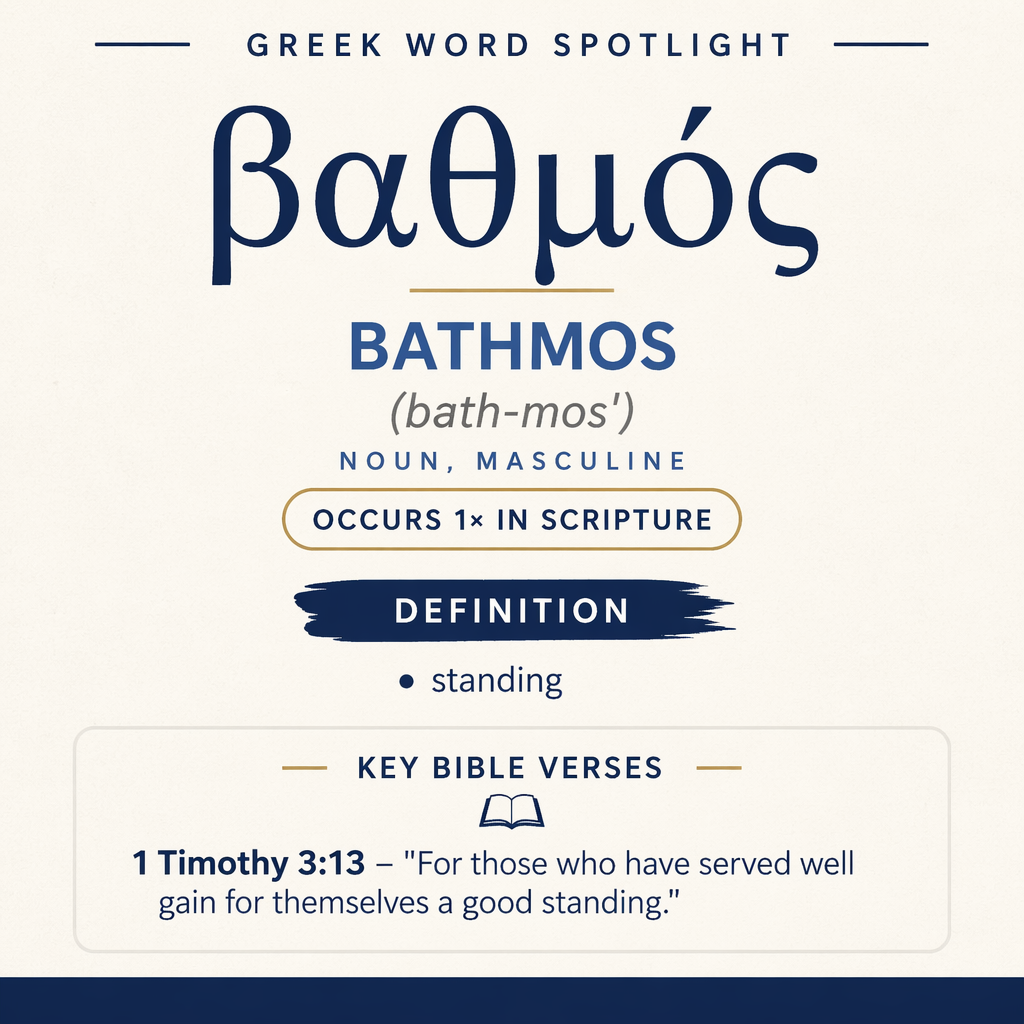
βαθμός means “standing” and appears once in Scripture in 1 Timothy 3:13.
Scripture Occurrence
This word occurs 1 time in Scripture. Its single occurrence is in 1 Timothy 3:13.
Learn More →Context in Verse
In 1 Timothy 3:13, it describes a “good standing” gained by those who have served well.
Learn More →βαθμός denotes “standing” and is attested in the Pastoral context of qualifications and outcomes for church servants. In its lone New Testament occurrence, it expresses the kind of settled position a person comes to possess as the fruit of faithful service.
Root and Related Words
βαθμός is derived from βάθος (bathos), “depth” (Strong’s G899). The relationship points to a shared lexical family in which the imagery of “depth” stands behind the notion of a person’s “standing.”

Occurrences
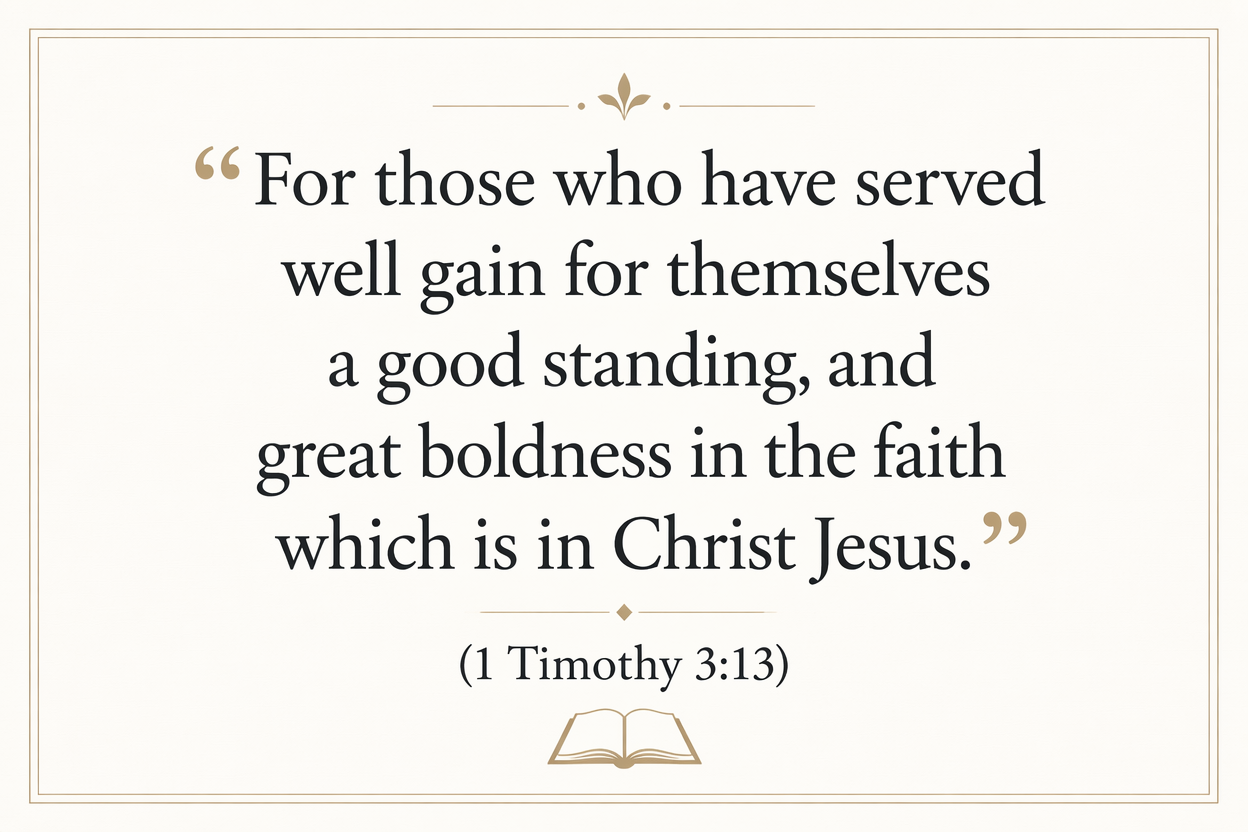
“For those who have served well gain for themselves a good standing, and great boldness in the faith which is in Christ Jesus.” (1 Timothy 3:13)
In 1 Timothy 3:13, βαθμός names what “those who have served well” come to “gain for themselves.” The verse presents it as a concrete outcome of demonstrated service: it is not merely observed by others, but “gain[ed]” as something possessed. The phrase “a good standing” places this result in the realm of recognized stability and credibility within the community addressed by the letter’s instructions. It is closely paired with a second result, “great boldness in the faith which is in Christ Jesus,” so that the verse portrays two coordinated benefits that accompany good service—one described as a “standing,” the other as an increased freedom of confidence within faith. The coordination suggests that “standing” is an outwardly describable condition with social and communal implications, while “boldness” is an internal and communicative readiness in relation to “the faith.”
The qualifying clause “who have served well” sets the moral and practical frame for the “standing.” The standing is not presented as automatic, hereditary, or granted apart from conduct; it is attached to a pattern of service characterized as “well.” In the logic of the sentence, the community’s life of ordered ministry yields a durable result for the servant, and βαθμός supplies the key noun for that result. The adjective “good” specifies the quality of this standing: it is not simply any position or status, but one evaluated as good in the same moral domain as the “served well” that precedes it.
Sense and Usage
In its New Testament usage, βαθμός functions as a term for an acquired condition of being firmly placed—one’s “standing” as a result of actions that have been tested over time. The verse’s structure highlights several features of this standing.
First, it is something that can be “gain[ed].” This frames “standing” as an outcome with a before-and-after: service precedes, standing follows. The word therefore carries a sense of settledness that comes into view after a pattern of conduct has been established. The notion of gaining implies that this standing is not merely private self-estimation; it is a recognized position that can be spoken of and acknowledged in the community’s shared life.
Second, it is described as “good.” The adjective anchors the standing in ethical evaluation rather than mere rank. In the sentence, “served well” and “good standing” mirror one another: the adverbial evaluation of service (“well”) corresponds to the adjectival evaluation of the resulting standing (“good”). This pairing suggests that the standing is not independent of character; it is the social and communal expression of proven faithfulness. The word thus depicts a stable footing that aligns with the letter’s concern for orderly, reputable ministry.
Third, the word’s placement alongside “great boldness in the faith which is in Christ Jesus” indicates that “standing” is not an isolated prize, but part of a compound outcome. The verse does not collapse these two into one; it treats them as distinct yet connected. “Standing” can be heard as the kind of firm position that supports confident speech and action, while “boldness” describes the resulting freedom and courage in relation to faith. The presence of “in the faith which is in Christ Jesus” ties the boldness explicitly to the sphere of Christian confession, but the standing is still presented as something “gain[ed]” through service. In that way, the verse portrays a harmony between faithful practice (“served well”), recognized stability (“good standing”), and strengthened confidence (“great boldness”).
Finally, in a letter that addresses standards for church servants, “standing” is naturally read as a public and relational reality: it is a way of describing how a servant comes to be placed among others. The verse does not detail the mechanisms by which this standing is conferred or perceived, but its language of gain and its pairing with boldness implies a real change in the servant’s position and confidence. βαθμός, therefore, supplies a compact noun for the settled condition that faithful service produces—an anchored place from which one’s life and testimony may proceed.
Imagery
Even in this single occurrence, βαθμός carries a plain spatial metaphor: “standing” evokes the idea of being firmly set, having a sure footing. In 1 Timothy 3:13, that footing is not pictured as static or accidental; it is reached through “serv[ing] well,” and it stands alongside “great boldness in the faith which is in Christ Jesus.” The imagery is of a servant whose faithful work results in a solid place to stand and, from that place, a strengthened readiness to act and speak with confidence within the faith.
Sources: Lexical data from Strong’s Exhaustive Concordance and the Translators Brief Lexicon of Extended Strongs for Greek (STEPBible, CC BY). Occurrence data from the Translators Amalgamated Greek New Testament (STEPBible, CC BY). Scripture quotations from the World English Bible (public domain).