
Exploring the Meaning of Ballo in Greek
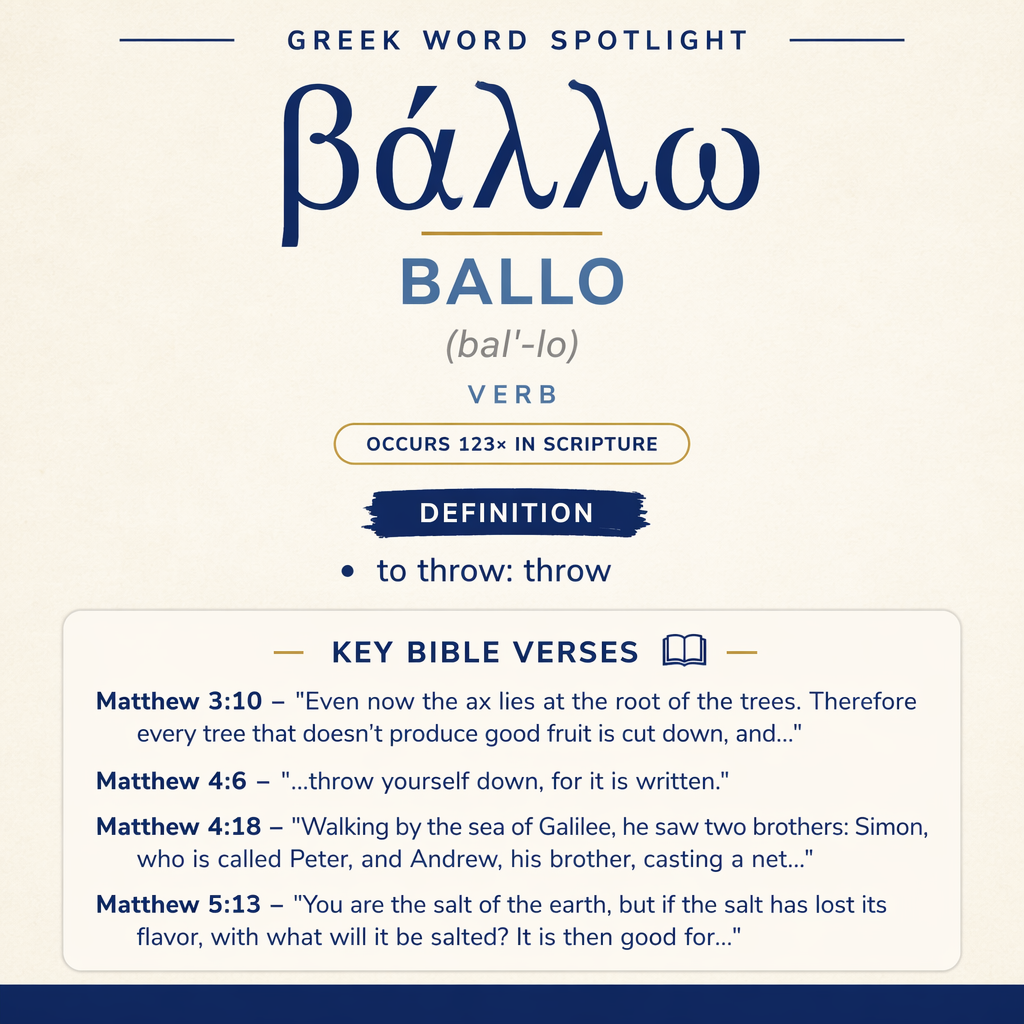
βάλλω means “to throw” and occurs 123 times in Scripture, including Matthew 3:10; 4:6,18; 5:13,29–30; and 6:30.
Matthew Examples
In Matthew 4:6 it describes throwing oneself down. In Matthew 4:18 it is used for casting a net into the sea.
Learn More →Thrown Away
In Matthew 5:29–30 it is used for throwing away what causes stumbling. In Matthew 6:30 it describes grass thrown into the oven.
Learn More →βάλλω means “to throw.” In the passages cited here, it supplies the concrete action of throwing in everyday scenes (nets, grass, pearls) and in warnings where people or things are thrown out, into prison, into fire, or into Gehenna.
Occurrences
“Even now the ax lies at the root of the trees. Therefore every tree that doesn’t produce good fruit is cut down, and cast into the fire.” (Matthew 3:10)
Here βάλλω expresses the final disposal of the unfruitful tree once it has been “cut down.” The image is forceful: what fails to produce “good fruit” is not merely removed from the orchard but actively thrown into fire, a deliberate act of judgment rather than an accident.
and said to him, “If you are the Son of God, throw yourself down, for it is written, ‘He will command his angels concerning you,’ and, ‘On their hands they will bear you up, so that you don’t dash your foot against a stone.’ ” (Matthew 4:6)
βάλλω supplies the daring physical action demanded: “throw yourself down.” The sentence frames the throw as self-initiated and risky, and the cited promise about angelic support is presented as the supposed protection from the consequences of such a throw (“so that you don’t dash your foot”).
Walking by the sea of Galilee, he saw two brothers: Simon, who is called Peter, and Andrew, his brother, casting a net into the sea; for they were fishermen. (Matthew 4:18)
In this coastal scene, βάλλω names the routine work of fishermen: the net is thrown outward “into the sea.” The verb captures a practiced, repeated motion that fits their identity (“for they were fishermen”), grounding their trade in a vivid physical act.
“You are the salt of the earth, but if the salt has lost its flavor, with what will it be salted? It is then good for nothing, but to be cast out and trodden under the feet of men.” (Matthew 5:13)
βάλλω portrays rejection and removal. Once the salt is “good for nothing,” the response is to throw it outside—an action that leads to its being “trodden under the feet of men.” The throw marks the transition from something meant to serve to something treated as waste.
Agree with your adversary quickly, while you are with him on the way; lest perhaps the prosecutor deliver you to the judge, and the judge deliver you to the officer, and you be cast into prison. (Matthew 5:25)
βάλλω here describes the end point of a legal chain of “deliver[ing]” from one authority to another: the person is finally thrown “into prison.” The verb gives the outcome a harsh, abrupt quality, emphasizing the loss of control once the process advances.
If your right eye causes you to stumble, pluck it out and throw it away from you. For it is more profitable for you that one of your members should perish, than for your whole body to be cast into Gehenna. (Matthew 5:29)
Two uses of βάλλω appear in a tightly argued contrast. First, the decisive act is to “throw it away from you,” a removal at close range meant to prevent stumbling. Second, the warning escalates: the alternative is the “whole body” being thrown “into Gehenna.” In both, the verb expresses a drastic relocation—either discarding what endangers or suffering a far greater, comprehensive casting.
If your right hand causes you to stumble, cut it off, and throw it away from you. For it is more profitable for you that one of your members should perish, than for your whole body to be cast into Gehenna. (Matthew 5:30)
The pattern from the previous saying repeats with a different body part, and βάλλω again marks the key movement: after “cut it off,” the hand is thrown away. The closing comparison again places individual self-removal against the possibility of the “whole body” being thrown into Gehenna, keeping the verb at the center of the warning’s imagery.
But if God so clothes the grass of the field, which today exists, and tomorrow is thrown into the oven, won’t he much more clothe you, you of little faith? (Matthew 6:30)
βάλλω depicts ordinary human handling of what is temporary: field grass exists “today” but is thrown “tomorrow” into an oven. The verb conveys the ease with which something living and visible becomes fuel; that everyday throw becomes the backdrop for the argument from lesser to greater about God’s care in clothing.
“Don’t give that which is holy to the dogs, neither throw your pearls before the pigs, lest perhaps they trample them under their feet, and turn and tear you to pieces.” (Matthew 7:6)
Here βάλλω is the ill-advised act of placing valuables where they will be abused: “throw your pearls before the pigs.” The verb suggests a careless or indiscriminate tossing that fails to respect the value of “pearls.” The result clause turns the throw into danger: the pigs “trample” and then “turn and tear,” so the act of throwing becomes both wasteful and perilous.
Every tree that doesn’t grow good fruit is cut down, and thrown into the fire. (Matthew 7:19)
As in the earlier tree image, βάλλω presents the final fate of a fruitless tree after it is “cut down.” The throw into “the fire” completes the picture of removal and destruction, with the verb focusing attention on the act that consigns the tree to burning.
and saying, “Lord, my servant lies in the house paralyzed, grievously tormented.” (Matthew 8:6)
This verse foregrounds the servant’s condition—“lies in the house paralyzed.” The posture is static and helpless, setting a scene where being “thrown” would only intensify vulnerability; the statement’s force lies in the contrast between the servant’s inability to move and the urgency implied by “grievously tormented.”
When Jesus came into Peter’s house, he saw his wife’s mother lying sick with a fever. (Matthew 8:14)
Again the scene centers on someone “lying” ill. The stillness of the setting highlights the kind of situations in these narratives where action verbs like βάλλω, when used, carry strong directional force—moving objects or persons decisively—over against the immobility of sickness in a house.

Sense and Usage
Across these contexts, βάλλω repeatedly marks a transfer from one place to another accomplished by forceful, decisive motion. Sometimes the throw is ordinary and skilled: fishermen cast a net “into the sea” (Matthew 4:18), and grass is thrown “into the oven” as a routine step in using it as fuel (Matthew 6:30). In such scenes, the verb emphasizes direction (“into the sea,” “into the oven”) and the completion of the action—what is in hand ends up elsewhere.
In other scenes the same action becomes a figure for rejection, loss, or punishment. Salt that has become “good for nothing” is thrown out to be trampled (Matthew 5:13). A person who does not resolve conflict is thrown into prison (Matthew 5:25). Fruitless trees are thrown into fire (Matthew 3:10; Matthew 7:19). In each, βάλλω conveys more than movement; it marks a decisive verdict on worth and destiny within the image: what is useless or condemned is not kept, stored, or repaired, but forcibly removed and assigned to a damaging environment (fire, prison, trampling).
The sayings about the eye and hand use βάλλω to sharpen a contrast in scale and outcome (Matthew 5:29–30). “Throw it away from you” presents self-initiated, urgent separation from what causes stumbling, while “cast into Gehenna” places the whole person under a far more severe casting. The verb’s repeated presence tightens the logic: a smaller, chosen throwing-away stands against the larger, feared being-thrown.
Matthew 7:6 shows how βάλλω can also characterize a misjudged act of placing something valuable. Throwing pearls before pigs is not a neutral relocation; it is a setting that invites trampling and violence. The verb’s bluntness underscores the mismatch between “pearls” and “pigs,” and it makes the warning practical: the way something is “thrown” can determine what happens next.
Imagery
These passages make βάλλω a vivid carrier of direction and outcome: nets go into the sea, grass into an oven, pearls before pigs, salt out underfoot, bodies into prison, trees into fire, and the whole person into Gehenna. The repeated “into” and “out” settings give the verb a consistent visual strength—throwing places something where it will be used, wasted, harmed, or destroyed, and the destination in each scene interprets the force of the throw.
Sources: Lexical data from Strong’s Exhaustive Concordance and the Translators Brief Lexicon of Extended Strongs for Greek (STEPBible, CC BY). Occurrence data from the Translators Amalgamated Greek New Testament (STEPBible, CC BY). Scripture quotations from the World English Bible (public domain).




