Understanding the Biblical Significance of Azotos in Greek
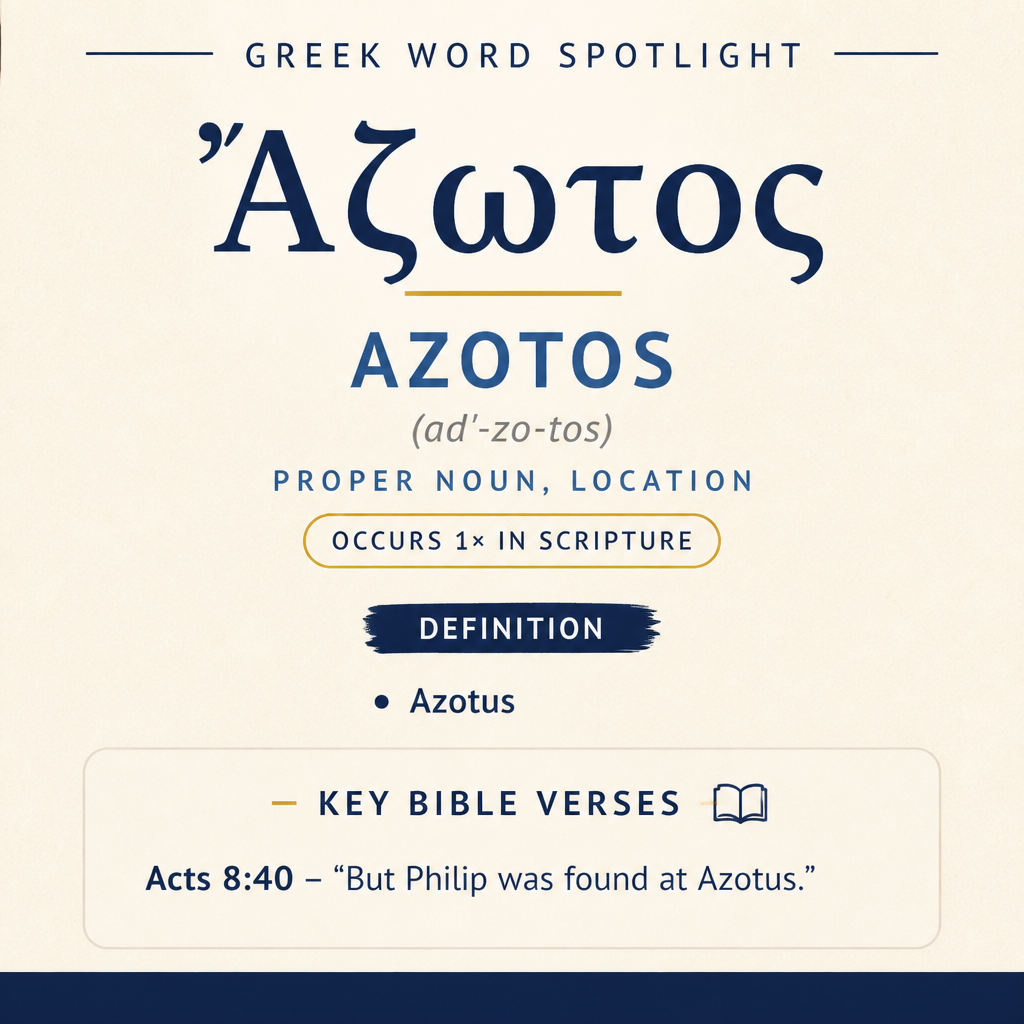
Ἄζωτος means “Azotus” and appears once in Scripture in Acts 8:40.
Context in Acts
In Acts 8:40, Philip was found at Azotus and preached the Good News through the cities until Caesarea.
Learn More →Ἄζωτος names the place called “Azotus.” It appears once, in Acts 8:40, where it anchors Philip’s location in the unfolding movement of his preaching along a route of cities.
Occurrences
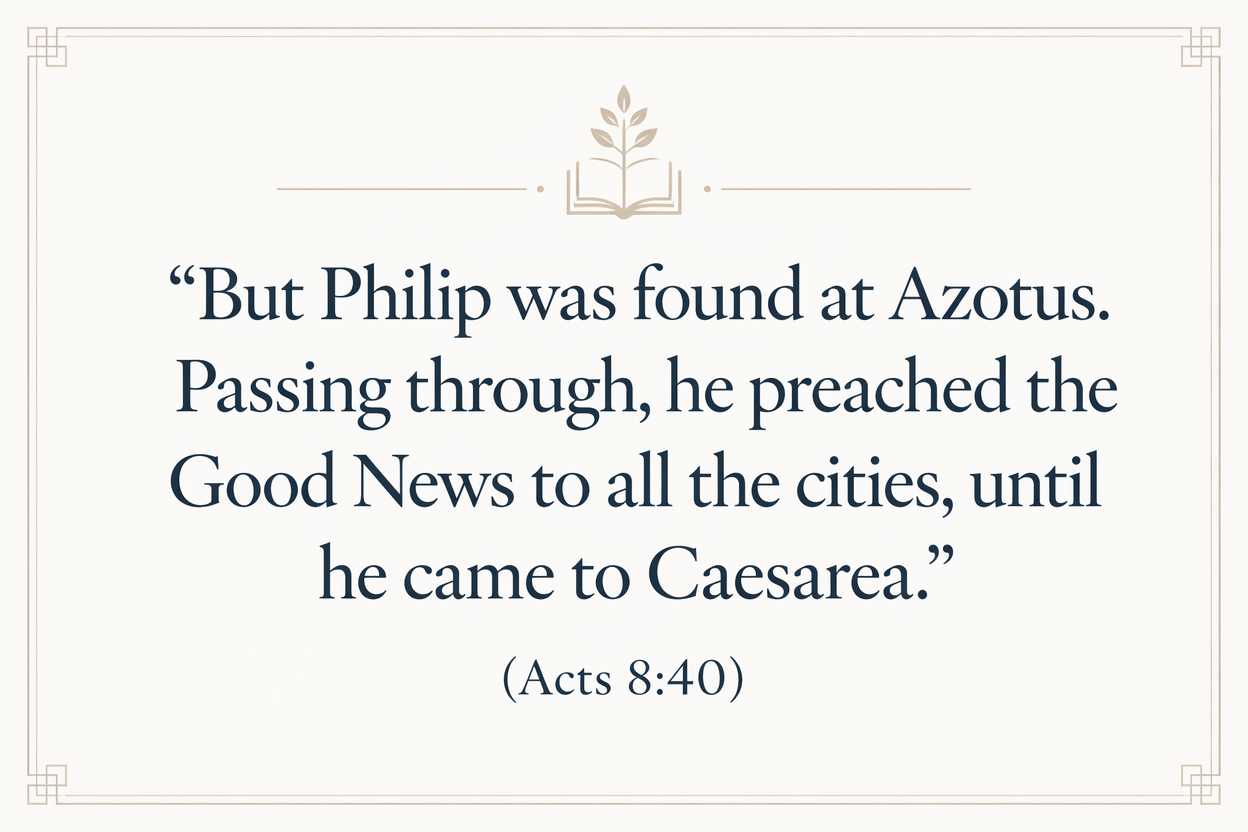
“But Philip was found at Azotus. Passing through, he preached the Good News to all the cities, until he came to Caesarea.” (Acts 8:40)
Here Ἄζωτος functions as a concrete geographical marker in a concise travel notice. The sentence opens with a passive-style report—“Philip was found at Azotus”—that places Philip at a definite point on the map without describing how he arrived there. In the narrative logic of the verse, Azotus is the first named location in a chain of movement: from Azotus, Philip is pictured “Passing through,” and his passing is not aimless but filled with activity—“he preached the Good News to all the cities.” The mention of Azotus therefore does more than supply a destination; it establishes the starting location for a stretch of itinerant proclamation. The verse then frames the extent of that movement with an endpoint clause, “until he came to Caesarea,” making Azotus the initial anchor of a trajectory that culminates at Caesarea.
Azotus also helps the reader feel the narration’s pace. The verse compresses what could have been a longer account into a quick sequence: found at Azotus → passing through → preaching broadly → arriving at Caesarea. By naming Azotus at the outset, the text gives this rapid summary a specific beginning, turning a general report (“he traveled and preached”) into a geographically situated summary (“from Azotus… until he came to Caesarea”). In this way, Ἄζωτος contributes a sense of groundedness: Philip’s preaching is presented as taking place within real locales, in a movement that touches “all the cities” along the way rather than being limited to a single point.

Sense and Usage
The definition “Azotus” indicates that Ἄζωτος is used as a proper place name. In Acts 8:40 it does not describe a quality, role, or institution; it simply names a location. That simplicity is rhetorically effective in a verse focused on transition: the narrative does not linger on Azotus itself, yet by naming it the text can summarize an entire span of activity with clarity. The place name becomes a narrative hinge: it is where Philip is located at the moment the verse opens, and it serves as the point from which his subsequent “Passing through” is imagined.
Within the single attestation, the place name also interacts with the verse’s two other geographical references: “all the cities” (an intentionally broad sweep) and “Caesarea” (a specific terminal location). Against the expansiveness of “all the cities,” Azotus is a precise dot; against the specificity of Caesarea, Azotus is a corresponding starting dot. The verse thus uses a named place (Azotus) to set the boundary conditions for an unnamed set of places (“all the cities”), capped by another named place (Caesarea). This gives the reader a sense that the proclamation mentioned—“he preached the Good News”—is not confined to a single audience but is carried through a succession of urban settings, beginning from Azotus and extending until the stated arrival at Caesarea.
Because Ἄζωτος appears in a travel-and-preaching summary, it bears the ordinary narrative force of a waypoint: it is the location at which a character is “found,” the platform from which further motion is described. The verse’s wording leaves Azotus as a locale that is important not for description but for orientation. The name does not invite interpretation within the verse; it invites the reader to track where the action is taking place and how the action moves.
Imagery in Context
Acts 8:40 sets Azotus within imagery of motion and message: a traveler “Passing through” and “preach[ing] the Good News” across multiple cities, progressing “until he came to Caesarea.” In that compressed picture, Azotus stands as the first fixed point in a moving line—an identifiable place where the messenger is located, from which the work spreads outward along the route the verse sketches. The place name therefore carries the simple but vivid imagery of a real location on the way, a beginning point for a passage marked by continued travel and continued proclamation.
Sources: Lexical data from Strong’s Exhaustive Concordance and the Translators Brief Lexicon of Extended Strongs for Greek (STEPBible, CC BY). Occurrence data from the Translators Amalgamated Greek New Testament (STEPBible, CC BY). Scripture quotations from the World English Bible (public domain).