
Exploring the Meaning of Atimos in Greek
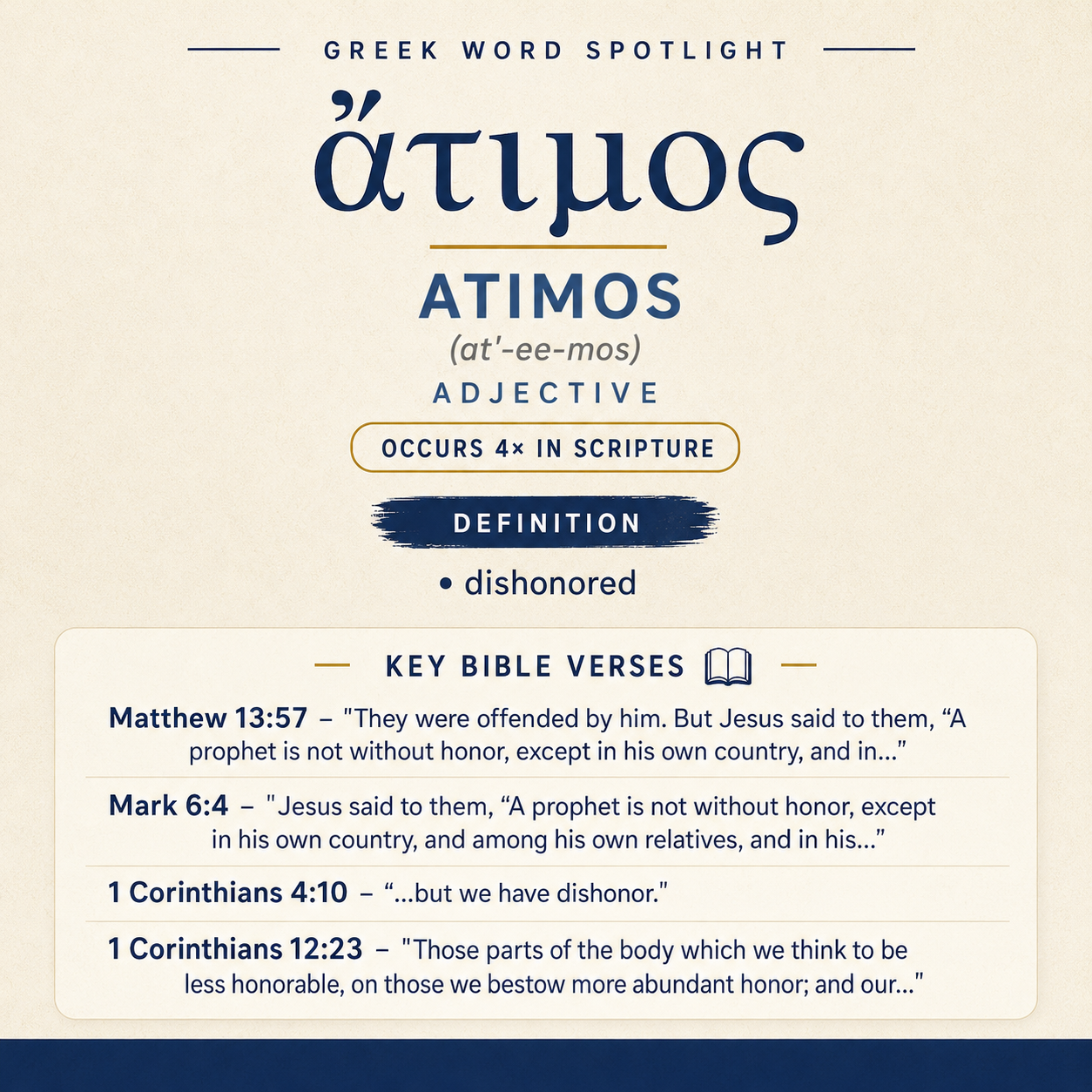
ἄτιμος (Atimos) means “dishonored” and occurs four times in Scripture: Matthew 13:57; Mark 6:4; 1 Corinthians 4:10; 1 Corinthians 12:23.
Gospel Occurrences
In Matthew 13:57 and Mark 6:4, Jesus says a prophet is not without honor except in his own country.
Learn More →Pauline Occurrences
In 1 Corinthians 4:10, Paul contrasts the Corinthians’ honor with the apostles’ dishonor. In 1 Corinthians 12:23, less honorable body parts receive more abundant honor.
Learn More →ἄτιμος describes a state of being “dishonored,” appearing in sayings about a prophet’s reception at home and in Paul’s reflections on status within the church. In its four contexts, it marks what is regarded as lacking honor, whether in social standing, apostolic experience, or the body’s seemingly lesser parts.
Root and Related Words
ἄτιμος (Atimos) is related to τιμή (time), “honor” (Strong’s G5092). Strong’s also connects it with α (Alpha), “Alpha” (Strong’s G1).

Occurrences
Matthew 13:57: “They were offended by him. But Jesus said to them, “A prophet is not without honor, except in his own country, and in his own house.””
In this scene Jesus answers a local offense taken at him with a proverb-like contrast: the prophet has “honor,” yet there is a notable exception close to home. Within the quoted line, the idea behind ἄτιμος is the condition opposed to “honor”—the prophet’s standing is treated as diminished in precisely the places where familiarity should have fostered respect: “his own country” and “his own house.” The word’s force is not abstract; it is tied to an identifiable social setting where a person’s worth is assessed and refused.

Mark 6:4: “Jesus said to them, “A prophet is not without honor, except in his own country, and among his own relatives, and in his own house.””
Mark’s wording expands the circle of exception: beyond “his own country” and “his own house,” it includes “among his own relatives.” The dishonored status implied by ἄτιμος is thus shown operating at multiple layers of closeness—region, kinship, and household. The line draws attention to a paradox of recognition: the prophet’s customary “honor” is expected, yet the most intimate social networks become the very place where honor is withheld. The term therefore contributes a pointed reversal: what should have been the strongest base of honor becomes the arena of dishonor.
1 Corinthians 4:10: “We are fools for Christ’s sake, but you are wise in Christ. We are weak, but you are strong. You have honor, but we have dishonor.”
Here ἄτιμος functions in a sharp set of paired contrasts. Paul sets “we” and “you” side by side in three parallel lines, and the final line places “honor” over against “dishonor” as a lived social reality. Dishonor is not presented as a vague feeling but as a recognizable public valuation: the apostles’ role is being read by others as shameful, unimpressive, or lacking the esteem accorded to the Corinthians. The structure of the sentence makes dishonor part of a broader pattern—“fools… weak… dishonor”—so that ἄτιμος aligns with exposure and low regard in the way Paul frames apostolic life.
1 Corinthians 12:23: “Those parts of the body which we think to be less honorable, on those we bestow more abundant honor; and our unpresentable parts have more abundant propriety;”
In Paul’s body metaphor, ἄτιμος belongs to the evaluation “we think” about certain “parts of the body”: some are judged “less honorable.” The word’s contribution is to name that perceived deficit of honor—an assessment that leads to a deliberate response. The community’s action is to “bestow more abundant honor” on what is regarded as less honorable, reversing the normal distribution of esteem. In this verse, dishonor is not simply endured; it becomes the reason for intentional honoring, so that what is considered lacking honor is treated with special care.
Sense and Usage
Across these passages, ἄτιμος consistently marks a condition where honor is missing or denied in the eyes of others. In the Gospel sayings, the focus is relational and geographic: a prophet’s dishonor is concentrated in the familiar spaces of “his own country,” “his own relatives,” and “his own house.” Dishonor, then, is shown as something that can be localized—experienced most sharply within a tight social radius where one might assume honor would come most naturally.
In 1 Corinthians 4:10, dishonor is cast as a corporate experience of Paul and his companions (“we have dishonor”), contrasted with the Corinthians’ possession of “honor.” The term participates in Paul’s rhetorical strategy: he uses honor/dishonor language to expose a mismatch between how different groups are being regarded and to frame apostolic ministry as publicly unimpressive by common standards. The line does not define the mechanisms of dishonor; instead it places it alongside other low-status descriptors, suggesting a whole social profile that is easy to recognize and hard to romanticize.
In 1 Corinthians 12:23, the word is applied to a collective judgment about the body’s members—what “we think” to be less honorable. Here ἄτιμος highlights the difference between perceived honor and conferred honor. Even if certain parts are regarded as lacking honor, Paul describes a practice of compensatory honoring: the community “bestow[s] more abundant honor” precisely where honor seems absent. Thus the word helps articulate a principle of reversal: the presence of dishonor is not the final verdict but the point at which greater honor is intentionally given.
Taken together, the occurrences show ἄτιμος functioning in both observation and critique. It can describe how people actually treat a prophet at home, how an apostolic group is socially evaluated, and how believers may instinctively rank what seems “less honorable.” In each case, dishonor is socially legible: it involves reputation, reception, and the distribution of esteem within a community.
Imagery
The passages attach ἄτιμος to concrete social scenes: a prophet standing among townspeople and relatives who refuse him “honor” (Matthew 13:57; Mark 6:4), and a community learning to treat what seems “less honorable” with “more abundant honor” (1 Corinthians 12:23). Even when used as a summary evaluation—“we have dishonor” (1 Corinthians 4:10)—the word evokes a public setting where honor can be possessed, denied, or reassigned.
Sources: Lexical data from Strong’s Exhaustive Concordance and the Translators Brief Lexicon of Extended Strongs for Greek (STEPBible, CC BY). Occurrence data from the Translators Amalgamated Greek New Testament (STEPBible, CC BY). Scripture quotations from the World English Bible (public domain).





