Exploring the Meaning of Athetesis in Greek
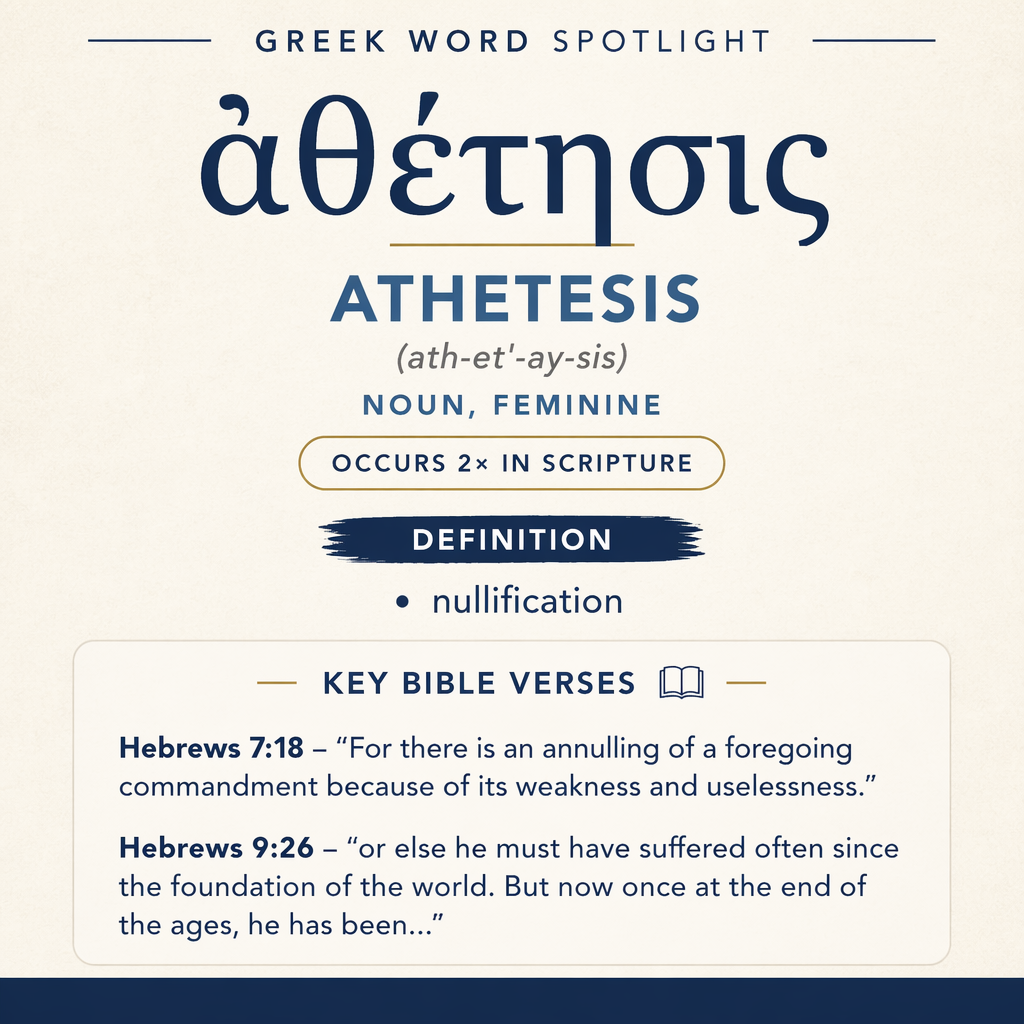
ἀθέτησις means “nullification” and appears twice in Scripture, in Hebrews 7:18 and Hebrews 9:26.
Biblical Occurrences
This word occurs 2 times in Scripture. Its references are Hebrews 7:18 and Hebrews 9:26.
Learn More →Hebrews Context
In Hebrews 7:18, it describes an annulling of a foregoing commandment because of its weakness and uselessness. In Hebrews 9:26, it appears in a sentence about what occurs “once at the end of the ages.”
Learn More →ἀθέτησις denotes “nullification.” In the New Testament it appears in Hebrews in contexts that speak of an “annulling” of a commandment and of sin being “put away” through Christ’s self-sacrifice.
Root and Related Words
ἀθέτησις is related to the verb atheteō (ἀθετέω), “to reject” (Strong’s G114).

Occurrences
Hebrews 7:18: For there is an annulling of a foregoing commandment because of its weakness and uselessness
Here ἀθέτησις is expressed in the clause “there is an annulling of a foregoing commandment.” The verse itself frames this act of nullification as a judgment on what precedes: the commandment is described as “foregoing,” and the reason given for the annulling is “its weakness and uselessness.” In this sentence, the word carries a formal, decisive sense: what once stood as a “commandment” is treated as something that can be set aside, not by neglect, but by an “annulling” that is explained and defended. The immediate scene is argumentative and evaluative—Hebrews is presenting a rationale (“because of…”) for why nullification is warranted, and ἀθέτησις supplies the key term for that removal from force.

Hebrews 9:26: or else he must have suffered often since the foundation of the world. But now once at the end of the ages, he has been revealed to put away sin by the sacrifice of himself.
In this verse the movement is temporal (“since the foundation of the world… now once at the end of the ages”) and contrasts what would be necessary “often” with what has happened “once.” Within that contrast, the word’s contribution is tied to the clause “to put away sin by the sacrifice of himself.” The verse presents an act that deals conclusively with “sin,” and it anchors that act in the singular, completed event of Christ’s self-offering. In this setting, ἀθέτησις stands within a passage that argues against repeated suffering and for a once-for-all intervention; it serves the thought-world of removal and cancellation, giving theological weight to the claim that sin is dealt with in a way that does not need constant repetition. The direction of the verse is from a hypothetical endless cycle (“must have suffered often”) to an enacted finality (“now once… revealed”), and the word belongs to that logic of decisive disposal.
Sense and Usage
Across its two appearances in Hebrews, ἀθέτησις functions as a term for nullification applied to two distinct targets: a “foregoing commandment” (Hebrews 7:18) and “sin” (Hebrews 9:26). In both cases, the surrounding wording emphasizes conclusiveness and explanation. Hebrews 7:18 speaks in a legal-sounding register: a commandment can be evaluated (“weakness and uselessness”) and therefore annulled. Hebrews 9:26 speaks in an event-focused register: what could have required repeated suffering is instead addressed by a single revelation and sacrifice that results in sin being “put away.” The definition “nullification” thus plays out not as a vague lessening, but as an effective cancellation within the argument’s structure—something is treated as no longer holding sway.
The relationship to atheteō (ἀθετέω), “to reject,” helps clarify the kind of action envisioned: nullification is not merely an accident of fading relevance, but an act that stands over against what is nullified. Hebrews 7:18 is explicit that the annulment is grounded in reasons; Hebrews 9:26 is explicit that the putting away of sin is grounded in the “sacrifice of himself.” In both verses, nullification is attached to a stated basis—either an evaluation (“weakness and uselessness”) or an accomplished means (“by the sacrifice of himself”). The word therefore belongs to Hebrews’ way of speaking about decisive change: not simply that something is replaced, but that it is rendered inoperative by a reasoned act.
The two contexts also show that ἀθέτησις can be used for different kinds of objects without changing its essential force. A “commandment” is annulled because it is assessed as insufficient; “sin” is put away through a sacrifice that is portrayed as singular and climactic. One object is a “foregoing” directive within the story Hebrews is telling; the other is a moral-spiritual reality. Yet both are treated with the same sort of finality: nullification marks the transition from what would otherwise remain in effect to what has been decisively dealt with. The passages’ emphasis on cause (“because of…”) and instrument (“by…”) keeps the term from feeling abstract; it is a concrete claim about what has been invalidated and why.
Imagery
Though ἀθέτησις is an abstract noun, these verses carry vivid argumentative imagery: an “annulling” that removes a “foregoing commandment” from force (Hebrews 7:18), and an act that “put[s] away sin” through a single, climactic sacrifice (Hebrews 9:26). In Hebrews’ framing, nullification is pictured as a decisive clearing—something once operative is now treated as set aside, and what once would have required repeated action is met by a once-for-all resolution.
Sources: Lexical data from Strong’s Exhaustive Concordance and the Translators Brief Lexicon of Extended Strongs for Greek (STEPBible, CC BY). Occurrence data from the Translators Amalgamated Greek New Testament (STEPBible, CC BY). Scripture quotations from the World English Bible (public domain).