Understanding the Significance of Asebeia in Greek
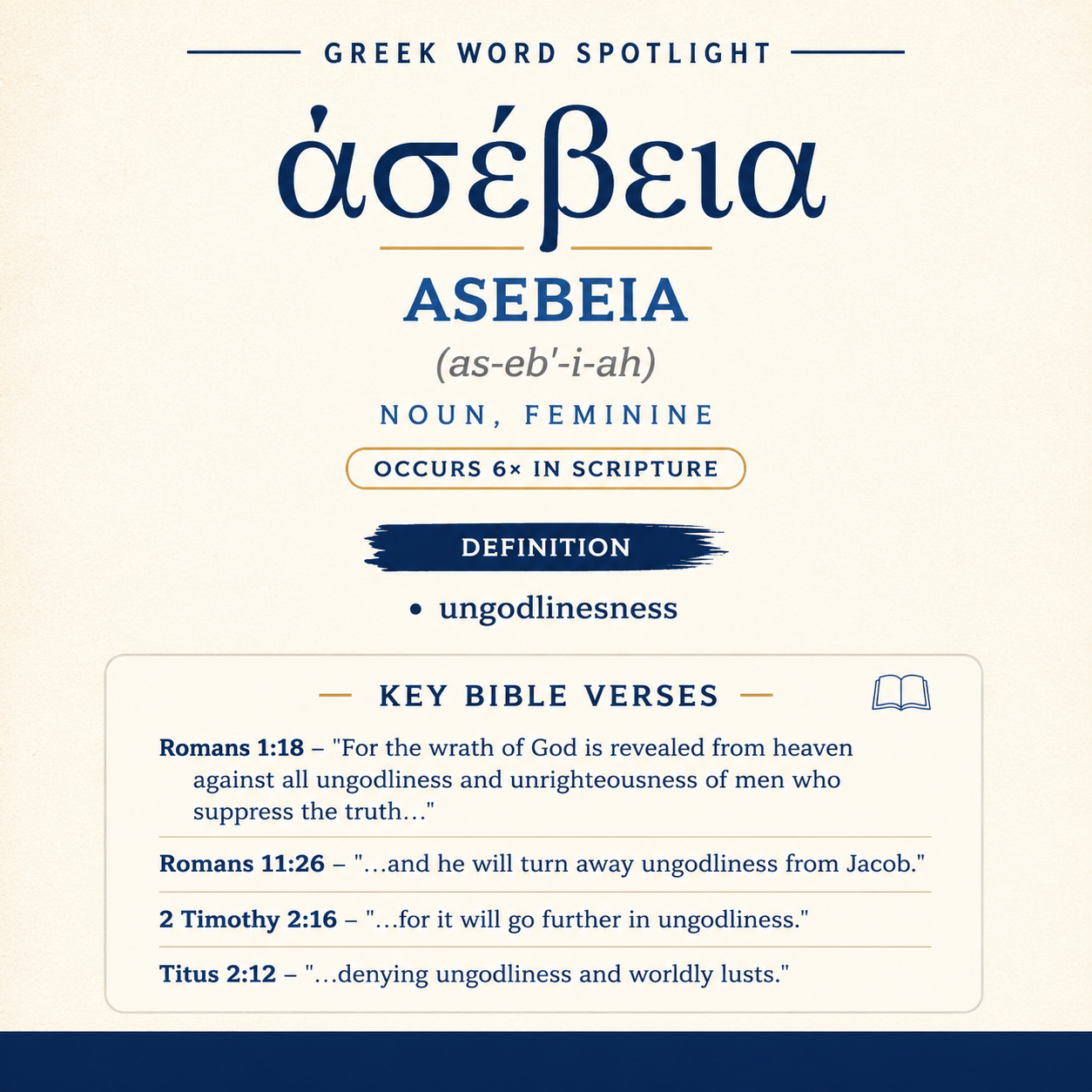
ἀσέβεια (Asebeia) means “ungodlinessness” and occurs 6 times in Romans, 2 Timothy, Titus, and Jude.
Where It Appears
It occurs 6 times in Scripture: Romans 1:18; Romans 11:26; 2 Timothy 2:16; Titus 2:12; Jude 1:15; Jude 1:18.
Learn More →Usage In Context
Romans 1:18 speaks of God’s wrath revealed against all ungodliness and unrighteousness. Titus 2:12 calls believers to deny ungodliness.
Learn More →ἀσέβεια (Asebeia) denotes “ungodlinessness,” a term used in the New Testament for a condition or course of life set in contrast to God’s righteous ways. It appears in Romans, the Pastoral Epistles, Titus, and Jude, where it is named as an object of divine wrath, something to be turned away, something that spreads, and something to be denied.
Root and Related Words
ἀσέβεια (Asebeia) is related to ἀσεβής (asebes, ἀσεβής), “ungodly” (Strong’s G765), the corresponding adjective describing the person characterized by what ἀσέβεια names.

Occurrences
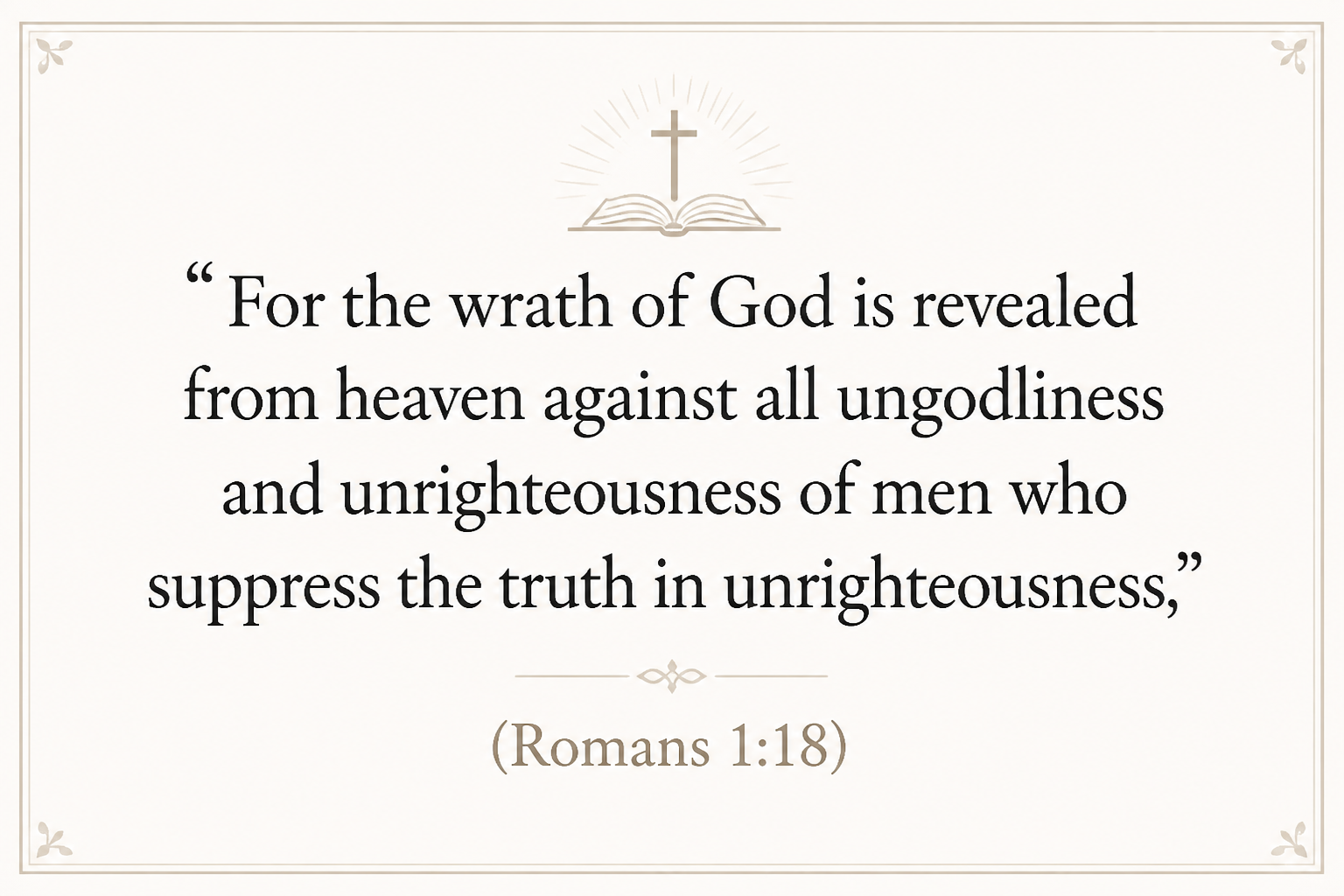
“For the wrath of God is revealed from heaven against all ungodliness and unrighteousness of men who suppress the truth in unrighteousness,” (Romans 1:18)
Here ἀσέβεια is placed under the scope of divine wrath: God’s wrath is “revealed from heaven against all” of it. The verse pairs it with “unrighteousness” and then describes people who “suppress the truth,” so the word functions as part of a moral indictment that is broad (“all”) and directed toward human conduct that actively holds down truth “in unrighteousness.” Within this sentence, ἀσέβεια stands as one of the headline charges explaining why wrath is revealed.
“and so all Israel will be saved. Even as it is written, “There will come out of Zion the Deliverer, and he will turn away ungodliness from Jacob.” (Romans 11:26)
In Romans 11:26, ἀσέβεια is not merely identified; it is something from which a people are to be relieved. The “Deliverer” who comes “out of Zion” is said to “turn away” ungodliness “from Jacob,” giving the word a concrete relational direction: it is depicted as attached to, or present among, the people and then removed. In this scene, ἀσέβεια is treated as a condition requiring decisive intervention, and its “turning away” is part of what accompanies the announced salvation.
“But shun empty chatter, for it will go further in ungodliness,” (2 Timothy 2:16)
In 2 Timothy 2:16, ἀσέβεια is the trajectory toward which “empty chatter” tends. The instruction “shun” indicates the danger is not only in the speech itself, but in what it produces: it “will go further in” ungodliness. The phrasing presents ἀσέβεια as a sphere or direction of progress—something into which behavior can advance. The word here helps frame talk as morally consequential, able to expand its reach and deepen its effects.
“instructing us to the intent that, denying ungodliness and worldly lusts, we would live soberly, righteously, and godly in this present age;” (Titus 2:12)
In Titus 2:12, ἀσέβεια is set opposite a way of life described by three adverbs: “soberly, righteously, and godly.” The verse describes instruction with a purpose: that believers, “denying” ungodliness along with “worldly lusts,” would live differently “in this present age.” ἀσέβεια thus becomes something to be renounced, not as an abstract label but as a practical alternative to a disciplined and righteous manner of living. The pairing with “worldly lusts” also places it within a cluster of desires and practices that must be refused if the intended manner of life is to be maintained.
“to execute judgment on all, and to convict all the ungodly of all their works of ungodliness which they have done in an ungodly way, and of all the hard things which ungodly sinners have spoken against him.” (Jude 1:15)
Jude 1:15 concentrates the vocabulary of “ungodly” around ἀσέβεια by repeatedly describing persons, deeds, and manner. The verse speaks of judgment “on all” and conviction “of all the ungodly,” then specifies “all their works of ungodliness” and adds that these works were done “in an ungodly way.” In this setting, ἀσέβεια is tied to observable outputs (“works”) and to the style or mode in which those works are carried out (“way”), and it is also connected to speech: “hard things” spoken “against him.” The word’s contribution is to name the moral quality that pervades the whole description—identity, actions, and manner are all portrayed as consistent with the same ungodly character that judgment exposes.
“They said to you, “In the last time there will be mockers, walking after their own ungodly lusts.”” (Jude 1:18)
In Jude 1:18, the focus shifts to a predicted pattern of behavior: “mockers” who are “walking after their own” lusts described as “ungodly.” Though ἀσέβεια itself is not expanded here with additional clauses, the verse gives it a social and behavioral profile: mockery accompanies a life-pattern (“walking after”) driven by desire. The language suggests direction and pursuit—these people order their conduct by their desires, and those desires belong to the same ungodly domain described elsewhere in the letter’s warning.
Sense and Usage
Across these passages, ἀσέβεια functions as a moral and theological diagnosis that can be (1) judged, (2) removed, (3) spread into, (4) denied, and (5) proven in deeds, manner, and speech. Romans 1:18 places it under the revealed wrath of God and links it with a posture toward truth: people “suppress the truth in unrighteousness,” so ungodliness is not portrayed as passive ignorance but as bound up with culpable human action. Romans 11:26 then treats ungodliness as something that can be turned away from a people, placing it within a narrative of deliverance: a Deliverer acts so that ungodliness is no longer the defining reality “from Jacob.”
The Pastoral usage in 2 Timothy 2:16 and Titus 2:12 highlights how ἀσέβεια relates to everyday practice. In 2 Timothy, it is the outcome of “empty chatter,” implying that words can be a pathway into deeper ungodliness; the instruction to avoid such talk assumes that ungodliness has momentum—it can be advanced toward, increased, and intensified. In Titus, ungodliness stands as one of the things to be denied so that life may be marked by sobriety, righteousness, and godliness “in this present age.” In that frame, ἀσέβεια is not only a label for outsiders; it is a pattern to be refused as a matter of ongoing formation shaped by instruction.
Jude’s concentrated description shows the term’s capacity to describe comprehensive moral corruption without needing multiple different categories. The same ungodly quality characterizes persons (“the ungodly”), their output (“works of ungodliness”), their manner (“in an ungodly way”), and their speech (“hard things … spoken against him”). Jude 1:18 complements this by sketching the lifestyle that accompanies it: mockery paired with a walk governed by “ungodly lusts.” Together, these uses demonstrate that ἀσέβεια can name both an internal orientation (expressed through desires) and its outward expression (works and speech), while still being treated as a single, coherent reality.
Imagery
These passages repeatedly picture ἀσέβεια as something that bears weight and direction. It stands beneath God’s revealed wrath (Romans 1:18), is turned away by a Deliverer (Romans 11:26), spreads forward from corrupt speech (2 Timothy 2:16), is denied so that a different life can be lived in the present age (Titus 2:12), and is brought into the open by judgment that convicts deeds, manner, and words (Jude 1:15). The cumulative effect is to treat ungodliness not as a thin abstraction, but as a describable force with consequences, movement, and exposure.
Sources: Lexical data from Strong’s Exhaustive Concordance and the Translators Brief Lexicon of Extended Strongs for Greek (STEPBible, CC BY). Occurrence data from the Translators Amalgamated Greek New Testament (STEPBible, CC BY). Scripture quotations from the World English Bible (public domain).