Exploring the Meaning of Aschemosune in Greek
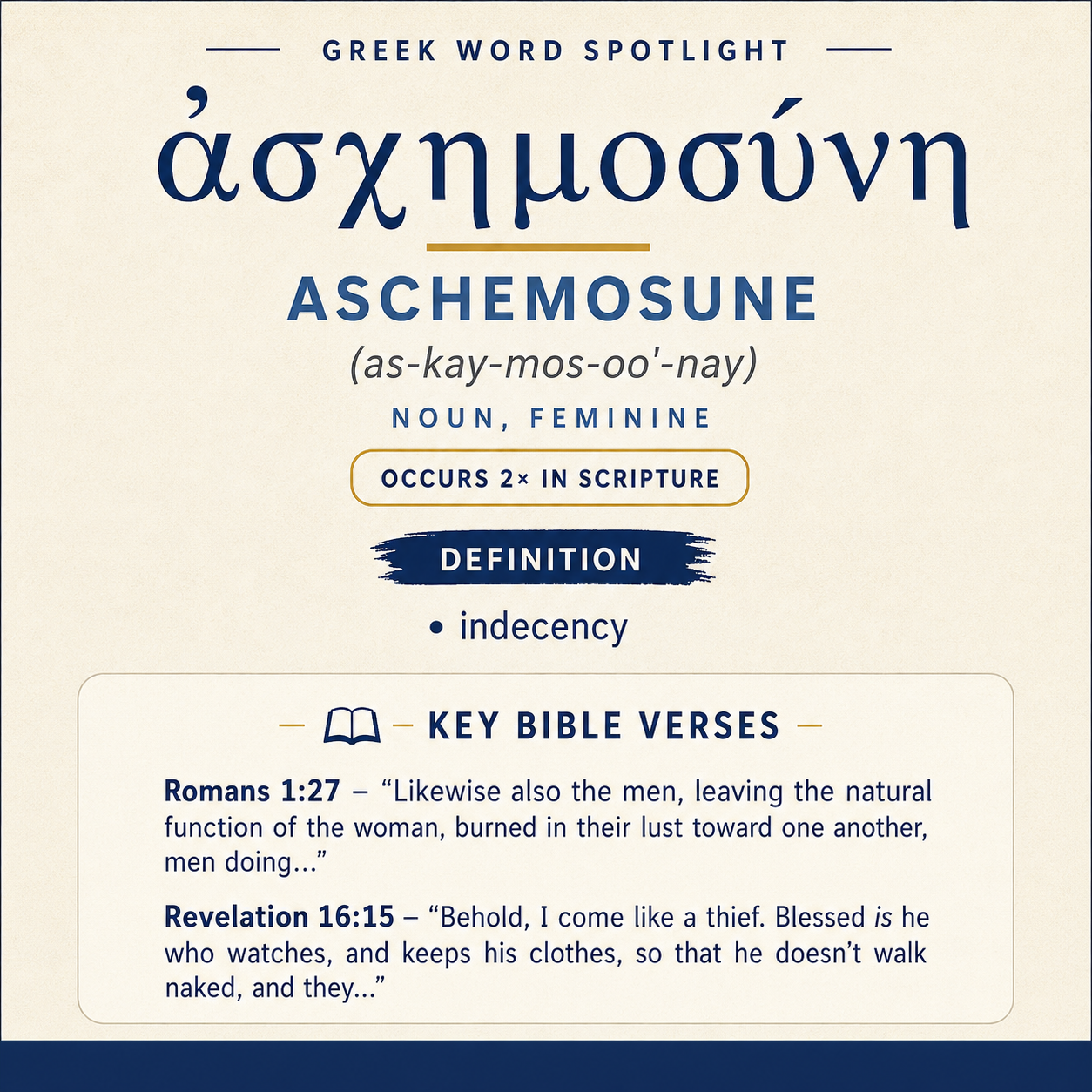
ἀσχημοσύνη means “indecency” and appears twice in Scripture: Romans 1:27 and Revelation 16:15.
Scripture Occurrences
This word occurs 2 times in Scripture: Romans 1:27 and Revelation 16:15.
Learn More →Context Snapshots
Romans 1:27 uses it in a context describing men “burned in their lust toward one another.” Revelation 16:15 connects it with walking naked and being seen.
Learn More →ἀσχημοσύνη denotes “indecency.” It appears twice in the New Testament: once in Paul’s description of same-sex acts in Romans, and once in Revelation’s warning about being found uncovered at the Lord’s sudden coming.
Root and Related Words
ἀσχημοσύνη (Aschemosune) derives from the adjective ἀσχήμων (aschemon), “indecent” (Strong’s G809). The noun form turns the adjective’s description into a named condition or quality, suitable for speaking of what is regarded as indecent in an act or in a state.

Occurrences
“Likewise also the men, leaving the natural function of the woman, burned in their lust toward one another, men doing what is inappropriate with men, and receiving in themselves the due penalty of their error.” (Romans 1:27)
In Romans 1:27, ἀσχημοσύνη labels the character of the action Paul describes: “men doing what is inappropriate with men.” The sentence is built to show deliberate departure (“leaving the natural function of the woman”), heightened desire (“burned in their lust toward one another”), and the act itself (“doing what is inappropriate”). Within this movement, ἀσχημοσύνη functions as a moral descriptor for the conduct, identifying it as indecent in the very moment of its performance, not merely as something that later becomes regrettable. The following clause, “receiving in themselves the due penalty of their error,” places the indecency within an ethical framework of consequence; the word belongs to the portrayal of the deed as an indecent exchange that carries its own recompense “in themselves.”
““Behold, I come like a thief. Blessed is he who watches, and keeps his clothes, so that he doesn’t walk naked, and they see his shame.” (Revelation 16:15)
In Revelation 16:15, ἀσχημοσύνη is tied to exposure: the contrast is between “keeps his clothes” and “walk naked.” The warning is framed by suddenness—“I come like a thief”—so the issue is readiness under unexpected arrival. Here, indecency is pictured not as an action done to someone else but as a condition in which a person is seen: failing to keep one’s clothes leads to walking naked, and that nakedness results in others seeing one’s “shame.” In this scene the term is socially visible; the problem is not private feeling alone but public perception (“they see”). The blessing pronounced on the one who “watches” aligns indecency with being unprepared and uncovered at the critical moment of encounter.
Sense and Usage
Across these two contexts, ἀσχημοσύνη names indecency in two distinct but related ways: indecency as enacted behavior (Romans) and indecency as exposed condition (Revelation). Romans 1:27 places the word in the realm of conduct described as “inappropriate,” where the indecency is attributed to what is done. The syntax directs attention to intentional choice and mutual desire—“leaving,” “burned,” “doing”—so indecency is attached to the act as an expression of disordered desire. The verse then connects that indecency with “error” and “due penalty,” so the term participates in a moral diagnosis that includes consequence within the person (“in themselves”).
Revelation 16:15, by contrast, expresses indecency through the imagery of clothing retained or lost. The verbal pair “watches” and “keeps” suggests ongoing attention, while the negative result—“doesn’t walk naked”—shows what vigilance prevents. Indecency here is the shame of exposure, and it is defined by being seen: “they see his shame.” The same definition (“indecency”) thus covers both the disgracefulness of an act and the disgracefulness of being uncovered, but the passage presses the second sense through a concrete scenario where the boundary between covered and naked marks whether shame becomes observable.
Both passages share a thread of incongruity: in Romans the act is presented as “inappropriate,” a mismatch with what is called “natural function”; in Revelation the person without clothing is out of place in public, vulnerable to the gaze of others. In each case, ἀσχημοσύνη points to a condition that ought not to be—either a deed done contrary to what is fitting or a state in which one is improperly exposed. The word’s force is therefore evaluative: it names indecency as a recognized category of disgrace in the scene, whether that disgrace is bound to bodily actions or to bodily exposure.
Imagery
These two occurrences together give ἀσχημοσύνη a bodily cast. Romans 1:27 speaks of bodies in desire (“burned in their lust”) and of consequences “in themselves,” setting indecency within embodied action and embodied recompense. Revelation 16:15 uses the body’s covering as a vivid measure of readiness—clothes kept or lost—and presents indecency as shame that becomes visible when one “walk[s] naked.” In both, the term moves beyond abstraction into scenes where indecency is bound to what is done with the body or what is displayed of it before others.
Sources: Lexical data from Strong’s Exhaustive Concordance and the Translators Brief Lexicon of Extended Strongs for Greek (STEPBible, CC BY). Occurrence data from the Translators Amalgamated Greek New Testament (STEPBible, CC BY). Scripture quotations from the World English Bible (public domain).