
Understanding the Meaning of Aristoboulos in Greek
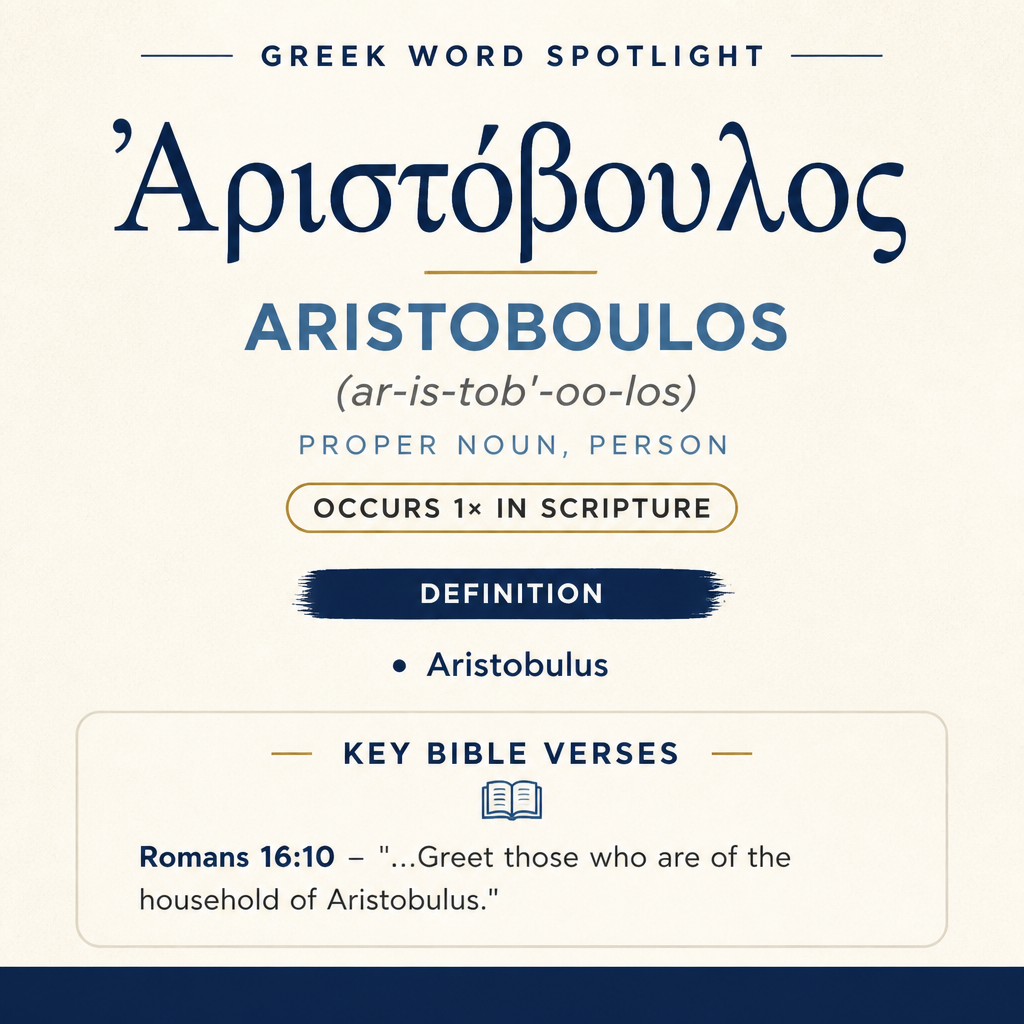
Ἀριστόβουλος (Aristoboulos) means “Aristobulus” and appears once in Scripture in Romans 16:10.
Household Mention
Romans 16:10 includes a greeting to “those who are of the household of Aristobulus.”
Learn More →Ἀριστόβουλος means “Aristobulus” and appears in a single greeting within Paul’s closing salutations in Romans. There the name functions as a point of reference for identifying a particular group within the Roman church.
Root and Related Words
Aristoboulos is presented as deriving from
ariston
ἄριστον (ariston), “early meal,” and
boule
βουλή (boule), “plan.”

Occurrences
“Greet Apelles, the approved in Christ. Greet those who are of the household of Aristobulus.” (Romans 16:10)
Here Aristoboulos appears not as the person directly greeted but as the name that marks out a circle of people: “those who are of the household of Aristobulus.” The verse places this designation alongside other greetings, first to “Apelles” described as “the approved in Christ,” and then to a larger, related group defined by their connection to Aristobulus’ household. The name therefore works as an identifier within the network of relationships assumed by the greetings: the addressees are to recognize which people are meant by the description and to extend greeting to them.
The wording “those who are of the household of Aristobulus” makes the name serve a social and practical function. Rather than isolating an individual, it anchors a group in relation to a household—an established unit that can be named and thus located within the community. In the rhythm of the verse, Aristoboulos is one of several proper names used to direct greetings accurately, and his household becomes a category of recipients parallel to the individual Apelles.
Sense and Usage
As a personal name, Aristoboulos contributes to Romans 16:10 by enabling specificity in community address. The greeting does not require a description of Aristoboulos’ role or character; the name alone is sufficient to function as a reference point for others—people who can be grouped as belonging to his “household.” In this way the definition “Aristobulus” plays out not merely as a label for a person, but as a label that organizes people relationally in the act of greeting.
The phrase “of the household of Aristobulus” also shows how a proper name can operate metonymically in ordinary discourse: the name of a person stands at the head of a household designation, so that the greeting reaches beyond a single individual to those associated with him in that household context. Within the verse’s brief, directive style (“Greet… Greet…”), the name functions as a stable reference that allows the instruction to be carried out among a diverse set of Roman believers and associates addressed in the closing lines.
Imagery in Context
Romans 16:10 evokes the everyday picture of greetings moving through a community by named connections: an individual, then a household connected to another named person. Aristoboulos’ name, attached to “household,” calls up the concrete setting of a recognizable domestic circle within the larger body being addressed, where people can be identified and greeted through their association with a known household.
Sources: Lexical data from Strong’s Exhaustive Concordance and the Translators Brief Lexicon of Extended Strongs for Greek (STEPBible, CC BY). Occurrence data from the Translators Amalgamated Greek New Testament (STEPBible, CC BY). Scripture quotations from the World English Bible (public domain).




